
China ESG risk: the next unknown

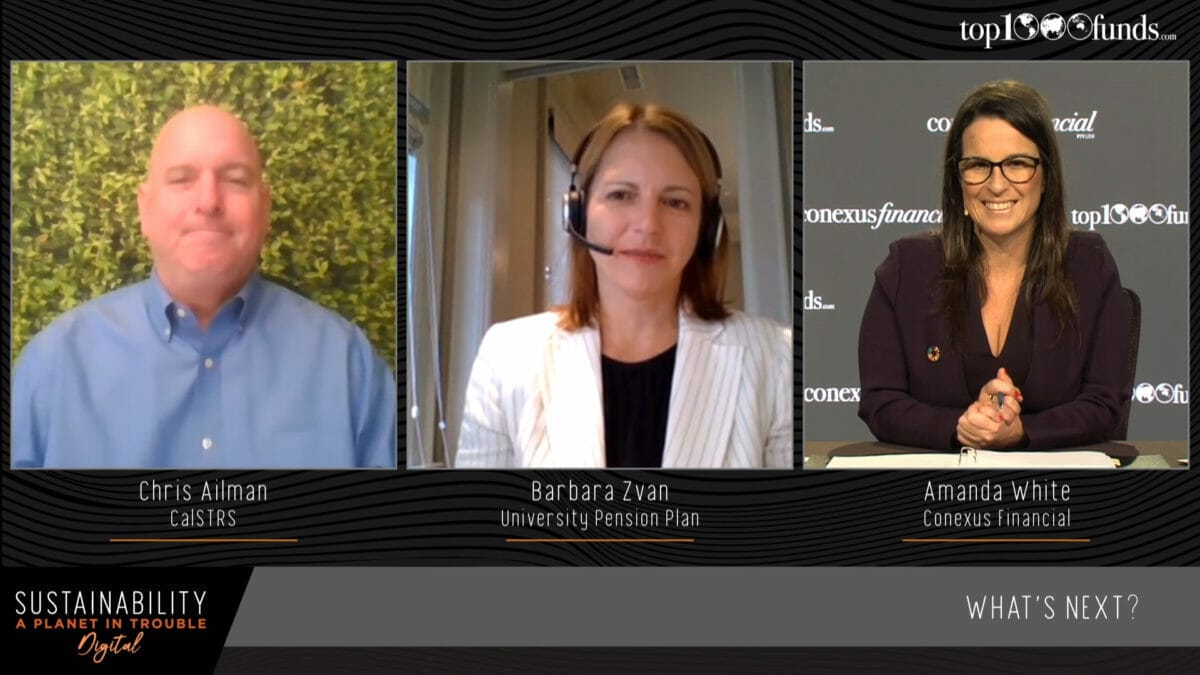
One of the most important, upcoming challenges at CalSTRS is how the fund should evaluate Chinese investments from a human capital and environmental standpoint, said Chris Ailman, chief investment officer at the giant pension fund.

Speaking at Sustainability Digital he noted how ESG integration has evolved from divestment and screening to these kinds of new criteria. Now strategies have shifted away from traditional benchmarks to enhanced indexes and issues around human capital management, he said.

In another nod to asset owners’ need to adapt, Ailman noted how some assets currently in the portfolio may not transition to the “new economy” with consequences for internal teams.

He expressed his admiration for models whereby asset owners collaborate to form their own asset manager like Australia’s infrastructure investor IFM Investors. In a call for more syndications and networks, he said teaming together to bid on investment opportunities meant asset owners would be able to cut out costs. “Wall Street is too expensive,” he said.

Ailman noted that although sustainability is a core part of CalSTRS’ culture, there are many “laggards” both at home in the US and in other parts of the world.

He said America’s November election is revealing divisions in the US and only “some kind of shock” would wake people up to the reality of climate change. “Personal examples wake people up,” he said.

Sponsored Content

He also espoused the need for more regulation to force change.

“I am pushing a price on carbon,” he said. Regulations will cause pension funds to adjust their portfolios. He said there was a need to take issues out of the hands of politicians and talk about risk. For example, real estate managers needed to “pay attention” to the impact of storms and climate change on their portfolios.

Ailman urged more US pension funds to move on sustainability, calling the current cohort of sustainable investors “too narrow” a group.

“It needs to be a broader discussion with all pension plans,” he said.

While Dutch and Canadian funds “get it,” he said other parts of the world are not thinking about it.

“I am worried about the future; it is harder to make money and do it in the right way that is sustainable.”

Fellow panellist Barbara Zvan, president and chief executive of Canada’s University Pension Plan noted a key evolution at the pension fund was an expanded stewardship role to “help transition to a low carbon economy.”

The pension fund has an ESG framework that includes measuring carbon and setting meaningful targets across the portfolio.

She said that the investment industry is moving on sustainability and noted the growing recognition of what asset owners can achieve both individually but also collectively.

Urging cooperation, she said no one group can solve today’s challenges and that when asset owners tackle issues from climate change to diversity together, they have a bigger impact. She also noted how the private sector was a great source of industry and market insight.

“Governments’ role is much more in terms of instigation,” she said.

For all the conference sessions, stories and white papers visit the Sustainability content hub here.

Leave a Comment

AO talk manager selection and data gap

AO talk manager selection and data gap

Discussing how they integrate sustainability across their portfolios investors at New York State Common Fund, PKA, and TCorp, highlight the importance of manager selection and the challenge of the data gap.

Sort content by

How to integrate the SDGs

Integrating the SDGs involves analysing investee companies' core business, the products and services they sell, and mapping that to the SDGs. Two investors, APG and Schroders,  outline the indepth process.

Coca-Cola and Robeco talk engagement

In an intimate case study this session at the Sustainability conference profiles the relationship between Robeco and CocaCola and how investor engagement has helped prioritise sustainability issues and drive long-term growth through a focus on the circular economy.

Nordhaus calls for carbon tax

International negotiations like the Paris Agreement no longer work. The world needs a new framework supporting a carbon tax with both carrots and sticks to encourage participation, says William Nordhaus, Sterling Professor of Economics, Yale University and 2018 Nobel Prize winner in Economics.

Bridgewater’s three dimensional approach

In a rare insight into the portfolio construction process at Bridgewater, the head of investment research, Karen Karniol-Tambour discusses how to shift from only looking at risk and return to adopting a three-dimensional model that incorporates impact.

Ford Foundation’s impact strategy

The Ford Foundation outlines its ability to achieve impact and returns and announces plans to invest for impact in public markets in the next 18 months. Elsewhere, renown impact investor Pictet Asset Management explains how impact investment is becoming more mainstream.

Longterm investment: A better capitalism

Stewardship and engagement will become an integral part of investment in the future, and asset owners need to write stewardship and non-financial objectives into their mandates with managers, according to Saker Nusseibeh, chief executive international of Federated Hermes.