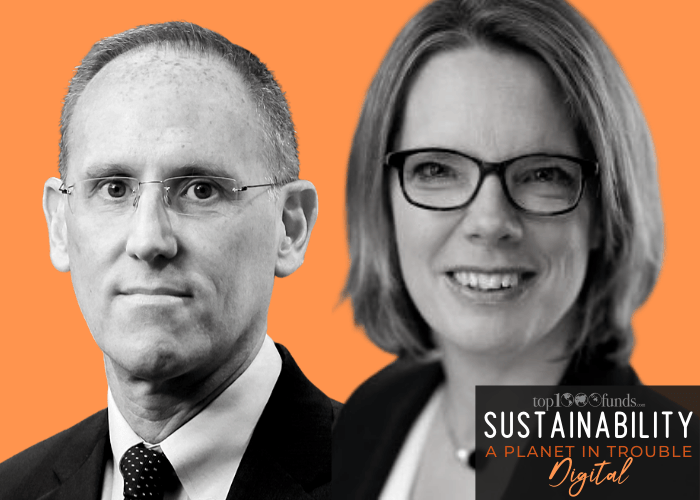
APG and NYC talk Amazon push back

Two of the world’s most influential institutional investors are hitting a brick wall in their attempts to engage with Amazon’s board on workplace safety. Every time the Netherland’s APG and the office of New York City Comptroller, fiduciary to New York city’s five pension funds, try to engage with the board at the tech giant in which they own a combined $6.5 billion they get push back from management.

The duo began engaging with the company about a year ago, in search of a better understanding of Amazon’s workplace safety during the pandemic. Their priority remains exploring the disconnect between what they have heard from workers and in the press, and the information the company puts out, explained Anna Pot, head of responsible investment, Americas, at APG and Mike Garland, assistant comptroller, NYC Comptroller’s office speaking at “Sustainability Digital; A Planet in Trouble.”

The institutional investors want to know what metrics the board is using to ensure staff are safe as a consequence of the company’s well documented investment in measures like masks and COVID tests.

“We have tried to correspond with the board, but every time we try, we receive a response from management,” said Garland. “We have been told in a letter from management that [board] directors meet with investors, but can’t honour all requests.”


APG’s engagement with Amazon has involved reaching out to the company and looking at the measures it is taking to safeguard the workforce. The process has revealed that the company has invested a significant amount in social distancing measures, masks and associated health benefits, said Pot.

Sponsored Content

“It is great to see these measures, but what are the outcomes?” she questioned. Both investors want to see what methods the company uses to oversee the effectiveness of the measures it has put in place; last December they compiled a shareholder proposal, but it didn’t “get the response” they sought.

Garland told delegates that because “the same person” was speaking for the board and management, it was impossible for the investors to have a window into the board’s oversight.

Describing APG as an engaged investor and its stake in Amazon as “significant” with ensuing responsibility and leverage, Pot said the asset manager would continue to engage.

“We want Amazon workers to be safe,” she said. Adding that APG “won’t stop” here but will continue to engage on improving labour conditions in a commitment to progress. Moreover, Pot said she believed engagement will ultimately yield access to the board for further discussions.

“We started a year ago and the company is responding to our requests,’ she said. “They are opening up a bit.”

Both investors’ engagement activity is also focused on the auto sector. Here dialogue is based around how companies are supporting their workforce in the transition to a green economy. A low carbon economy holds consequences for the future size of the sector’s workforce, and the investors are asking questions around how companies are equipping workers with new digital skills and how workers can become part of fast-changing companies.

Garland concluded that although all companies tout their workers as their most important asset, few disclose information about what this means, and how they actually manage their human capital.


Leave a Comment

Climate the No.1 priority for 2021

Climate the No.1 priority for 2021

Climate is by far the number one sustainability priority for investors in 2021 according to a poll of asset owners from more than 32 countries which came together for the Top1000funds.com online Sustainability event in March.

Sort content by

Engaging with Investors on ESG Issues

Bond issuers—including sovereigns, who represent 50 percent of the fixed income asset class—are faced with increasing scrutiny on environmental, social, and governance (ESG) issues from investors. Forums organized by the World Bank Treasury to promote dialogue between institutional investors and sovereign bond issuers have highlighted the challenges sovereign issuers face in engaging with investors on ESG topics and in communicating ESG-related information that investors consider financially material to their portfolios. This document provides examples, best practices, and action plans that can help debt managers enhance their capacity to engage with investors incorporating ESG information in investment decisions.

Portfolio Engineering

For decades, we have engineered scalable portfolios to help institutional investors achieve their goals. In the past, these goals have typically been financial (eg. return and risk targets), but now many investors are also seeking to achieve environmental and social impacts through their portfolios. We believe the best way to achieve both financial investment goals and these impact goals is through portfolio engineering that incorporates these objectives holistically, beginning with crisply defining an investor's goals, systematically looking across a variety of asset classes to find assets that are aligned with these goals, and then combining those assets to create a portfolio that is designed to achieve a high ratio of return to risk.

New Policy Concensus

We are now at a turning point, with Democrats controlling both legislative chambers and the presidency, and an emerging concensus among Democratic policy makers and their advisors that enables fiscal spending that is both significant in size and ambitious in scope. Later this year, we expect to see the first expansionary fiscal package centered around the pursuing long-term social, environmental, and competitiveness policy goals (following the more immediate COVID recovery package). In these Observations, we explore two key shifts in Democrats' thinking underlying these policy proposals, which we expect will be sustained well beyond this fiscal package.

Social Conditions Consideration

The ultimate goal of economic policy is simple and timeless - to ensure prosperity and maximise living standards. Broad macroeconomic measures such as GDP growth, the unemployment rate, and inflation had for decades been a good proxy of rising prosperity, so they have dominated economic policy making and are enshrined in most central bank mandates. But even before the COVID-19 crisis, it had become clear that traditional economic measures have increasingly diverged from social outcomes.

Secular Supply and Demand

Over the past two decades, China's secular rise dominated commodity markets, as its industrialization required a massive amount of raw materials to build up the country. As we consider the future, we see many reasons to be bullish on commodities tactically, but one of the most important secular factors will likely support industrial commodity demand for years to come: the shift in global economies away from fossil fuels and toward greener energy.

Diversity Impact Score

Throughout its history, the U.S. domestic Asset Management Industry, projected by PwC to grow to $71.2 trillion in assets under management by 20251, has exhibited an empirical lack of diversity with respect to gender and ethnicity within its ranks. Numerous studies have shown that Women and People of Color (“POC”) are underrepresented in the Industry, including a 2019 study commissioned by the Knight Foundation finding that Asset Management firms owned substantially or majority-owned by Women or POC managed only 1.3% of the Industry’s total assets under management.

Previous



