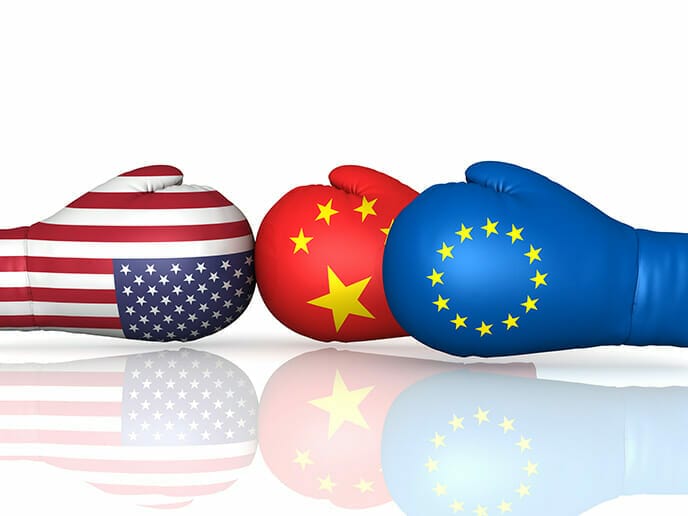

IFSWF marks rise of protectionism

Geopolitical issues, in particular the rise of protectionism, are a threat to the free flow of capital, a condition of investment extremely important to large global institutions, says Shahmar Movsumov, executive director of the $39 billion State Oil Fund of Azerbaijan.

In an interview at the International Forum of Sovereign Wealth Funds in Morocco, Movsumov, who was elected to the board of the IFSWF on Wednesday, said protectionism needed to be addressed.

At the forum, participants are celebrating 10 years since the creation of the Santiago Principles, which are credited with bringing transparency, accountability and a rule book on best practice to the sovereign wealth fund community, which represents about $10 trillion.

“When the principles were created 10 years ago, they were far-sighted and achieved a lot,” Movsumov said. “Today, there are new threats, protectionism is rising again…This might mean renewing the Santiago Principles, or maybe there are other ways we can impact that.

“The free flow of investment and capital is the most important thing for all of us, and protectionism is becoming a threat to that.”

The Oil Fund of Azerbaijan was one of the first member funds of the IFSWF to do a self-assessment of progress on the principles.

Sponsored Content

“This helped us see our gaps in relation to governance, accountability and disclosure and we made some minor adjustments,” Movsumov said. “For other SWFs, newcomers, it has been a rule book, an important set of best practices.

“They have also been important for the whole industry. [A decade] ago, SWFs were not well known players, and there were some misconceptions and concerns around their investments. This has disappeared. We are what we declare and thanks to the Santiago Principles and the IFSWF, we can show we are prudent, institutional investors without any hidden objectives.”The Oil Fund of Azerbaijan was established in 1999 with $270 million and has grown to about $39 billion.

Its policy portfolio is 60 per cent bonds, 25 per cent private and public equity, 10 per cent real estate and 5 per cent gold. The fund has dual purposes – the stabilisation of the economy and the needs of future generations. Due to the stabilisation objective, it currently has a lot of liquidity so, in reality, about 80 per cent of investments are in bonds, managed internally.

This year, the fund will contribute about $6.5 billion to the government’s budget and will receive about $10 billion from oil contracts. Azerbaijan is one of the fastest-growing economies in the world, due to its energy sector.

The executive director of the oil fund is appointed and dismissed by the president of the Republic of Azerbaijan.


For more on the Santiago Principles see:

SWFs could help global stability: forum

Abu Dhabi sovereign fund coughs up: first ever review published

Sovereign wealth funds look to risk[vc_images_carousel images=”25444,25443,25442,25441,25440,25439,25438,25437,25436,25435,25432″ img_size=”full” title=”Photos from IFSWF 2018″]

Leave a Comment

Impact investing’s case for scale

Impact investing’s case for scale

Impact investing has come a long way in the past two decades, going from a niche strategy to a $1.5 trillion industry, but there are still challenges for it to reach institutional scale due to the lack of products and insufficient evidence of outperformance in some parts of the market.

Sort content by

How next-gen investors at GIC, Temasek harness AI potential

A new generation of investors are starting their careers with artificial intelligence on their side as not only an investment trend that offers immense return potential but also a critical portfolio management tool. Professionals from GIC and Temasek told FIS Singapore how both SWFs are integrating AI in their operations.

Right benchmark provides different perspective on private markets alpha

A private market equivalent benchmark is superior to either peer group benchmarks or a public market equivalent in measuring private equity and infrastructure manager outperformance, according to Frederic Blanc-Brude, director of Scientific Infra & Private Assets at EDHEC Asia Pacific.  

China is getting its mojo back

After years of underperformance the Chinese stock market had strong gains at the beginning of 2025, giving investors confidence that the country might be getting some of its pre-COVID mojo back.  

Why the energy transition won’t die with Trump 2.0

Despite the uptick in anti-ESG sentiment that’s come with Donald Trump’s return to the White House, large institutional investors are certain that innovations in transition technology will continue and that the broader world has not changed course on the journey to decarbonisation.  

How Asia-Pacific investors can navigate Trump’s America first plan

President Trump is dramatically reshaping geopolitics, creating new risks and opportunities for investors across the Asia-Pacific.

How new technologies are changing the game in private markets

With the ability to uncover hard-to-find information and enable more frequent trading in traditionally illiquid asset classes, new technologies like artificial intelligence and tokenisation could be the biggest disruption most private markets investors will see in their lifetime. 

Previous



