
IFSWF marks rise of protectionism

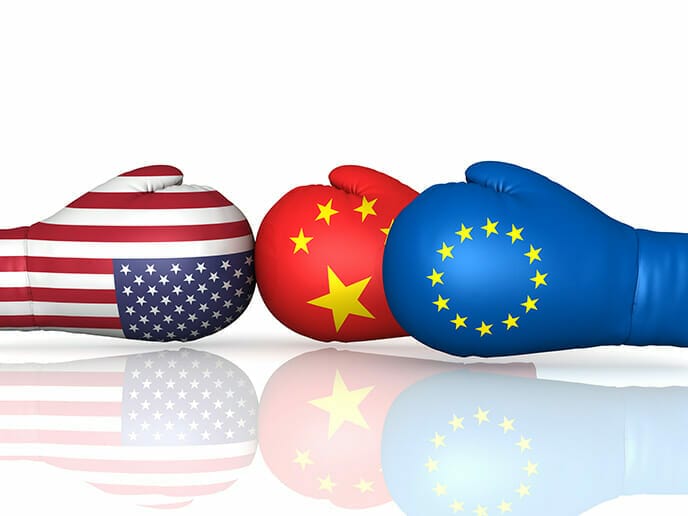
Geopolitical issues, in particular the rise of protectionism, are a threat to the free flow of capital, a condition of investment extremely important to large global institutions, says Shahmar Movsumov, executive director of the $39 billion State Oil Fund of Azerbaijan.

In an interview at the International Forum of Sovereign Wealth Funds in Morocco, Movsumov, who was elected to the board of the IFSWF on Wednesday, said protectionism needed to be addressed.

At the forum, participants are celebrating 10 years since the creation of the Santiago Principles, which are credited with bringing transparency, accountability and a rule book on best practice to the sovereign wealth fund community, which represents about $10 trillion.

“When the principles were created 10 years ago, they were far-sighted and achieved a lot,” Movsumov said. “Today, there are new threats, protectionism is rising again…This might mean renewing the Santiago Principles, or maybe there are other ways we can impact that.

“The free flow of investment and capital is the most important thing for all of us, and protectionism is becoming a threat to that.”

The Oil Fund of Azerbaijan was one of the first member funds of the IFSWF to do a self-assessment of progress on the principles.

Sponsored Content

“This helped us see our gaps in relation to governance, accountability and disclosure and we made some minor adjustments,” Movsumov said. “For other SWFs, newcomers, it has been a rule book, an important set of best practices.

“They have also been important for the whole industry. [A decade] ago, SWFs were not well known players, and there were some misconceptions and concerns around their investments. This has disappeared. We are what we declare and thanks to the Santiago Principles and the IFSWF, we can show we are prudent, institutional investors without any hidden objectives.”The Oil Fund of Azerbaijan was established in 1999 with $270 million and has grown to about $39 billion.

Its policy portfolio is 60 per cent bonds, 25 per cent private and public equity, 10 per cent real estate and 5 per cent gold. The fund has dual purposes – the stabilisation of the economy and the needs of future generations. Due to the stabilisation objective, it currently has a lot of liquidity so, in reality, about 80 per cent of investments are in bonds, managed internally.

This year, the fund will contribute about $6.5 billion to the government’s budget and will receive about $10 billion from oil contracts. Azerbaijan is one of the fastest-growing economies in the world, due to its energy sector.

The executive director of the oil fund is appointed and dismissed by the president of the Republic of Azerbaijan.


For more on the Santiago Principles see:

SWFs could help global stability: forum

Abu Dhabi sovereign fund coughs up: first ever review published

Sovereign wealth funds look to risk[vc_images_carousel images=”25444,25443,25442,25441,25440,25439,25438,25437,25436,25435,25432″ img_size=”full” title=”Photos from IFSWF 2018″]

Leave a Comment

Public equity manager challenges the case for private

Public equity manager challenges the case for private

Loomis Sayles’ Aziz Hamzaogullari has questioned whether asset allocators are giving private equity more credit than it is worth, saying the case for investing in PE rests on flawed return measurement, hidden risks and high fees and that public equities should be treated with the same “patience” that PE receives.

Sort content by

The twin forces rewriting the rules of investing

Portfolios built for the old world will be severely tested as emerging forces rewrite the rules of investing. The Fiduciary Investors Symposium heard that geopolitical and macroeconomic upheaval, together with the disruption wrought by AI, should force asset owners to rethink the structure and composition of portfolios.

CPP outlines risk playbook for a new world order

The $570 billion CPP Investments is strengthening efforts around scenario analysis as volatile fiscal, geopolitical and economic risk factors plunge the macro environment into a state of flux, with the fund naming four scenarios for the future world order within its risk management framework.

Asset owners must prepare for ‘fast and furious’ AI debt wave

Corporate AI implementation is accelerating, not decelerating, all around the world, and the capital need is vast, with significant debt issuance still to come. Asset owners have to decide where they want to get involved, and how.

Credit market flashes warning sign for software investors: SVP

The credit market is seeing elevated default rates that could climb over the next few years, spelling trouble for software investors, according to the founder and CIO of Strategic Value Partners. Red flags are also showing up in private credit.

Investors head back to EM as US tech capex bill mounts

US tech mega caps are grappling with surging capital expenditure, casting doubt on whether the premium attached to these stocks in the AI super cycle has become detached from fundamentals. Investors are now turning their attention to emerging markets equities where they have the opportunity to buy into the AI hype at a much lower price.

China tech rivalry is ‘existential’ for the US – and diversification

Decades of US economic and financial supremacy have made diversification away from it a drag on returns for many investors, but the forces that have underpinned that supremacy may now be coming to an end.



