

A higher interest rate environment, increasing divergence among major central banks, and geopolitical uncertainty are some of the major risks that top asset owners are bracing for in coming years.
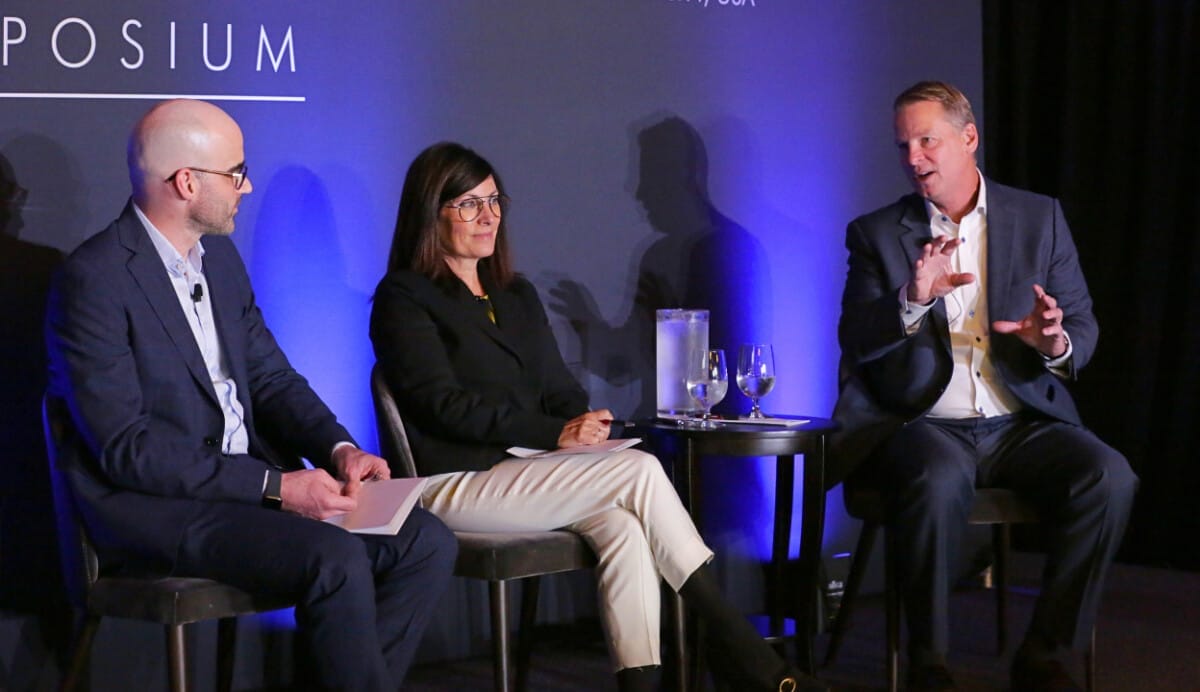
In a discussion at the Fiduciary Investors Symposium at Stanford University, long-term investors including APG Asset Management, MFS Investment Management, CPP Investments, considered the top macroeconomic themes that will play out over the next few years and what their implications will be for investors.
“Our expectation is that we’re moving into a higher-interest rate, higher-inflationary environment. Yes, rates are likely to come down from where they are currently, but we’re unlikely to go back to where we were in the period following the global financial crisis,” said Jonathan Hubbard, managing director in MFS’ investment solutions group.
Hubbard said he believes the driving elements behind the current persistence in inflation are less well understood, given that it follows more than a decade of zero interest rate environments after the GFC. Despite central banks kicking off a monetary easing cycle, that could mean periods of rolling inflation.
Inflation is also top of mind at Canadian pension fund CPP, head of portfolio design and construction Derek Walker said, with the potential that we have entered a world where inflation is either higher or more volatile.
“The reason that is relevant for us, as it will be for asset allocators in general, is that diversification benefits that we see between fixed income and equities are very strongly driven by that,” he told the audience of pension and sovereign funds.
“In those environments where it’s primarily growth that’s driving that correlation, we see a more negative correlation. But when it’s primarily inflation and real rates increasing, then that tends to be a positive relationship. So it has big implications from a diversification standpoint.”
Policy Divergence
APG global head of fixed income Ann Marie Griffith said one of the key issues that central bank policies have largely been co-ordinated since the global financial crisis, with rates coming down to very low levels.
However, now we’re seeing dispersion. The Federal Reserve delivered a supersized 50 basis point rate cut on Wednesday, the Bank of Canada has already eased three times, the Bank of England once and, two cuts have come from the European Central Bank.
“But what we’re really seeing is these central banks reacting to facts on the ground in their particular countries or regions, instead of acting in concert. So that’s creating a bit more volatility within markets and then across markets,” Griffith said.
She pointed out that some other countries such as Japan and Brazil, are actually thinking about raising rates as they deal with issues such as weakness in their own currency, and wage and inflation pressures.
“These are very sort of unusual activities, considering where we’re coming from since the financial crisis, but definitely creating a lot more volatility and a lot more interesting opportunities in portfolios.”
Another issue that is finding resonance is re-globalisation where global trade relationships, global supply chain structure and logistics are all changing.
What started in 2017 with the Trump administration tariffs were underscored during Covid, where companies couldn’t access their supply chains in different countries; then was impacted by the Russian invasion of Ukraine; and is currently being felt through the war in the Middle East, which is impacting shipping channels.
“Put that all together, and as a COO of an organisation, does it make sense to have outsourced all of this business and manufacturing?” Hubbard said.
“So we’re starting to see some of that come back to the US. But we’re also starting to see some of those trade relationships change and I think the beneficiaries will be countries in Asia, some countries in South America.”
Strategic Allocation, Tactical Play
Asset owners are looking to deal with the volatility in different ways. As a long term investor, CPP’s first line of defence is around building a resilient and robust strategic allocation, Walker said. That also involves stressing portfolio allocation to a number of different scenarios.
“So making sure that we are not allocating capital in assuming a very benign inflation and rate environment. We kind of put more weight on a higher rate, higher inflation environment.”
APG’s Griffith noted that there is still a very compressed spread environment, with potential for the Federal Reserve to be a little bit slower than the market has anticipated.
“We’re probably still a little bit biased to have risk on in the portfolios, but much more closer to home, and also trading up into more liquid, larger names and trying to create a little bit of extra liquidity in the portfolios to take advantage of some of the volatility that we may see in the coming months.”
Hubbard said while short-term market trends took precedence, he was advising clients to continue to focus on the long term.







Leave a Comment
You must be logged in to post a comment.
Login