
‘Built different builds different’: Embracing neurodiversity in investment

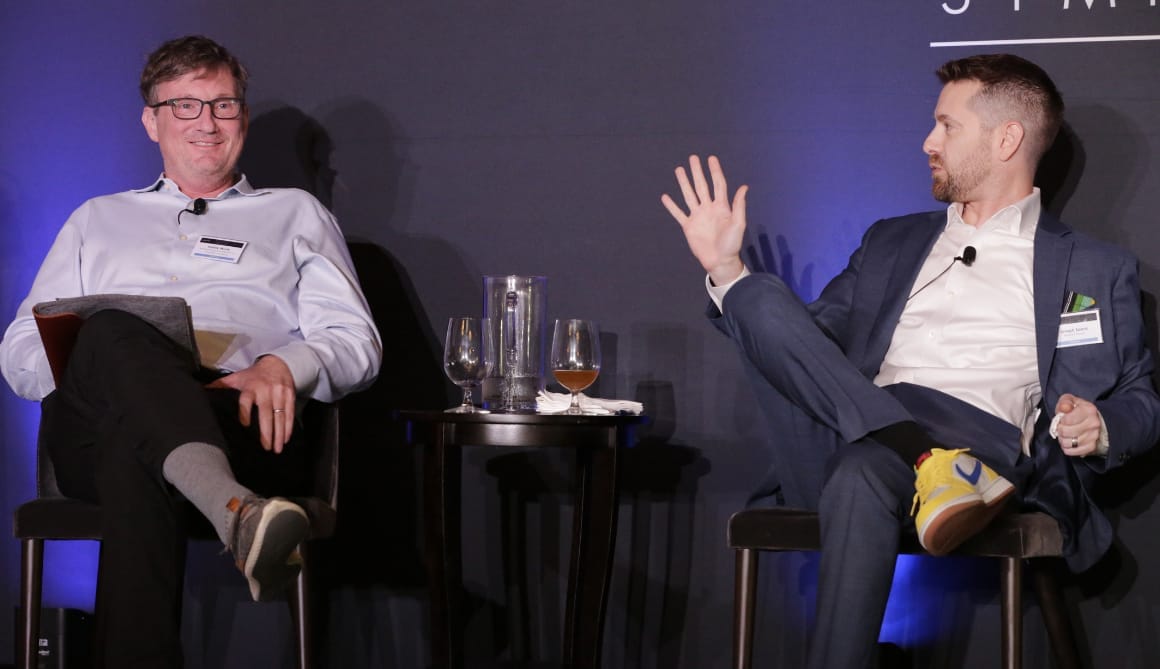
Ashby Monk (L) and Joseph Saénz. Image: Jack Smith

Finding ways to accommodate neurodiverse individuals within investment teams could be the key to unlocking better investment performance, as well as bringing the benefits of better collaboration and creativity, the Fiduciary Investors Symposium at Stanford University has heard.

Stanford Research Initiative on Long-Term Investing executive research director Ashby Monk said exploring the benefits of neurodiversity is an avenue of research that builds on the work already done to help asset owners become better at what they do.

He said the asset owner community controls about $140 trillion of capital and they are “quietly becoming the most important organisations in the world”.

The core of the research Monk oversees at Stanford is about “how do I help you make more money?”.

“We focus on your governance,” Monk said. “We focus on your culture, your technology and your ability to innovate.

“Some people think of my work as sitting in the category of behavioural finance. At times, it feels that way. But [while] behavioural finance academics do a fabulous job of diagnosing your biases, cognitive and behavioural, they may not have the solutions ready made to de-bias your organisations, to tune your decision makings, to make smarter, more efficient decisions, to generate higher performance.”

Sponsored Content

Monk said neurodivergence is the latest topic of research.

“Neurodivergence is not – let’s get it out there – a disorder,” he said. “It’s like biodiversity. [It is] the normal range and variation of human brains. We see it as a superpower.”

Monk said that although he doesn’t love the idea of putting a label on neurodivergence, sometimes that’s what must be done to enable organisations to recognise, harness and value it in their ranks.

“You do need to accommodate different things in your organisation in order to get the most out of these talented individuals,” Monk said.

Fremont Group managing director of quantitative analytics and risk Joseph Saénz told the symposium that it is typical for neurodivergent individuals to learn about their own neurodivergence through their children.

“The reason that neurodivergence is so important to me is through my son, as is the method for many that I started to meet, I started to find out that I myself was neurodivergent, and then eventually I also found out that the specific type of neurodivergence that I had was I’m actually autistic,” Saénz said, courageously revealing that for the first time in public.

Working in collaboration with Monk, Saénz said that “what I’m hoping to do is by identifying how neurodivergent individuals can assist in the in the investment arena, we can identify how we can accommodate so that they can better find that alpha”.

Monk said the objective of the research is to work out how organisations can find and bring in neurodivergent individuals and “give them safe spaces to innovate and create”. In the case of pension funds, that goal is to “meet target returns and pay pensions; it is about performance”.

Saénz said a key lesson is that “built different builds different”.

“At the heart of this is, new perspectives can come up with innovative stuff,” he said.

“I hire differently, and I have, as a result, a bunch of people that come up with fresh ideas all the time, and they bring them to me, and we try to put them in an arena that’s well hemmed in so that these ideas can create a strong portfolio that can withstand drawdowns but can also produce alpha.

“Folks can build their portfolios individually from the bottoms up, but as I said, it’s hemmed in from around the sides. It’s innovation, but with control. It’s a new approach, but with all the same people in the room allowing to say, ‘Well, have you thought of this? Have you thought of that?’ It’s new perspectives.”

Saénz said organisations must develop specific capabilities to recruit and retain neurodiverse professionals.

“I hire based on intellectual horsepower,” he said, but the exact metrics are “different with each and every candidate”. In one case a candidate claimed to have achieved a 1000 per cent return trading Pokémon cards.

“He buys rare Pokémon cards, holds onto them for a little while, and then flips them in Japan,” Saénz said.

“I told him that a 1000 per cent return is a terrible metric, and to come back to me with an IRR. So, he came back to me with an IRR, and then I hired him.”

Saénz described this sort of criteria as “non-standard information”.

“I used to say they’re going to at least need a graduate degree, to get into the quantitative group, because everybody else in the organization needs one less degree, and the quantitative group needs more math than everybody else,” he said. “Every time that a new person comes on, all of the problems that the last person came on to solve have been solved, so the newer problems are harder than the previous problems. The math is going to be harder.

“I need people with strong math skills, but they were too expensive. I recognised that I had to teach everybody that was coming, no matter what. I had to look at the cheaper end of the spectrum, which means I had to get more creative with the data that I was looking at.”

One response to “‘Built different builds different’: Embracing neurodiversity in investment”

  1. Nikolay Popov

    Would bipolar be considered neurodiverse or disability in this context?

Leave a Comment

The ‘most momentous’ in living memory: The 2024 US presidential election

The ‘most momentous’ in living memory: The 2024 US presidential election

Douglas Rivers, chief scientist at pollster YouGov, said data coming out of the current US presidential election confirms significant cultural and demographic shifts that are reshaping the political map. Rivers told the Fiduciary Investors Symposium that the once-popular “demographics is destiny” mantra predicting permanent centre-left majorities has lost meaning in the Trump era.

Sort content by

Changing geopolitical risks are getting harder to manage – but here’s how

The changing nature of geopolitical risks has made them harder to manage, even though the adversaries to an American-led world order have remained nearly the same over the decades. The Fiduciary Investors Symposium heard a key difference is that everything that happens everywhere is now interconnected.

Macro risks, opportunities prompt rethink of portfolios

Investment heads at large global funds are cutting down on risk, making higher allocations to equities and shifting focus to absolute returns as they reorganise portfolios to future-proof against global macro risks on the horizon, and to take advantage of potential opportunities, the Fiduciary Investors Symposium has heard.

Nobel laureate advises a different focus on risk to enhance returns

Nobel Prize-winning economist Myron Scholes advises investors to think differently about risk to improve the way it is managed, to help boost returns. He told the Fiduciary Investors Symposium the focus of asset owners should shift from thinking of risk as a constant to considering how risks are changing.

Flawed Fed encouraging excessive risk taking

An increasing willingness of regulators to bail out investors at times of crises is reducing the competitive environment in which banks and financial institutions operate, the Fiduciary investors Symposium at Stanford University has heard. It is also encouraging more risky behaviour, and creating a fragile system in the longer run.

FIS Stanford 2024 Gallery

mrec4inarticleinline Sponsored Content scnative1 scnative2 scnative3

The trait that will define ‘the California model’, according to CalPERS

Allocation to climate solutions and the ability to generate alpha from that across asset classes are what will define the future “California model”, according to CalPERS managing director of sustainable investment, Peter Cashion.