Changing geopolitical risks are getting harder to manage – but here’s how

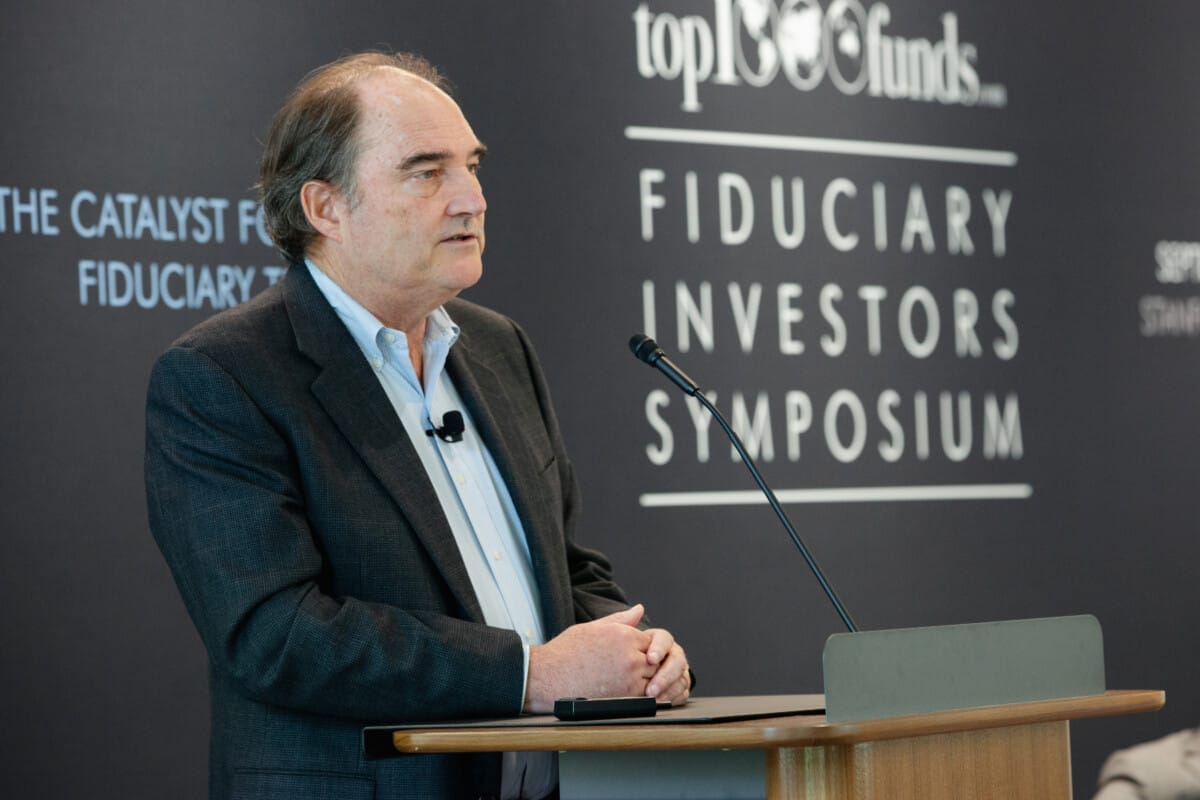
Stephen Kotkin. Image: Jack Smith.

The changing nature of geopolitical risks has made them harder to manage, even though the adversaries to an American-led world order have remained nearly the same over the decades, according to Stephen Kotkin, the Kleinheinz Senior Fellow at the Hoover Institution.

These risks can still be managed between the extremes of appeasement and provocation, and will require allies and friends to work with US, as well as fiscal power to undergird the challenge, the Top1000funds.com Fiduciary Investors Symposium at Stanford University heard.

“The world has changed a lot less than it seems,” Prof Kotkin, who is a specialist on geopolitical risk and authoritarianism, said. “So it’s manageable, it can be done; and if it’s not managed, then it’s unpriceable geopolitical risk.”

The geopolitical world, and America’s adversaries, are largely the same as in 1945 when the US-led order was created. It’s no longer Russia as the senior partner in the Eurasian bloc that’s opposed to US power now, instead it is China. On the other hand, Iran, which was part of the US-led order before the Islamic revolution in 1979, has now flipped.

Kotkin said the US bloc has remained vulnerable to conflict since 1945, in three places across the world – Crimea, Israel and the South China Sea.

At the time, the Soviet bloc formed “borders of victory” after winning World War II and taking over Eastern Europe, and a chunk of the Korean Peninsula. By contrast, the current conflicts centre around “borders of defeat”.

Sponsored Content

“They used to have it, they don’t have it, they want it back,” he said, referring to territorial conflicts in Ukraine and the South China Sea.

“It’s a lot harder to stabilise the other side when it wants the land back, unlike the Soviet case, where they had what they were after.”

Another key difference is that everything that happens everywhere is now potentially interconnected. While it took the world a while to master radio and TV technology, the power of the internet has been much harder to control.

“This interconnectivity, which is so empowering, is also massively destabilising, and we don’t know how to manage it. It’s relatively new,” Kotkin said.

Another key contrast to the old state of world affairs is the growing problem of “dual-use” technology, he added.

Back in the Soviet days, technology could either be classified as of use to the military industrial complex, or for consumer goods.

“Now, the rocket and the refrigerator, it’s the same. It’s all just a bunch of semiconductors and other dual-use technology,” Kotkin said, giving the example of a small private company that may simply come up with an innovation in computerisation, but which could be potentially considered as having military industrial applications.

These are the major differences in the world we live in now compared to 30 to 40 years ago. Otherwise, it’s the same problematic with the US led world order, like it or not, he said.

“In real life, it’s not justice and equality and sovereignty. It’s a US-led order with warts and all, or it’s the other guy’s order, and so solving that problem is really hard with these three big changes that have happened.”

Leave a Comment

The ‘most momentous’ in living memory: The 2024 US presidential election

The ‘most momentous’ in living memory: The 2024 US presidential election

Douglas Rivers, chief scientist at pollster YouGov, said data coming out of the current US presidential election confirms significant cultural and demographic shifts that are reshaping the political map. Rivers told the Fiduciary Investors Symposium that the once-popular “demographics is destiny” mantra predicting permanent centre-left majorities has lost meaning in the Trump era.

Sort content by

Better performance and alignment of purpose: The benefits of TPA

A total portfolio approach aligns investment implementation with the purpose of being a fiduciary, rather than short term or relative performance. Not only that, there is huge upside performance from the approach, the source of which is not what you might think according to Sue Brake.

Catching up with reality: Investment beliefs need a rethink

Co-founder of the Thinking Ahead Institute, Tim Hodgson, thinks your investment beliefs are out of date. He says if they were written five or more years ago they aren’t grounded in a 2024 reality and inadequately consider climate risk and systems thinking, both essential for a modern day asset owner.

UN pension fund slashes equity and pushes into impact and venture

The United Nations Joint Staff Pension Fund (UNJSPF) recently reduced the allocation to equity in its $92.5 billion portfolio in what Pedro Guazo, representative of the secretary-general (RSG) for the investment of the UNJSPF assets, describes as a conservative strategic allocation in response to the overvaluation in tech.

CalPERS’ plan to generate alpha from climate investments

CalPERS’ sustainable investment strategy is predicated on a belief it can generate outperformance by investing in climate solutions – with $100 billion to be allocated by 2030. Peter Cashion, managing investment director for sustainable investments tells Amanda White why, and how, it looks for climate alpha opportunities.

AIMCo talks total portfolio approach, private credit, and risk

As AIMCo prepares to beef up its private credit team in New York, CIO Marlene Puffer explains how she plans to scale the allocation, as well as describing a new total portfolio approach to private markets, and the investor's new approach to risk management.

Texas Teachers embraces AI and talks applications and risks

The Teacher Retirement System of Texas is already using AI in its giant equity portfolio and in real estate and venture. In a recent board meeting, CIO Jase Auby and MD Mohan Balachandran explain how the technology will shape returns, investment opportunities and differentiate the fund.