
‘New energy system’, not transition, needed to reach net zero

 More than $4 trillion a year in investment is needed over the next 30 years to meet the goal of net zero by 2050, asset owners have been told. Arun Majumdar, dean of Stanford University’s school of sustainability describes it as the “defining challenge and opportunity of the 21st century” for investors. But Greg Jackson, chief executive of renewables pioneer Octopus Energy, says it is only feasible if a revolutionary new global energy grid is established.  

More than $4 trillion a year in investment is needed over the next 30 years to meet the goal of net zero by 2050, asset owners have been told.

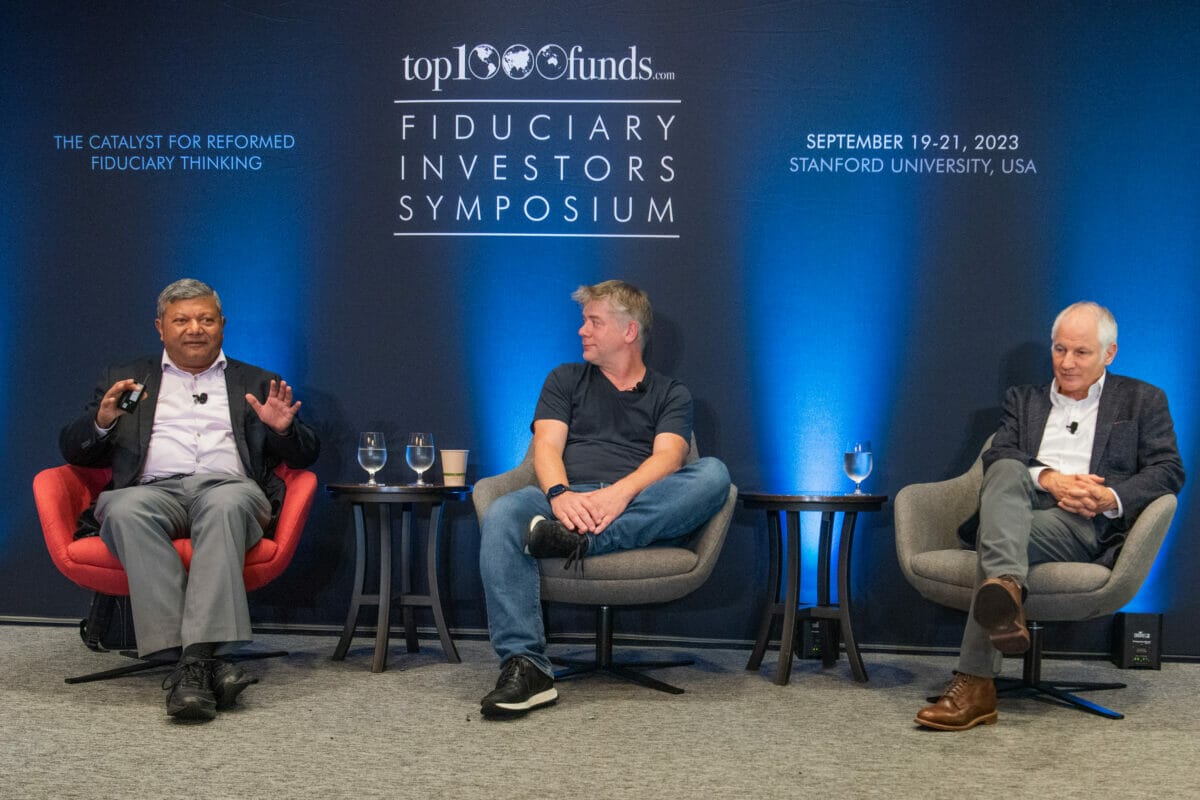
The figure, an estimate of the International Energy Agency, was described by Arun Majumdar, inaugural dean of the Stanford Doerr School of Sustainability, as the “defining challenge and opportunity of the 21st century”, with a critical role to be played by private capital.

“All the major nations, fortune 500 companies have made commitments but no-one knows how to get there,” Majumdar told the Top1000funds.com Fiduciary Investors Symposium at Stanford University in California last week.

Majumdar, a former vice-president of energy at Google, said the scale of the challenge was vast but the commercial opportunities for investors were beginning to stack up. “We have never seen solar and wind this good and cheap in human history,” he said.

But Greg Jackson, chief executive of London-headquartered Octopus Energy – which has 5.3 million customers via its retail arm – said “incumbent thinking” was thwarting progress on net zero and investment in renewables.

Sponsored Content

“If anyone should understand exponential growth its investors,” Jackson told the symposium. “The only thing holding us back is actions of governments, companies and their investors.”

He joked that he was going to “ban the words ‘energy transition’” in his company, urging that a more wholesale shift in consumer and investor behaviour was required.

“We need to build an entirely new, upgraded global energy system,” he said.

Majumdar concurred, describing the approach as “powerful” and noting that the electricity grid used in most nations had not advanced much technologically since “Edison and Tesla”, a reference to 19th century inventors Thomas Edison and Nikola Tesla.

At the same time, Majumdar, who had just returned to the Stanford campus from a tour of Asia, including the G20 summit in India, said it was important that business and activists acknowledged that different regions must set their own timelines and commitments.

He gave the example of Indonesia, which he said would “love to transition” because its food production was already being adversely affected by climate change-related heat waves, but was also still opening and operating coal power stations years away from ammortization.

On the flipside, Jackson said there were signs of swift progress in the developed world, with the number of EV charging stations in the UK growing tenfold in a 12-month period.

In response to a question from the floor from an executive at a US pension scheme, who complained that some interpretations of the fiduciary duty precluded impact investing in renewable energy, Jackson reminded delegates to the symposium of their political clout, as the stewards of almost $8 trillion in investor capital.

“Talk to your governments – if you’re being forced to invest in the wrong things, they [will] listen to you.”

Leave a Comment

Why venture capital is a better AI play than large-cap equities

Why venture capital is a better AI play than large-cap equities

Sceptics cautious about the hype surrounding artificial intelligence underestimate the major scientific and civilisational advancements the technology will bring, says former Google Cloud chief scientist Fei Fei Li. She says investors should look beyond household tech names, and explains why Chat GPT-style large language models are just the beginning.

Sort content by

What drives success at CPP Investments’ giant PE portfolio

Size and scale are not always advantages. Against the backdrop of tougher market conditions, CPP Investments' global head of private equity Suyi Kim says successfully managing what could be the world’s largest private equity allocation a program will depend on successfully managing the large team.

Temasek’s approach to AI: Support portfolio companies create value

Temasek's CIO Rohit Sipahimalani explains the investor is approaching opportunities in generative AI by focusing on supporting portfolio companies apply the technology so they can better create value.

AI, humans and the new age of asset management

AI cannot yet fully replicate human behaviour in all its dimensions, but if we are able to mitigate the risks that have and will come from multiple sources, it can be a game changer for our industry.

How CPP’s active equities team delivers pure alpha

The active equities team at CPP Investments has abandoned antiquated investment categorisations, such as style and size, and views companies through a more holistic “domain” interpretation. Global head Frank Ieraci discusses the team’s approach and the contributions it makes to the total fund, including capital efficiency, agility and pure alpha.

Portfolio managers 3.0: APG’s digital future

APG recently hired its first digital portfolio manager. “Samuel” comes complete with an employee identity number and underlines the firm's ambitions around data-driven money management. Amanda White spoke with APG's CIO Peter Branner about the road ahead.

APG talks crypto: Those who got rich in the gold rush didn’t do the digging

APG’s chief economist Thijs Knaap and senior strategist Charles Kalshoven lay out the case for not investing in crypto. They find that only an expected return of 25% pa would make it worthwhile and even then there’s no cashflows. They argue pension funds can afford to ignore this asset.