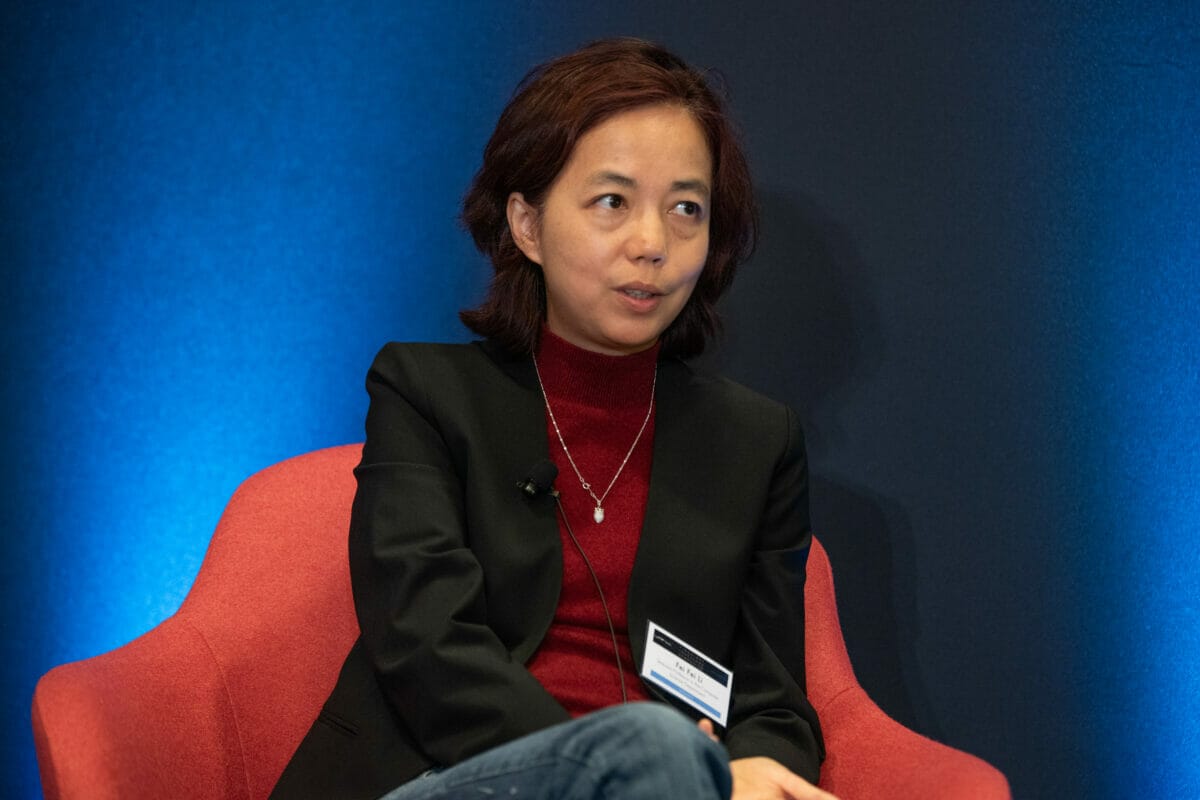

Why venture capital is a better AI play than large-cap equities

Sceptics cautious about the hype surrounding artificial intelligence underestimate the major scientific and civilisational advancements the technology will bring, says former Google Cloud chief scientist Fei Fei Li. She says investors should look beyond household tech names, and explains why Chat GPT-style large language models are just the beginning.

Asked whether artificial intelligence is just another fad, destined for bouts of market mania and malaise like cryptocurrency, Fei Fei Li takes issue with the premise.

“As a Stanford Professor, we are not in the business of hype – we are scholars and technologists,” she told the Fiduciary Investors Symposium, hosted by Top1000Funds.com on the grounds of the famed Californian university campus in September.

“I’ve seen hype cycles and misinformation, but I do genuinely believe this technology has arrived. This is a genuine inflection point in technology.”

Li, a professor of computer science and former Google executive described by Bloomberg as the “godmother of AI”, says the technology being developed in labs like the one she oversees at Stanford will not just trigger a productivity revolution that is advantageous to commerce, as predicted by bullish investors and analysts. Properly applied, it will “boost our civilisation in an accelerative way”, Li said.

While AI-enabled language models have captured global attention since the launch of the ChatGPT tool last year, the next frontier of innovation is the development of models that “understand the physical world” and can interact with it via robotics or other hardware applications, Li said. She gave the example of AI tools cooking an omelette, building flat pack furniture or changing an infant’s diaper.

Sponsored Content

But these physical world applications would also have vastly beneficial impacts for humanity, Li said, identifying the healthcare sector as being perhaps the example of use cases she is most excited by. AI-enabled medical technology and patient care could greatly alleviate the cost and labour burdens on hospital systems, she said.

Even the current iteration of large language models are assisting rapid advancements in health, she said, with some researchers using AI to comb through centuries’ worth of medical literature in search of new treatments and drugs in light of more contemporary knowledge.

“I am particularly gung ho about healthcare, it’s not easy, but there are so many human lives to be benefited — aged care, companionship, wellbeing, there are a lot of opportunities.”

‘Let’s not be lazy’

For investors, Li said the opportunity was almost unfathomably large given her thesis that AI will become as omnipresent as the internet. “Anything with a piece of software in it right now – your phone, your car, your fridge – tomorrow that will have AI in it,” she said. “It is the new compute. It manifests itself as a computational technology.”

And, as such, many of the largest Fortune 500 and Nasdaq-listed tech companies have understandably made forays into the emerging market, most notably Microsoft’s backing of ChatGPT issuer OpenAI.

However, amid the surging market demand and analyst and press attention, Li warned institutions not to confine their allocations to the promising technology to large-cap public equities.

“I want to invite everyone to rejuvenate this technology,” Li said. “I worry the oxygen is being sucked by a single-digital number of big companies. There’s nothing wrong with them, they’re amazing. But it would be better for many flowers to bloom.”

Professor Stephen Kotkin of Stanford’s Hoover Institution added: “So let’s not be lazy and just go to the big companies that own the cloud.”

But she also warned that funds willing to provide capital to start-ups operating in the AI space should ensure the firms and founders they are backing truly understand the computer science behind their operations, and not just the business use cases.

Asked about the downsides of AI, Li admitted that unregulated application of AI could be “dangerous” and identified misinformation as a key concern.

However, she concluded this was true of almost all groundbreaking technologies throughout history – and that the potential social and economic upsides greatly outweighed the risks.

“I am not a pure utopian,” she said. “To promise [only good would come from AI]  would be a little irresponsible, because along the way this technology, plus the pitfalls of human nature, creates landmines.

“[But] from the time we build axes with stones we knew those tools could be used positively and negatively.”

Leave a Comment

Impact investing’s case for scale

Impact investing’s case for scale

Impact investing has come a long way in the past two decades, going from a niche strategy to a $1.5 trillion industry, but there are still challenges for it to reach institutional scale due to the lack of products and insufficient evidence of outperformance in some parts of the market.

Sort content by

Reports of America’s decline greatly exaggerated: Kotkin

Reports of America’s decline as a geopolitical and economic power are exaggerated, and the noise investors should learn to ignore is really only the presidency itself, celebrated historian Stephen Kotkin told the Fiduciary Investors Symposium at Harvard.

Responsible investing remains ‘common sense’: MassPRIM chair

Trustee of Massachusetts PRIM and state Treasurer Deborah Goldberg said investing with a stewardship and sustainability-conscious approach remains “common sense” for the $116 billion fund, though she said it has been harder for the investor to access some ESG-related information from managers and companies.

How the Future Fund built a TPA culture that scales

The total portfolio approach has allowed Australia’s sovereign wealth fund to capture the themes that will power markets and economies for decades to come, said director of thought leadership Craig Thorburn – but that doesn’t mean it’s not hard to scale.

Crisis the real test of LP-GP relationships

When Blue Owl Capital came under sustained media pressure over redemptions to its private credit funds, Michael Hitchcock, chief executive of the South Carolina Retirement System Investment Commission (RSIC), didn’t waver. He thinks that what allocators learn from their managers in a period of crisis tells them more than any official due diligence could.

Fed independence a key US inflation variable: Former CEA chair

The path of US inflation hinges on the future of the Federal Reserve, with leading Harvard economist and former Obama administration Council of Economic Advisers chair Jason Furman warning that another variable for inflation is whether the central bank can remain independent.

Public equity manager challenges the case for private

Loomis Sayles’ Aziz Hamzaogullari has questioned whether asset allocators are giving private equity more credit than it is worth, saying the case for investing in PE rests on flawed return measurement, hidden risks and high fees and that public equities should be treated with the same “patience” that PE receives.



