
‘New energy system’, not transition, needed to reach net zero

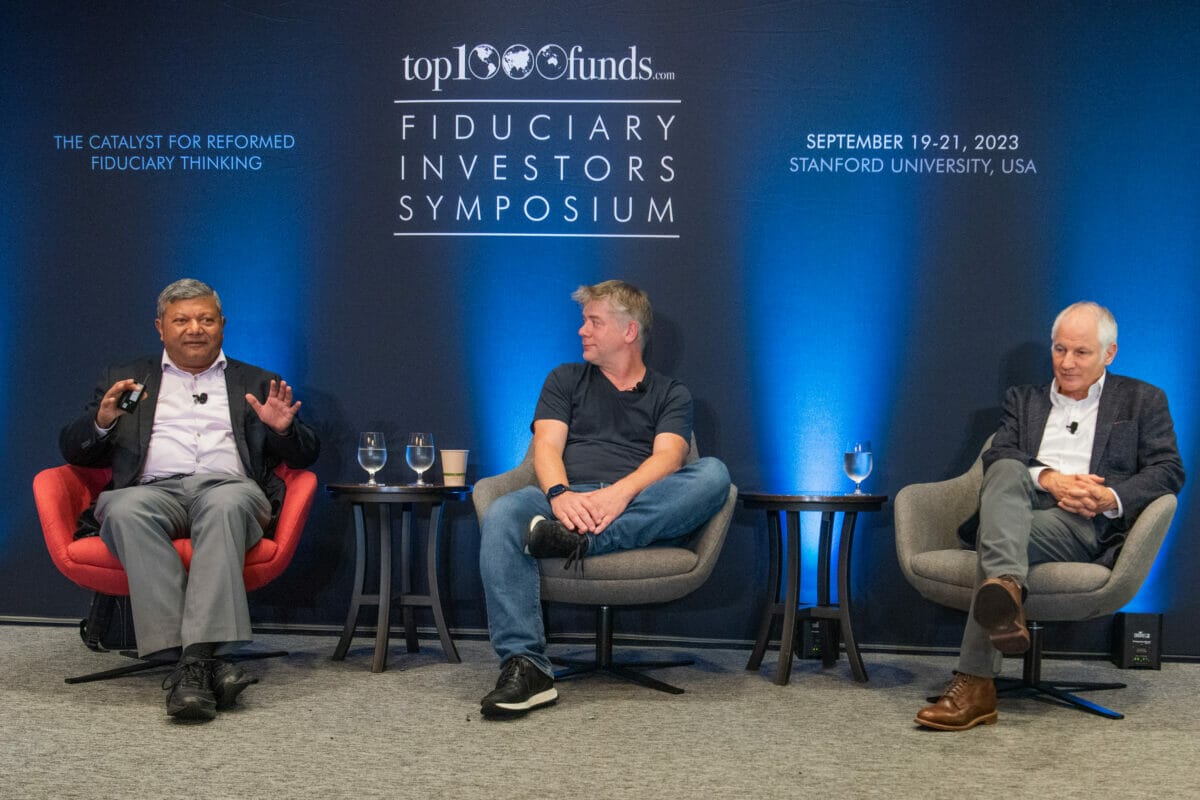
 More than $4 trillion a year in investment is needed over the next 30 years to meet the goal of net zero by 2050, asset owners have been told. Arun Majumdar, dean of Stanford University’s school of sustainability describes it as the “defining challenge and opportunity of the 21st century” for investors. But Greg Jackson, chief executive of renewables pioneer Octopus Energy, says it is only feasible if a revolutionary new global energy grid is established.  

More than $4 trillion a year in investment is needed over the next 30 years to meet the goal of net zero by 2050, asset owners have been told.

The figure, an estimate of the International Energy Agency, was described by Arun Majumdar, inaugural dean of the Stanford Doerr School of Sustainability, as the “defining challenge and opportunity of the 21st century”, with a critical role to be played by private capital.

“All the major nations, fortune 500 companies have made commitments but no-one knows how to get there,” Majumdar told the Top1000funds.com Fiduciary Investors Symposium at Stanford University in California last week.

Majumdar, a former vice-president of energy at Google, said the scale of the challenge was vast but the commercial opportunities for investors were beginning to stack up. “We have never seen solar and wind this good and cheap in human history,” he said.

But Greg Jackson, chief executive of London-headquartered Octopus Energy – which has 5.3 million customers via its retail arm – said “incumbent thinking” was thwarting progress on net zero and investment in renewables.

Sponsored Content

“If anyone should understand exponential growth its investors,” Jackson told the symposium. “The only thing holding us back is actions of governments, companies and their investors.”

He joked that he was going to “ban the words ‘energy transition’” in his company, urging that a more wholesale shift in consumer and investor behaviour was required.

“We need to build an entirely new, upgraded global energy system,” he said.

Majumdar concurred, describing the approach as “powerful” and noting that the electricity grid used in most nations had not advanced much technologically since “Edison and Tesla”, a reference to 19th century inventors Thomas Edison and Nikola Tesla.

At the same time, Majumdar, who had just returned to the Stanford campus from a tour of Asia, including the G20 summit in India, said it was important that business and activists acknowledged that different regions must set their own timelines and commitments.

He gave the example of Indonesia, which he said would “love to transition” because its food production was already being adversely affected by climate change-related heat waves, but was also still opening and operating coal power stations years away from ammortization.

On the flipside, Jackson said there were signs of swift progress in the developed world, with the number of EV charging stations in the UK growing tenfold in a 12-month period.

In response to a question from the floor from an executive at a US pension scheme, who complained that some interpretations of the fiduciary duty precluded impact investing in renewable energy, Jackson reminded delegates to the symposium of their political clout, as the stewards of almost $8 trillion in investor capital.

“Talk to your governments – if you’re being forced to invest in the wrong things, they [will] listen to you.”

Leave a Comment

Why venture capital is a better AI play than large-cap equities

Why venture capital is a better AI play than large-cap equities

Sceptics cautious about the hype surrounding artificial intelligence underestimate the major scientific and civilisational advancements the technology will bring, says former Google Cloud chief scientist Fei Fei Li. She says investors should look beyond household tech names, and explains why Chat GPT-style large language models are just the beginning.

Sort content by

Managing not just measuring risk is key to long-term returns

Nobel Prize-winning economist Myron Scholes told the Fiduciary Investors Symposium at Stanford University that the focus of asset owners needs to shift from measuring risk to managing it, to avoid the downside while capturing the upside and allowing compounding to do its thing.

Asset owners need organisational prowess to take advantage of distress

The market has already entered the early stages of a multi-year restructuring cycle that will present many opportunities for credit providers. Researchers and investors from GIC, CalPERS and IMCO recommend some organisational changes that will ensure asset owners can make the most of those opportunities.

Operational excellence as critical as asset allocation for success

Asset allocation is often nominated as the most important element in long-term investment performance. But the Fiduciary Investor s Symposium at Stanford University heard that no investment strategy or process can operate in a vacuum – it can’t happen effectively without operational excellence.

Get on board: why the megatrend is your friend

Megatrends are the forces that will shape our planet, our society and our lives decades into the future. The Fiduciary Investors Symposium at Stanford University heard Megatrends provide potentially rich pickings for investors, as long as they know how to use them,.

The future of portfolio construction

Evolving portfolio construction techniques that include more attention to liquidity management, diversification and resilience are needed in a macro environment that has more complexity and volatility delegates at the Fiduciary Investors Symposium at Stanford University heard. Investors from CalSTRS, CPP Investments and MFS share their approach.

Politics rivals profits for portfolio influence, says Bridgewater co-CIO

Bridgewater co-CIO Greg Jensen said government policy has steadily increased in influence over the economy and portfolio construction over the past 20 years and now outstrips the importance of private sector incentives. He says the pace of deglobalisation is a key trend for institutional investors to keep abreast of.