
What it means if ‘DNA is not destiny’

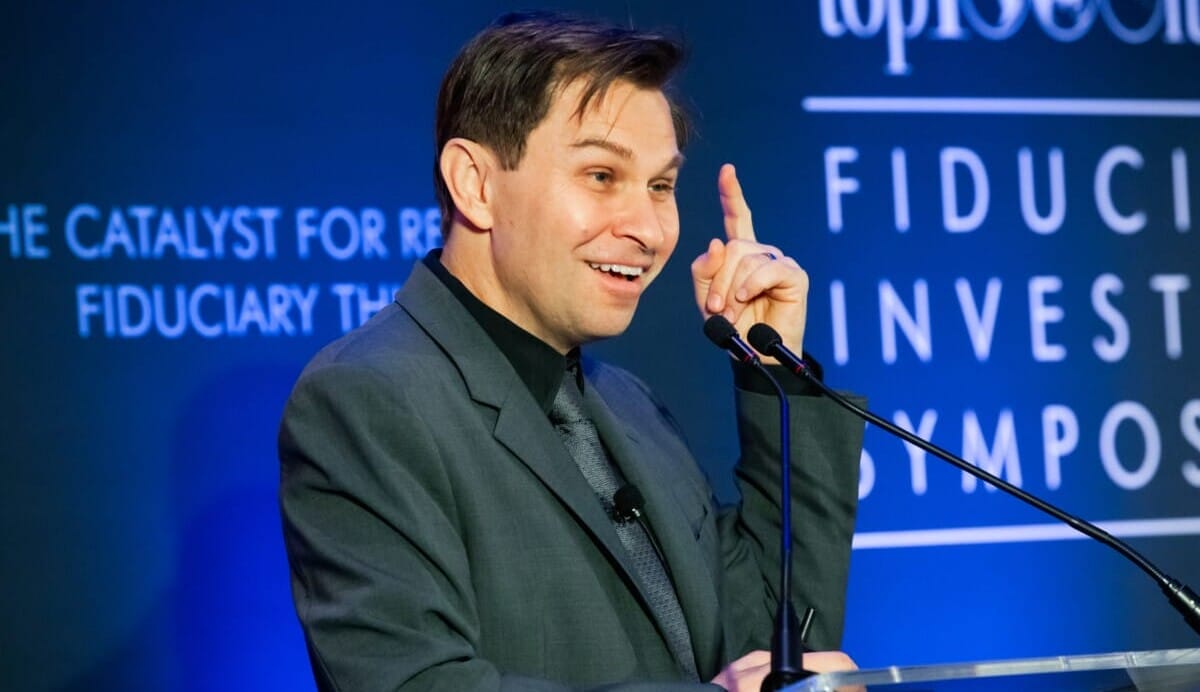
David Sinclair. Photo: Jack Smith

If aging were a disease like any other that could be treated and “cured”, the implications for society would be profound, and the Top1000funds.com Fiduciary Investors Symposium at Harvard University has heard that time is not far off. 

Harvard Medical School Department of Genetics Professor David Sinclair told the symposium that aging is a medical condition like any other, that it may be preventable or treatable, and that getting older may, in the not-too-distant future, become a matter of choice. 

Sinclair said understanding how genes are turned on and off is the key to understanding the aging process and therefore how to arrest or reverse it. 

Heart attack, stroke and kidney failure and other diseases are “manifestations of this universal process I’m talking about today, that we now know occurs in every cell and in every organism on the planet, even yeast cells, that we call aging”, Sinclair said. 

Ageing affects the body’s ability to handle those diseases, but if aging is reversed they go away. 

“We know it works in what we call, affectionately, non-human primates, or monkeys,” Sinclair said.  

Sponsored Content

“Monkeys are very similar to us, of course, and so I’m on record saying I’d be really surprised if it doesn’t work in us as well.” 

Sinclair said it has long been believed that in the process of replication over a lifetime, DNA becomes damaged or mutates, and that’s what causes aging in cells. 

“There’s still a few people that hang on to this idea, but there’s a lot of evidence that that’s not true,” Sinclair said.  

“The other bit of evidence that, if you think about it, is really damning to the DNA-damage hypothesis, is I could take a cell from each of you and clone you, and I’d make babies out of your old cells. 

“It says that [in] our old cells, it’s not the DNA that’s a problem, it’s something else that has a reset button. I believe we found out what that reset button is. And fortunately, we won’t have to go through a cloning step to be rejuvenated. We can do it while we’re still alive. 

“It’s not the DNA that’s the destiny, it’s something else.” 

Sinclair said that in essence there exists a kind of “backup” of an organism’s original DNA, called the epigenome, which can be used as a reference to “reset” the organism’s DNA. The trick, Sinclair said, is not to push back the aging process too far and cause the DNA to create stem cells, because that is fatal to the organism. 

“What we had to figure out, which really was the hard part, was how do you reset aging by 75 per cent, 80 per cent, but not 100 per cent, and safely?” he said. 

“What we’ve found is a way to not just keep embryos young, but to safely keep adult tissues young.  

“We’ve done it… in living monkey tissue, and humans are next.” 

Change the pattern 

Sinclair said his lab’s goal is to “change the DNA methylation pattern on the DNA”. 

“What we’ve shown in my lab and … in the monkeys is that we can reset the pattern of those chemical changes on the DNA,” he said. 

“And if you’re astute, you might be saying, how is that possible? How does the cell know which of these chemicals is missing to put it back on and vice versa? And my answer is: that’s the Nobel Prize. If you want to win one, go figure that out. You’d be racing me for that answer. 

“We don’t fully know yet how it works, but we have some clues, and I have students on that, but we think that there’s physical changes, some tags on the DNA that gets laid down when we’re babies that tells the cell how to go back and put those chemicals back where they belong.” 

Sinclair said that if his research holds up and he’s correct about the hypotheses so far put forward, it could be as big an advance in medical science as vaccination or antibiotics. 

“It’s really big, and it will really change society,” he said, 

“It will change the way we think about our lives and what diseases we can treat that we currently have nothing for. 

Sinclair said the pace of research and discovery has been accelerated exponentially by the application of artificial intelligence, allowing his researchers to do “AI screens of trillions of molecules in a matter of two months that would normally take probably 20 years to go through physically”. 

“Out of those trillions of molecules, we have hits that are reversing aging in similar ways to the gene therapy, single molecules, not cocktails that we’ve been using.  

“Those single molecules, if they work, you could imagine, and we will try them, to take a pill to cure blindness or to cure Alzheimer’s. That’s how fast it’s going, that in two months, we can do 20 years of research now by simulating chemistry in the computer and docking trillions of molecules against proteins.” 

Sinclair said the work that’s been possible in the past few months was literally impossible only a few years ago and would have taken “more than a million years to do this, probably,” without AI. 

“What we were looking for was a single molecule that could activate one enzyme and inhibit three other different ones,” he said. 

“Normally, you’re after one target, which is extremely difficult. We said, let’s do four with one molecule, and we got it to work.  

“But you can only do that in the in the virtual world. It wouldn’t be possible physically. So AI is huge. If you ask my students, how often do you use AI, for them, it’s like breathing.” 

Leave a Comment

Behind Norges’ search for pure alpha

Behind Norges’ search for pure alpha

Despite uncertainties, Norges Bank is tipping that the US stock market will continue to outperform Europe in the next two decades. The mammoth fund also explained how it carved out a $90 billion pure alpha portfolio from passive investments, overseen only by 8 portfolio managers.

Sort content by

Investors reflect on whether active managers can escape the Magnificent 7

Active managers has been under stress for several years due to lukewarm performance commonly attributed to the rise and rise of large cap technology stocks and passive investing. However, investors at the Top1000funds.com Fiduciary Investors Symposium concluded that the root cause of that stress might be more complicated.

Path to net zero requires honest dialogue about sustainable investing

Leading institutional investors at the Fiduciary Investors Symposium at Harvard said the industry could benefit from having a franker conversation about sustainable investments, both in terms of what climate goals are achievable on the path to net zero and what is behind the pushback on ESG funds.  

CPPIB spots accelerating change, alpha opportunities in healthcare

Technology is reshaping the healthcare sector, creating opportunities that investors “never imagined” as companies apply robotics and AI to new and established treatments.

TPA: Unlocking alpha through enhanced liquidity management

Stronger liquidity management through a total portfolio approach (TPA) can do more than manage real-time risk exposures – it can also help generate alpha, according to panellists at the Fiduciary Investors Symposium at Harvard University. 

AI the ‘most consequential’ trend for infra investors despite scepticism

AI is “the most consequential megatrend” for infrastructure investors with opportunities not only around data centres, but also energy and fibre networks by extension. But despite the bullishness, some asset owners are wondering when – or if – AI will deliver a miraculous productivity gain and benefit the underlying infrastructure.

European capital markets reform could unlock trillions in investment

Co-president of Apollo's asset management arm, John Zito, said reforms to European capital markets could unlock trillions of dollars worth of investment opportunities as investors seek alternatives to the US market, and Germany and France are key to leading the region's growth narrative.