
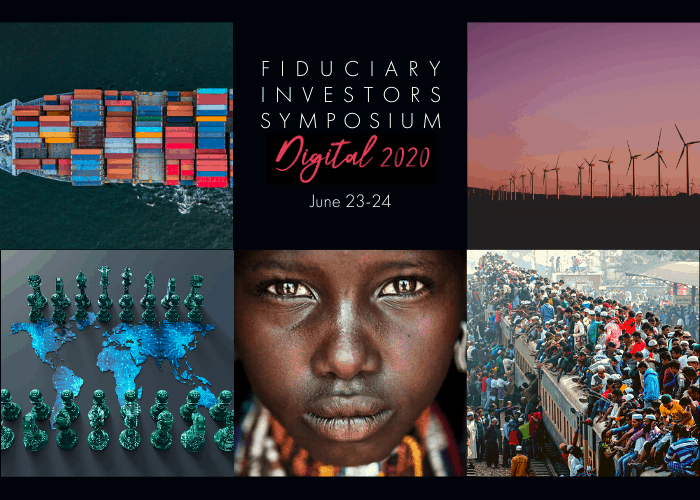

In the first of four articles looking ahead to FIS 2020, we highlight how the event will focus on de-globalisation and geopolitical stress, particularly the deteriorating relationship between China and the US. Elsewhere, FIS delegates will hear how asset owners are positioning their portfolios in today’s challenging environment.
Crises have a habit of accelerated existing global trends, and Coronavirus is no exception. Trends like de-globalisation, already rooted in populism, and the absence of global leadership have moved centre stage in recent months. More positively, the crisis has also underscored the importance of directing capital to benefit society and the environment as a whole.
It is these key themes that the Fiduciary Investors Symposium Digital 2020 (June 23-24) will unpick via in-depth conversations with academics and asset owners. Institutional investors will play an essential role in rebuilding the global economy, and FIS Digital aims to set out their concerns and priorities in today’s unchartered landscape.
Geopolitical stress, already present in the global economy, but fractured even more by the current crisis and most visible in the deteriorating relationship between the US and China, is a main theme over the two-day agenda. During the global financial crisis, the G20 came together to orchestrate a co-ordinated economic policy response, yet this time around the US and China have been unable to put aside bilateral issues for a global imperative.
In the last few months alone President Trump has cracked down on Chinese companies listed in the US and moved to stop the Federal Retirement Thrift Investment Board, a government agency that manages $594 billion in assets for 5.9 million workers through its Thrift Savings Plan, from investing in Chinese companies. “These moves have rightfully spooked markets and raised the spectre of further curbs on Chinese investment in the US and US investment in China,” flags Cambridge Associates Aaron Costello, regional head for Asia who predicts more “tough on China” policies on Trump’s campaign trail.
“My biggest worry regarding the US-China-tensions is around technology. Are we evolving into two separate ecosystems for similar technology?” questions Patrik Jonsson, head of manager selection, public assets at AP2, Sweden’s SEK345 billion ($39.1 billion) buffer fund which first invested in China seven years ago. “In my opinion, the world needs more cooperation not less. So far, we have not made any changes to our portfolio to account for increased strains between the two countries, but we are monitoring the situation closely.” All this at a time – ironically – Costello points out China is a relative safe haven, with both the stock market and currency proving resilient during the March meltdown.
Delegates will hear how the globalisation and interdependence that has fuelled wealth and spurred companies to set up production overseas is now under threat. Ian Goldin, Professor of Globalisation and Development at Oxford University, will talk on how its demise could unravel to impact portfolios. In another session, FIS regular Stephen Kotkin, Professor in History and International Affairs, Princeton University, will argue how high-level interdependence is based in shallow global governance mechanisms and that although today’s failing relationship has similarities to historical events, we have the power to change it.
Emerging markets
If globalisation has peaked it has implications for emerging markets, one of the biggest investor stories in recent decades. Before the pandemic struck, the IMF was already flagging concerns that emerging market reform like financial liberalisation and privatisation, which take years to materialise and gathered pace in the 1990s, has slowed. Now export controls, protectionism and the economic slump threaten further growth. It is harder for governments in these countries to fund an economic stimulus, and few can borrow at rock-bottom interest rates.
Long-term investors are not inclined to panic and have the luxury to think things through. Yet some pension funds are facing reduced funding levels (many still not replenished after the financial crisis) and high return targets. All are navigating rock bottom yields on government bonds.
“This downturn is a serious step backwards in their funding progress,” warned a recent report on US public pension funds. Take, for example, $226.9 billion CalSTRS latest actuarial valuation (June 2019) which gives a funded ratio of 66 per cent.
At FIS Digital 2020, delegates will hear how asset owners facing these challenges are positioning their portfolios.
“In the wake of the pandemic we needed to ensure we had the cash and liquidity to survive the storm,” says Simon Pilcher, chief executive officer, USS Investment Management, manager of the United Kingdom’s Universities Superannuation Scheme.
“Now we are seeking to take advantage of opportunities where they present themselves. This is particularly true in fixed income, while we are also looking at further building our private markets business.”
Elsewhere CalPERS CIO Ben Meng will share his thoughts on asset allocation and liquidity alongside the Dutch €514 billion fund APG, where current strategy also includes expanding expertise in illiquid real estate, infrastructure and private equity to counter low yields on government bonds.
The Fiduciary Investors Symposium Digital 2020 on June 23 and 24 will look at the extreme uncertainty of the global economy including the changing geopolitical dynamics and the potential unravelling of globalisation; the unprecedented fiscal and monetary policy responses and the implications for investments; how investors are positioning portfolios and managing short and long term risks; supply chain risks and responsible capitalism; what a sustainable recovery looks like and how investors can ensure it happens.
Asset owners can register for the Fiduciary Investors Symposium here.







Leave a Comment
You must be logged in to post a comment.
Login