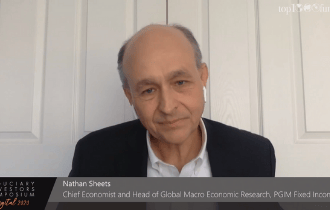
Nathan Sheets, the former undersecretary of the U.S. Treasury for international affairs representing the U.S. government on international economic policy, and now chief economist at PGIM will outline the expected policy responses from a Biden government and what that means for global interest rates, currencies and sovereign debt and credit markets. The prospect of global inflation is a conversation around all investment committee meetings this year. This session will also look at what deep structural factors are driving inflation, or disinflation, and what that means for emerging and developed markets heading into 2021.[vc_quotes layout=”accordion” quotes=”%5B%7B%22name%22%3A%22Nathan%20Sheets%22%2C%22job_role%22%3A%22Chief%20economist%20and%20head%20of%20global%20macro%20economic%20research%2C%20PGIM%20Fixed%20Income%22%2C%22content%22%3A%22Nathan%20Sheets%2C%20PhD%2C%20is%20chief%20economist%20and%20head%20of%20global%20macroeconomic%20research%20at%20PGIM%20Fixed%20Income.%20He%20is%20responsible%20for%20the%20oversight%20of%20the%20firm%E2%80%99s%20global%20macroeconomic%20research%20team%2C%20leading%20the%20formulation%20of%20the%20global%20macroeconomic%20outlook%2C%20supporting%20fundamental%20views%20on%20developed%20and%20emerging%20countries%2C%20and%20the%20analysis%20of%20global%20interest%20rate%2C%20currency%2C%20sovereign%2C%20and%20credit%20markets.%20He%20is%20a%20member%20of%20the%20senior%20investment%20team%20and%20provides%20thought%20leadership%20on%20global%20monetary%20and%20fiscal%20policy%20and%20macroeconomic%20trends.%20Sheets%20was%20most%20recently%20the%20undersecretary%20of%20the%20US%20Treasury%20for%20international%20affairs%2C%20representing%20the%20US%20government%20on%20international%20economic%20policy.%20Previously%2C%20he%20held%20positions%20with%20Citigroup%2C%20as%20global%20head%20of%20international%20economics%2C%20and%20with%20the%20Federal%20Reserve%20Board%2C%20most%20recently%20as%20director%20of%20the%20division%20of%20international%20finance%20and%20FOMC%20economist.%20He%20earned%20a%20Bachelor%E2%80%99s%20in%20Economics%20from%20Brigham%20Young%20University%20and%20a%20Ph.D.%20from%20the%20Massachusetts%20Institute%20of%20Technology.%22%2C%22image%22%3A%2235231%22%2C%22linkedin%22%3A%22https%3A%2F%2Fwww.linkedin.com%2Fin%2Fnathan-sheets-044972172%2F%22%7D%5D” title=”Speakers” el_class=””][vc_quotes layout=”accordion” quotes=”%5B%7B%22name%22%3A%22Amanda%20White%22%2C%22job_role%22%3A%22Director%20of%20institutional%20content%2C%20Conexus%20Financial%20(Australia)%22%2C%22content%22%3A%22White%20is%20responsible%20for%20the%20content%20across%20all%20Conexus%20Financial%E2%80%99s%20institutional%20media%20and%20events.%20She%20is%20responsible%20for%20directing%20the%20bi-annual%20Fiduciary%20Investors%20Symposium%20which%20challenges%20global%20investors%20on%20investment%20best%20practice%20and%20aims%20to%20place%20the%20responsibilities%20of%20investors%20in%20wider%20societal%2C%20and%20political%20contexts%2C%20as%20well%20as%20promote%20the%20long-term%20stability%20of%20markets%20and%20sustainable%20retirement%20incomes.%20She%20is%20the%20editor%20of%20conexust1f.flywheelstaging.com%2C%20the%20online%20news%20and%20analysis%20site%20for%20the%20world%E2%80%99s%20largest%20institutional%20investors.%20White%20has%20been%20an%20investment%20journalist%20for%20more%20than%2020%20years%20and%20has%20edited%20industry%20journals%20including%20Investment%20%26%20Technology%2C%20Investor%20Weekly%20and%20MasterFunds%20Quarterly.%20She%20was%20previously%20editorial%20director%20of%20InvestorInfo%20and%20has%20worked%20as%20a%20freelance%20journalist%20for%20the%20Australian%20Financial%20Review%2C%20CFO%2C%20Asset%20and%20Asia%20Asset%20Management.%20She%20has%20a%20Bachelor%20of%20Economics%20from%20Sydney%20University%20and%20a%20Master%20of%20Arts%20in%20Journalism%20from%20the%20University%20of%20Technology%2C%20Sydney.%20She%20was%20previously%20a%20columnist%20for%20the%20Canadian%20publication%2C%20Corporate%20Knights%2C%20which%20is%20distributed%20by%20the%20Globe%20and%20Mail%20and%20The%20Washington%20Post.%20White%20is%20currently%20a%20fellow%20in%20the%20Finance%20Leaders%20Fellowship%20at%20the%20Aspen%20Institute.%20The%20two-year%20program%20consists%20of%2022%20fellows%20and%20seeks%20to%20develop%20the%20next%20generation%20of%20responsible%2C%20community-spirited%20leaders%20in%20the%20global%20finance%20industry.%22%2C%22image%22%3A%2235225%22%2C%22linkedin%22%3A%22https%3A%2F%2Fwww.linkedin.com%2Fin%2Famanda-white-101a7515%2F%3ForiginalSubdomain%3Dau%22%7D%5D” title=”Moderator” el_class=””][vc_empty_space height=”10px”]
Key takeaways
Biden’s team is experienced both as individuals and also as a collective team, so policy process is likely to be transparent to the public. Governance and policy by tweet will be a thing of the past.
Biden will see flaws in the economy and will take steps to rectify them, including in the areas of inequality, healthcare and climate change. Climate policy will be a critical part of what the Biden administration will focus on. Biden will quickly rejoin the Paris Agreement.
Job 1 for Janet Yellen will be to address the impact of the virus on the economy including the need to restore jobs and get people back to work as soon as possible. Nobody knows the US labour market more deeply than Janet Yellen.
The appointment of Brian Deese to lead the National Economic Council is a very important step.
US policy on China will stay strategically tough as they were under Trump but the methods Biden will apply will be much different, to bring in allies around the world to put constructive pressure on China to, for example, respect foreign technologies
The post-pandemic period will feel much like the pre-pandemic experience, with soft to moderate growth, low inflation and likely low rates.
It is possible as we get back to normal that we will see some temporary periods of high inflation but within a couple of years low inflation is expected to be the norm.
In a low inflation, low rate environment the reach for yield will continue which bodes well for risk assets including in the credit space. Equities for yield may also become attractive.
There is scope over the next few years for the US dollar to depreciate to a certain extent relative to RMB and emerging market currencies.
[vc_empty_space height=”10px”]
Unanswered questions and answers
[vc_empty_space height=”10px”]
Poll results
Are you hedging your portfolio against inflation?[vc_line_chart x_values=”” values=”%5B%7B%22title%22%3A%22Yes%2C%20increased%20allocations%20to%20assets%20such%20as%20infrastructure%20or%20inflation-linked%20bonds%20etc%22%2C%22y_values%22%3A%2244%22%2C%22color%22%3A%22blue%22%7D%2C%7B%22title%22%3A%22No%2C%20but%20discussing%20internally%20and%20monitoring%22%2C%22y_values%22%3A%2237%22%2C%22color%22%3A%22pink%22%7D%2C%7B%22title%22%3A%22No%2C%20consider%20inflation%20unlikely%22%2C%22y_values%22%3A%2219%22%2C%22color%22%3A%22orange%22%7D%5D”][vc_empty_space height=”10px”]
APG's CIO Peter Branner explains how the pandemic has accelerated key trends already underway around digitization, central bank policy and action to combat climate change. It all points to fierce competition for private assets.
The Responsible Asset Allocator Initiative finds that 25 leading public pension and sovereign wealth funds, with assets of $6 trillion, are investing tens of billions of dollars in COVID-19 solutions and in funds to support stricken companies. Here they look at what the leading asset allocators around the world are doing to respond to the pandemic.
Global economic activities will not be back to pre-COVID levels until 2022 according to CPP Investments’ outlook, with the giant Canadian investor expecting the situation to get worse before it gets better.
Meticulous planning for the next market crash, and an eye on liquidity, meant IMCO was well positioned to invest, particularly in credit, when the opportunity arose. The fund continues to use its agility to its advantage and is now looking for opportunities in private markets.
The best way to integrate different scenarios into portfolio construction is front of mind for investors right now. But as David Bell explores adapting academic practices into the more complex real world is full of challenges. There are some important learnings in examining different techniques though.
How can investors work together to combat inequality? In this podcast episode Amanda White speaks to the president of CalPERS, Henry Jones, about his own experience and the fund's journey in tackling diversity and inclusion, in particular issues of racism.










Leave a Comment
You must be logged in to post a comment.
Login