
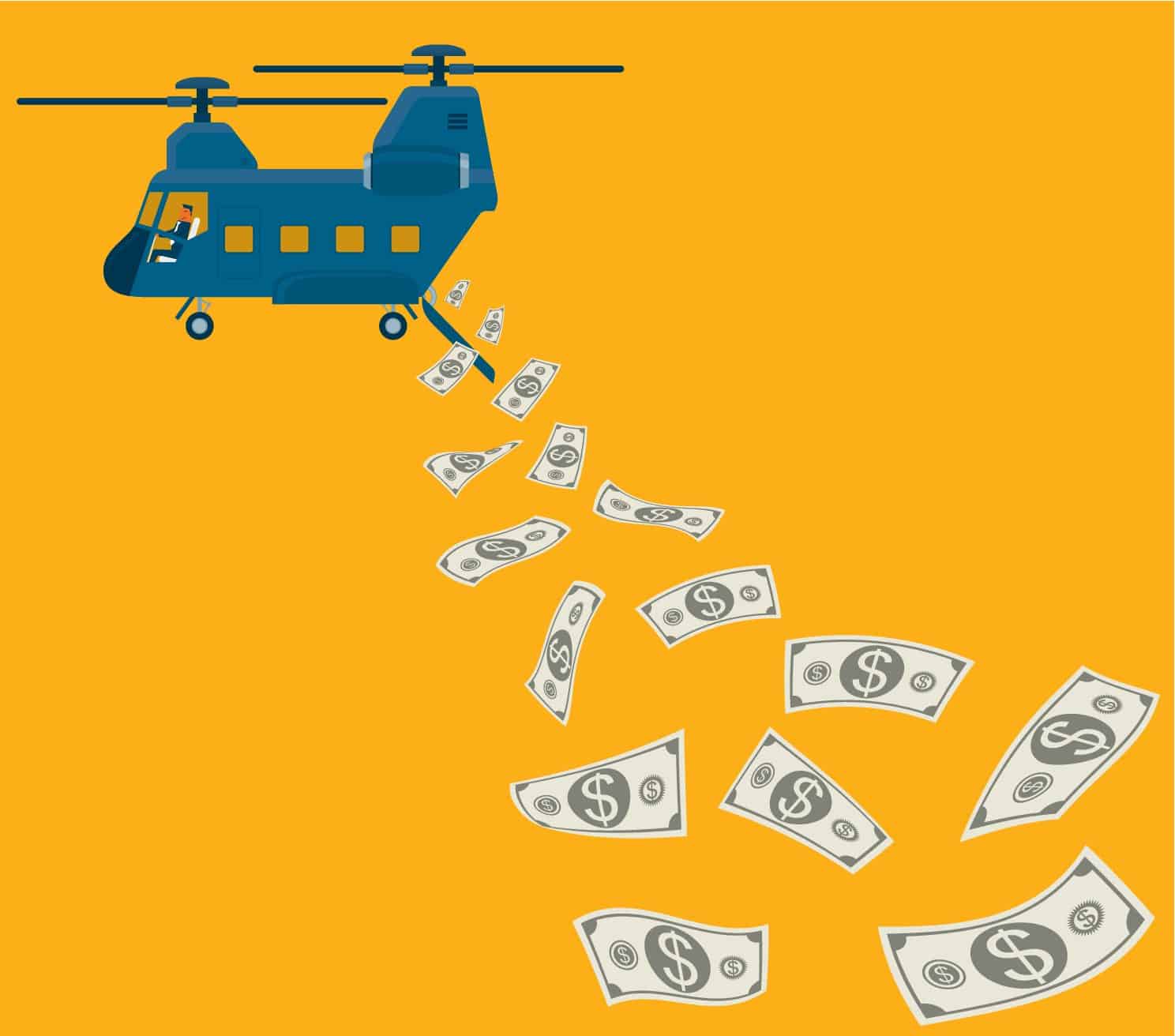

The US Federal Reserve has fired its last round of ammunition, cutting interest rates to zero, in a move that continues to see it play from the monetary policy songbook. Some market commentators doubt whether it will be enough to prop up markets, raising the question of whether it is finally time for a more coordinated fiscal and monetary policy approach.
On Sunday the US Federal Reserve cut interest rates to zero and announced it would buy at least $700 billion in government and mortgage-related bonds. Announcing the move, it said it was “prepared to use its full range of tools to support the flow of credit to households and businesses and thereby promote its maximum employment and price stability goals”, not to mention the smooth functioning of markets.
The general mood around commentators is that monetary policy will no longer be enough to stimulate markets and limit the shock caused by the coronavirus.
Nathan Sheets, chief economist and head of macroeconomic research at PGIM Fixed Income, says while monetary policy is helpful it cannot address the underlying tensions on its own.
“It’s like taking an aspirin when you’re sick, it’s not going to really address the underlying problems we face. For that it’s about a crisis response first to the health crisis and then fiscal policy responses. Monetary policy by itself won’t be sufficient.”
Fiscal policy initiatives seen around the globe last week, including in the UK and Italy, came in the form of packages that roughly amounted to 1 to 1.5 per cent of GDP. For the US this would mean about $200 billion.
The key, according to the Center on Budget and Policy Priorities, is fast and aggressive fiscal policy responses, in a bid to get resources in to the hands of middle and lower income households.
“The main thing is to get the money out there in size and fast. The fundamental economic situation is deteriorating pretty quickly so last week’s number may not be enough this week,” Sheets said. “Secondly, it should be targeted to those most adversely effected such as workers not getting paid or firms that are on the verge of going out of business. Get the money into the hands of the households as quickly as possible.”
But Sheets is sceptical that the US response is going to meet the dual necessities of speed and size.
“I haven’t seen any concrete proposals that give me confidence we are moving in the right direction. On the flipside of that, necessity is the mother of invention, particularly for the US political system. As it becomes more daunting the political players will have incentives to come together.”
In addition to the need for more coordinated monetary and fiscal policy, Sheets said coordinated regulatory and structural tools should be added too.
“I think this is what Abenomics was trying to get at,” he said, pointing out some of the current problems in the US are reminiscent of what Japan has faced.
“The fact monetary policy has less ammo than it used to is raising the bar to coordinate polices more effectively. But there are big challenges with that. Central Banks are very protective of their independence, and that coordination can be difficult while preserving independence. And fiscal policy is dependent on the political process which is unpredictable and slow.”
The other concern, of course, is there is more bad news to come and that the Fed now has limited tools to stimulate growth. With the Fed already using up all its ‘ammo’, what course of action can it take? What impact on the global economy would negative interest rates in the US have?
“Once we get to zero it’s very hard to escape. I’m less worried about being at zero than [I am about] the conditions that might motivate the US to be at zero – that would be the US economy struggling to hit inflation expectations and soft growth. The impact of that would be quite severe.”
Sheets believes that if this round of action doesn’t relieve liquidity stresses then the Fed will take further action to ensure those parts of the market are adequately liquid – markets like asset backed securities, commercial mortgage-backed securities and some of the corporate markets including high yield.
“The Fed has a deep responsibility to have the market functioning,” he said.
The case for a V-shaped return
Joachim Fels, PIMCO’s global economic advisor said while there have been some quick responses from governments and central banks to underpin the markets and the economy, a global recession is likely.
“Fiscal and monetary policy makers around the world will have to pull out all the stops to prevent what currently looks like an inevitable recession from turning into a depression, and financial markets to go from a drawdown to a meltdown,” he said.
The initial response from the market was hard to interpret, according to Sheets, referring to the fall in markets following the Fed’s March 3 cut of 50 basis points.
“I do think market participants will welcome this recent move but I don’t think they ‘re going to go back to normal,” he said. “On the margin it’s supportive. Market conditions will be a little better due to QE and liquidity conditions. I expect the market functioning to be better and asset prices to be somewhat higher – but it’s not a game changer.”
The PGIM view is this is a fundamental shock that has hit the system. This means regardless of where asset prices were, the market would have fallen sharply when the economy and system absorbed the uncertainty.
“The moves are a function of the shock rather than the initial level of asset prices,” Sheets said. “They were priced aggressively, but economic fundamentals supported that.”
The fact that underlying fundamentals were solid, and that there is now a lot of stimulus in the economy through monetary policy, gives Sheets some hope for a V-Shaped recovery.
In addition, he said the coming weeks will see a number of countries implement fiscal policy and pent up demand on purchases could kick in.
“There is a good case for a V shape. But the longer and more severe the virus, the more it reduces the vibrancy on the economy and there will be a longer lived down run,” he said. “The key question will be: when will we feel comfortable returning to our normal lives? Will it be two months, three months, six months? The shorter that is the more comfortable I am.”
Long-term investors
Most large pension funds have been acting responsibly to the shock, reminding their beneficiaries of the long-term nature of their investment horizons.
A CalSTRS statement reflects this: “The spread of COVID-19 has impacted global markets over the short term. CalSTRS is a long-term investor, and we think in terms of decades—not days, weeks or months. The CalSTRS investment portfolio is broadly diversified in order to respond to periods of market volatility and uncertainty. Our members’ retirement benefits continue to be secure.”
PGIM’s Sheets agrees that “broadly speaking investors are well served to look through it, and keep their eyes on where we are likely to be once the virus passes”.
He suggests at some point there will be meaningful buying opportunities.
“This is time to hunker down, not turn and run,” he said.
He also points out there has been a big focus on the shock to the market from coronavirus, but over the last week the global economy has also been hit by the collapse in oil prices, which was a pretty heavy blow to the US high yield.
This could also have a longer lasting effect if it is a nod to the future of energy and the impact of renewables on the energy sector. This again points to the importance of sustainability factors in long-term investors’ investment philosophy.
“Investors could think about who wins and loses as a result of that,” Sheets said. “It is a challenging time to make money now. If we can look through [the crisis] we can ask the question is it laying the foundation for future returns?” Sheets said. “The last time the market got hit, in late 2018, it laid the foundation for a strong 2019. Is that likely to repeat is a key question.”








Leave a Comment
You must be logged in to post a comment.
Login