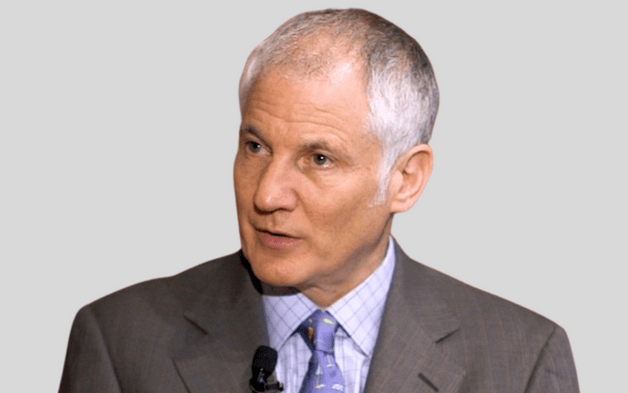

Kotkin talks transition, Ukraine war and western resilience

The 2050 energy transition will not happen in a way people predict, said Stephen Kotkin, Senior Fellow at the Hoover Institution and at the Freeman Spogli Institute, Stanford University, and Birkelund Professor Emeritus at Princeton University.

In a sobering address that spanned war in Ukraine and the resilience of the west against threats from Russia and China, Kotkin said the current energy system will survive into the new system, and oil and gas won’t disappear – wind and solar will not replace fossil fuels at scale.

“We are not going to get there; something is happening, but not what we are imagining,” he told delegates at the Fiduciary Investors Symposium in Maastricht.

Cement and steel production, plastics and fertilizers, all essential for everyday life, cannot be produced with renewables.

“There will be a transition, but it will look different,” he said.

Ways forward need to focus on the production of these types of materials before it is possible to talk seriously about a transition. Alternative solutions could include small-scale nuclear reactors that produce hydrogen than can power steel production.

Sponsored Content

“Innovative countries may be able to do this,” he said.

Kotkin also said that policy makers have failed to put a price on carbon, and subsidising wind and solar does little to spread take up of wind and solar, or reduce carbon.

War in Ukraine

After months of war, Russia is on the losing end of the story, and much weaker than its population imagines.

“Russia is not a power in the first rank and there is a gap between aspirations and capabilities,” he said. Russia is now a personalist regime, and the gap between the west is wider than ever.

Kotkin said that Russia didn’t appreciate the strength of the Ukrainian regime or Ukrainian resistance.

“Russia failed early in Ukraine,” he said adding recent strategy sees Ukraine conducting an offensive on the weakest part of the Russian line. The approach has shown allies in Europe and the US that Ukraine is capable of conducting an offensive assault, and has demoralised the Russians.

But Ukraine has to evict Russia, dug in and currently occupying 16 per cent of Ukrainian territory. Ukrainians have switched to a cold war battle plan, hitting fuel stores and causing disarray behind Russian lines. Now the Russians are disrupting the Ukrainians behind their lines too, striking critical infrastructure.

“How do you fight a war without power supply?” questioned Kotkin. “Russia is degrading Ukraine’s ability to fight.” He warned that Ukraine’s communication network could be next.

“The war is not won, Russia’s tactics have gotten better.”  All the while, Ukraine’s ability to fight will increasingly depend on European taxpayers money.

American power

Reflecting on western resilience, Kotkin listed a series of positives. American financial power is not about to be eclipsed and there is no threat to the US financial system. Mostly because there is no alternative to replace the dollar.

“Unless there is an alternative, it can’t be displaced,” he said, adding that digital currencies have been slow to evolve.

Nor is there a substitute for American military power. Despite follies in Afghanistan and Iraq there is no superior military system to the US. Still, he noted that American superiority involves moving from old platforms to smaller, more mobile systems.

“We’ve seen it in Ukraine,” he said, describing the evolution of US military away from old aircraft carriers that are vulnerable and take forever to build, to new weapons and software-driven military. A key challenge ahead will involve overcoming a procurement system tied to jobs in specific districts across the US.

Kotkin praised European regional integration. Despite problems and disappointments, European integration works as do other regional systems like ASEAN and in North America.

“The US and Canada are really a single economy; Mexico is almost there too,” he said.

Although these groupings are not the same as the EU where a regional court overrides national jurisdictions, he called them “impressive.” Together, these regional blocks make up a globalized world, part of an open, flexible world we all benefit from. War in Ukraine has made people want to hold onto and preserve these freedoms, he said.

Cutting the other way

Despite the many positive forces combining to help the preservation of the western system, equally powerful forces threaten its existence. Democracies find it difficult to assimilate social media and the internet in contrast to authoritarian regimes that harness it to their advantage. It led Kotkin to reflect on how democracies assimilated radio in the 1930s. The crazy technology that could broadcast into homes was highly disruptive at the time and used by dictators like Mussolini and Stalin as a source of empowerment. Overtime it was assimilated and this may also be said of social media.

Kotkin also warned of the implications of a continually squeezed middle class in successful democratic societies.

“The current system works well at the top,” he said. The super wealthy are shielded from the consequences of the decline in public services. The system works (mostly) at the bottom too, where “strivers” can progress, getting on the ladder up.

Still, he noted how some countries, like Sweden, are better as assimilating new immigrant populations than other societies.

Meanwhile, some areas in the US, like Silicon Valley, don’t hold any hope for striving, aspirational new arrivals to rise up the ladder. There is very little infrastructure for people who are not at the top in Silicon Valley.

“Silicon Valley has no Queens,” he said, referring to New York’s ethnically diverse suburb.

Populations that have a squeezed middle can be a force for destabilisation. People can’t get onto a higher level because the gulf between the middle and top is too great, an issue that is exacerbated by social media.

Debt is another challenge for the western world. Compare countries assets and obligations, and many are technically bankrupt. These countries cannot meet all the promises they’ve made in a “fiscal lunacy.”

Countries may be able to grow economically and pay back the debt, but this will be challenged by demographics whilst dealing with debt in an inflationary environment is more challenging.

China

Kotkin said that China is moving in a different direction to what many people imagined. The Chinese regime is not made up of economic reformers. President Xi’s government is populated by sycophants who favour state-owned industry, he said.

China has paid a high price for siding with Russia in the Ukraine war, mostly because it destroyed the wedge China had driven between the US and Europe.

“The EU is now closer to the US,” he said. One of the reasons for China’s mistake was because President Xi has no critics to warn him of potential blunders. But Kotkin said that China has leant lessons from Russia’s war in Ukraine regarding its own ambitions in Taiwan.

Invading Taiwan risks leaving Taiwan economically ruined.

“If you take it, you get nothing; you get a smoking pile of rubble,” said Kotkin. “To take it, you have to destroy it.” Instead, China is pursuing a policy of economic strangulation and diplomatic coercion a strategy that comprises threats, intimidation and blocking communication.

Kotkin stressed the importance of investing again in the west’s resilience and power; financial systems, military alliances and societies and better management of challenging issues around social media and debt. “Victory for Ukraine is joining the West. It is Ukraine’s war but they are fighting for values we all care about.”

Leave a Comment

La Caisse’s oil exit pays off as renewables portfolio pulls ahead of fossil fuels

La Caisse’s oil exit pays off as renewables portfolio pulls ahead of fossil fuels

Divesting from the oil sector has been a boon for La Caisse’s performance, as the Canadian pension giant says its energy investments have earned billions in value-add compared to the benchmark since the inception of its climate strategy. Head of sustainability Bertrand Millot unpacks the fund’s approach in an interview with Top1000funds.com.

Sort content by

Learning to see with a risk 2.0 lens

What happens if we examine past financial crises through a risk framework that acknowledges the adaptive, interconnected nature of real markets? Researcher at Thinking Ahead Institute Andrea Caloisi explores the application of a 'risk 2.0' framework to historical events. 

The future is a riskier place than the present

In this regular column for Top1000funds.com, Tim Hodgson of the Thinking Ahead Institute argues that the future is riskier not only because it is uncertain, but because the quantum of risk increases with time. He unpacks what this means for investors' risk analysis and the term 'risk premium'. 

AP4: Why a dynamic, shorter term allocation is paying off

Volatile markets have provided a rich hunting ground and opportunistic best ideas have come thick and fast for AP4’s new five-pronged global allocation made up of systematic equity, currency and rates, asset allocation, hedge funds/external mandates and analysis. Magdalena Högberg explains the risks and opportunities of the best ideas allocation.

Japan University Fund expands active allocation guided by risk factors

The $77 billion Japan University Fund is stepping up active strategies and introducing country-specific passive allocations as the young endowment, established only in 2022, builds out the policy portfolio. Co-CIO and the head of global investment department Naoya Sugimoto speaks about JUF's vision and manager expectations.

More funds consider TPA despite challenges

In January 2020, Roger Urwin laid down a call to action for asset owners and corporations to use the decade to drive greater wellbeing and wealth in the lives of their stakeholders. Now halfway through the decade, he reviews the state of play in this complicated picture.

Investors brace for volatility as tariffs spark global reckoning

The investors which will do well in times of market volatility will have the ability to do extensive, forward-looking scenario analysis, move assets tactically and dynamically and have liquidity. Top1000funds.com looks at investor reactions to tariff-induced market volatility.




