
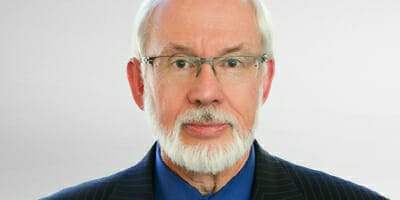

Robert Eccles has been trying to change the nature of corporate reporting for more than 20 years. He has been an advocate for supplementing financials with information on non-financial factors that are leading indicators of financial results – such as product development, customer satisfaction and the development of intangible assets.
The premise is those companies that do so, perform better.
Eccles is the Professor of Management Practice at Harvard Business School, the founding chairman of the Sustainability Accounting Standards Board and is a member of the steering committee of the International Integrated Reporting Council.
Now, he is also chairman of Arabesque Partners, the first funds management firm to combine a unique quantitative approach and the values of the United Nations Global Compact, the PRI and the Accounting and Auditing Organisation for Islamic Financial Institutions, together with balance sheet and business activity screening.
“I’d never seen an ESG quant fund before. These guys are really cool,” he says. “As a professor I’ve been saying all that – and now I can practice what I preach.”
Eccles was taken by Arabesque, and its chief executive Omar Selim, and thought the combination of a “hard core quants” with ESG guys was a nice sound bite.
“The connotations of ESG is they’re nice people, they have good values, they care about others. The quant implies they’re really smart. Arabesque – it’s nice and smart. It’s an incredibly sophisticated quant model where financial and non-financial information is given proper weights.”
Corporate reporting that includes non-financial information is a no-brainer for Eccles, who alongside Harvard colleague George Serafeim has been leading the charge on corporate sustainability and the value implications on performance.
The pair have studied the relationship between investors and companies that engage in sustainable, or integrated reporting, and in a recent paper Serafeim says that firms that report more information about the different forms of capital or follow more closely the guiding principles as described in the Integrated Reporting Framework exhibit a more long-term oriented investor base.
Eccles says that if investors take one thing from the integrated reporting movement it’s about materiality, a subject he goes into detail in his new book: The Integrated Reporting Movement: Meaning, Momentum, Motives and Materiality.
“A fact is either material and so it should be reported, or it is not material, in which case it does not need to be reported,” he says. “It is management’s and the board’s responsibility to ascertain what information it’s reasonable investors would want to know. In the end materiality is determined by the company itself and is entity specific.
“When the board of a company is very clear in its communication of what is material and what is not, and which audiences it feels are significant, investors gain relevant guidance on how the board judges importance and its ability to exercise this judgement. Investors are looking for this guidance.”
In this context he says, if all a company thinks about is the short term, then ESG is not important.
The international integrated reporting framework, on the other hand, seeks to improve the quality of information available to providers of financial capital to enable a more efficient and productive allocation of that capital.
Its focus on value creation, and the ‘capitals’ used by the business to create value over time, contributes towards a more financially stable global economy.
Christian Strenger, Professor and Academic Director at the Center for Corporate Governance, at the HHL Leipzig Graduate School of Management, who is a board member of the International Integrated Reporting Council, says while the annual report remains the most important information source for investors, the reports in their present form do not provide a sufficiently true and fair picture of the company.
He says this is due to the intensive weight that factors like ESG, brand values, customer and employee loyalty, market position (concept of capitals) that increasingly impact the long-term viability of the business models: for example, ‘intangible assets’ account for more than 80 per cent of the S&P500s market value.
“Integrated reporting is a chance for companies to tell their story – it’s the interface between a company and the market. Companies can explain how they are creating value and investors can have access to what the companies think is important. Let’s take a step back and forget labels, whether it is Impact Investing, SRI, or ESG and agree on the material issues,” Eccles says.
“The investment world is now recognising that superior returns can be earned by investing in companies that are performing well on material sustainability factors,” Eccles says.
“This is at the core of Arabesque’s investment strategy. Here is an asset manager that combines advanced ESG analysis with a quantitative investment approach to drive better performance. The results are highly impressive.
“We need companies to do integrated reporting, and investors need to screen and reward companies for good performance, which is what Arabeseque does,” he says.
“I’m 64, I’ve been opining on this for a long time, this opportunity came along and it’s a great opportunity to put this into practice.”
Established in 2013 after a management buy-out from Barclays, Arabesque fuses traditional investment techniques with an analysis of environmental, social and governance issues.
Chief executive, Omar Selim, says Eccles’ arrival underlines the firm’s focus on research and sustainability as key drivers to generate value for investors, shareholders and the capital markets more broadly.
“ESG information as a critical factor in the investment process is fast becoming a mega-trend across financial markets. With Bob´s background as a mathematician, an expert on sustainability and reporting and an academic from Harvard and MIT, he unites the three key building blocks of Arabesque’s partnership.”
For more reading:
Integrated reporting and investor clientele
The impact of corporate sustainability on organisational processes and performance
Corporate and integrated reporting – a functional perspective








Leave a Comment
You must be logged in to post a comment.
Login