
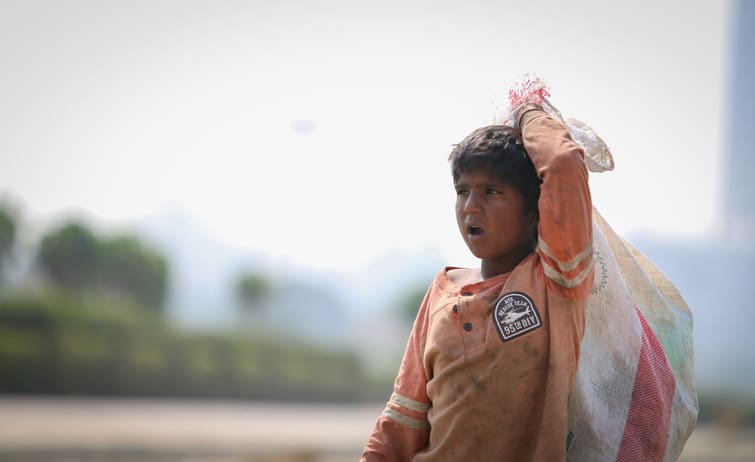

When Ghanaian James Kofi Annan was six years old, he was sold into slavery. He toiled as a fishing slave on Lake Volta for the next seven years of his life. Rising at 3am to work a 17-hour day of unimaginable hardship. Age 13 he managed to escape and returned to his home and in the ensuing years he put himself through education. Speaking at the PRI in Person in Paris in a panel to highlight the role of finance in addressing social issues, he told his story.
“I was born in a small village and was the last of 12 children. In our village every family is affected by trafficking because of the poverty. Families give their children to the fishermen,” he said.
Remarkably, Kofi Annan went on to university and got a job at Barclays Bank. But he was always driven to help other children, unable to forget “where he came from.” In 2003 he founded Challenging Heights, a charity for victims of trafficking. Its focus is on working to prevent trafficking by tackling poverty, naivety and family separation, which he highlights as main causes. The charity is also involved in advocacy, and lobbies to influence national policy.
“We help rescue children from slavery and give them opportunities to be human beings again. We offer programmes of rehabilitation and access income.”
Over 40 million people in the world are involved in some form of modern slavery. That amounts to one in 185 people and of those, 71 per cent are women. Modern slavery is also big business, generating revenues of US$150 billion annually.
“No matter how many times I state these statistics, it still shocks me. It is a growing, global human tragedy,” said Fiona Reynolds, CEO of the PRI, and Chair of The Liechtenstein Initiative for a Financial Sector Commission on Modern Slavery and Human Trafficking. The organization partners with the governments of Liechtenstein, Australia and the Netherlands, and a consortium of banks, philanthropic foundations, and associations. Partners also include trafficking survivors.
“In the financial sector people look at data and don’t always realise there is a human being at other end,” said Reynolds. “When we are trying to find solutions, we can’t say to these people it’s too hard. Once you’ve worked with people and heard their story, it makes a difference to the actions you take.”
The Commission is particularly focused on the role of the financial sector in facilitating trafficking. The banking sector plays a role in helping launder trafficker’s money and institutional investors have a role ensuring the businesses they invest in don’t exploit slave workforces through their supply chains. And better access to insurance and credit can stop vulnerable people being “picked off,” said Reynolds. Digital innovation can help broaden financial inclusion to those who are vulnerable to modern slavery and human trafficking.
“Every time we rescue a child, I feel like I have rescued myself,” said Kofi Annan.







Leave a Comment
You must be logged in to post a comment.
Login