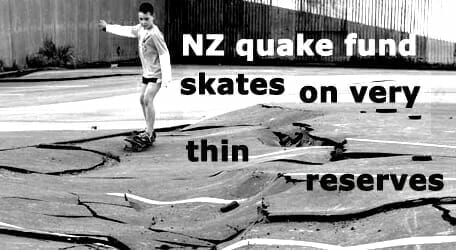

NZ quake fund skates on very thin reserves

New Zealand’s earthquake disaster relief fund could be completely drained following the fatal 6.3 quake that flattened large swathes of central Christchurch on February 22.

The Earthquake Commission (EQC) was already releasing about NZ$1.5 billion ($1.1 billion) of the $4.4 billion disaster fund to pay for claims generated by the 7.1 quake that caused widespread destruction in Christchurch last September.

The latest New Zealand government accounts to the end of January this year show the EQC had budgeted for insurance claims amounting to just over $1.78 billion from the September event.

While the fund itself must meet the first $1.1 billion in claims it had reinsurance in place up to a further $1.85 billion.

The EQC covers residential homeowners up to a value of $74,000 per claim. Owners who had been paid out after the September quake would be able to claim again if their homes sustained fresh damage following the latest catastrophe.

According to latest government estimates, about 10,000 Christchurch homes would have to be demolished while a further 100,000 required some level of repair as a result of the February earthquake.

Sponsored Content

If the latest round of claims exceeded $2.95 billion ($1.1 billion from the fund plus $1.85 billion from reinsurers), the EQC would have to dip into its remaining capital, which would amount to about $2.22 billion of New Zealand fixed-interest investments.

Last year Phil Jacques, EQC chief financial officer, told Top1000Funds’ sister publication, I&T News, the fund would first sell-down its $1.26 billion global equities portfolio to meet claims.

While EQC would not comment, it is understood the global equities sell-down had almost been completed. AXA’s annual accounts to the end of December last year, for example, reveal the EQC redeemed its $237.3 million global equities mandate with AllianceBernstein to cover costs incurred by the September earthquake.

The EQC also had global equity mandates with State Street Global Advisors, Tweedy Browne, T. Rowe Price and Capital International.

The remaining 70 per cent of the EQC portfolio was chiefly invested in a range of New Zealand government securities, including about 20 per cent in inflation-linked bonds.

Russell acts as investment adviser to the EQC fund.

EQC collects about $66.6 million in levies each year but New Zealand Prime Minister, John Key, said that figure could triple next year to replenish the disaster fund.

One response to “NZ quake fund skates on very thin reserves”

  1. Investor need to understand the risk of investing in infrastructure fund.

Leave a Comment

Sort content by

UK’s NAPF conference focuses on three issues

The agenda at the United Kingdom’s National Association of Pension Funds (NAPF) annual shindig in Liverpool’s Echo Arena on the banks of the Mersey couldn’t have been broader. From early analysis of auto-enrolment, the biggest shake-up of the industry in a generation and just days old, to life expectancy, Britain’s role in the European Union,

Brussels ‘cooking up real estate shock’

The European Union is threatening to drive pension funds out of real estate investments, experts warn. That could be one of the undesirable results of plans to put pension funds under new risk regulations akin to the Solvency II requirements for the continent’s insurers. What most concerns John Forbes, a PriceWaterhouseCoopers real estate expert, is

Size and scalability up, fees down

The world’s largest asset managers should be using the advantages of their size and scalability to adjust their fee structures, according to Craig Baker, the global head of manager research at Towers Watson, which just released this year’s Pensions & Investments/Towers Watson World 500. “The advantage of large managers is [that] they could structure their

300 Club roots for stewardship over salesmanship

The 300 Club is a rare group that combines long-term thinking and asset management provision. Taking on an industry that is evolving from client-driven to product-driven, the 300 Club is proposing a fundamental mindset shift from short-term salesmanship to long-term stewardship. In this paper, chief investment officer of Kempen Capital Management in the Netherlands, Lars

Aligning asset owners and managers

Delegation is a fundamental obstacle to the alignment of asset-owner and asset-manager goals. However, Sebastien Pouget, professor of finance at the University of Toulouse, believes a combination of customised performance benchmarks and a dual short and long-term fee incentive can help overcome the problems of the principal/agent relationship. Pouget, who spoke at the recent United

Danish pension is gold

Denmark has blitzed the pension-system competition, being awarded the first Mercer Global Pension Index A grading. In the process, it has relegated the Dutch and Australian systems to second and third places, respectively, after four years. Mercer senior partner and report author, David Knox, says the reasons for awarding Denmark the top grade were clear.

Previous




