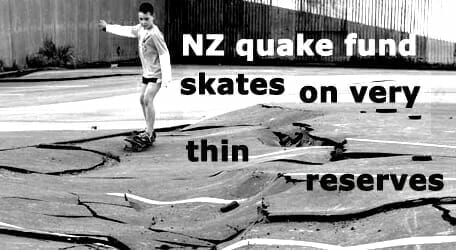

NZ quake fund skates on very thin reserves

New Zealand’s earthquake disaster relief fund could be completely drained following the fatal 6.3 quake that flattened large swathes of central Christchurch on February 22.

The Earthquake Commission (EQC) was already releasing about NZ$1.5 billion ($1.1 billion) of the $4.4 billion disaster fund to pay for claims generated by the 7.1 quake that caused widespread destruction in Christchurch last September.

The latest New Zealand government accounts to the end of January this year show the EQC had budgeted for insurance claims amounting to just over $1.78 billion from the September event.

While the fund itself must meet the first $1.1 billion in claims it had reinsurance in place up to a further $1.85 billion.

The EQC covers residential homeowners up to a value of $74,000 per claim. Owners who had been paid out after the September quake would be able to claim again if their homes sustained fresh damage following the latest catastrophe.

According to latest government estimates, about 10,000 Christchurch homes would have to be demolished while a further 100,000 required some level of repair as a result of the February earthquake.

Sponsored Content

If the latest round of claims exceeded $2.95 billion ($1.1 billion from the fund plus $1.85 billion from reinsurers), the EQC would have to dip into its remaining capital, which would amount to about $2.22 billion of New Zealand fixed-interest investments.

Last year Phil Jacques, EQC chief financial officer, told Top1000Funds’ sister publication, I&T News, the fund would first sell-down its $1.26 billion global equities portfolio to meet claims.

While EQC would not comment, it is understood the global equities sell-down had almost been completed. AXA’s annual accounts to the end of December last year, for example, reveal the EQC redeemed its $237.3 million global equities mandate with AllianceBernstein to cover costs incurred by the September earthquake.

The EQC also had global equity mandates with State Street Global Advisors, Tweedy Browne, T. Rowe Price and Capital International.

The remaining 70 per cent of the EQC portfolio was chiefly invested in a range of New Zealand government securities, including about 20 per cent in inflation-linked bonds.

Russell acts as investment adviser to the EQC fund.

EQC collects about $66.6 million in levies each year but New Zealand Prime Minister, John Key, said that figure could triple next year to replenish the disaster fund.

One response to “NZ quake fund skates on very thin reserves”

  1. Investor need to understand the risk of investing in infrastructure fund.

Leave a Comment

Sort content by

Maverick Series video: Gonski part I

In the first of a new series of video interviews featuring thought leaders in global institutional investment, chair of the $80 billion Australian Future Fund, David Gonski, outlines his views on governance. mrec4inarticleinline Sponsored Content scnative1 scnative2 scnative3

ATP reunites alpha and beta after 6 years

Alpha and beta rely to a large extent on exposures to systematic risk factors, so goes the “2013 thinking” of ATP in reversing the decision to separate alpha and beta in its investment portfolio six years ago. ATP has separate hedging and investment portfolios, with the hedging portfolio significantly larger at around DKK 670 billion

State Street’s Probyn into 2013

The current equity rally is not predicated on a shift in economic performance, according to chief economist at State Street, Chris Probyn, who says it would be reasonable to say the market may “pause for thought”. Probyn says the move from fixed income to equities has been fostered by some of the “economic areas for

CalPERS’ sustainability initiative drives investment beliefs

Launched this week, CalPERS’ Sustainable Investment Research Initiative (SIRI) will drive the development the $250-billion fund’s first set of investment beliefs. While difficult to believe a fund of its size, reach and history could invest without a set of investment beliefs, it is encouraging to see that sustainability will be a core part of that

Finnish pension reform a lesson for all

The findings from the first review of the Finnish pension system, commissioned by the Finnish Centre for Pensions, were handed down by Nicholas Barr from the London School of Economics and Keith Ambachtsheer from the Rotman International Centre for Pension Management last month. Although Helsinki in January is far from a party Ambachtsheer and Barr

European investors stay on the offensive

2012 was a year of battles for European pension funds. An ongoing war was waged against a severe regulatory challenge from the European Commission in the shape of Solvency II-style legislation. Aside from the uncertain struggle of that campaign, major European investors gained plenty of credit from standing up to corporate boards in the “shareholder

Previous




