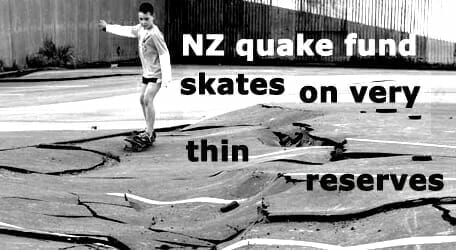

NZ quake fund skates on very thin reserves

New Zealand’s earthquake disaster relief fund could be completely drained following the fatal 6.3 quake that flattened large swathes of central Christchurch on February 22.

The Earthquake Commission (EQC) was already releasing about NZ$1.5 billion ($1.1 billion) of the $4.4 billion disaster fund to pay for claims generated by the 7.1 quake that caused widespread destruction in Christchurch last September.

The latest New Zealand government accounts to the end of January this year show the EQC had budgeted for insurance claims amounting to just over $1.78 billion from the September event.

While the fund itself must meet the first $1.1 billion in claims it had reinsurance in place up to a further $1.85 billion.

The EQC covers residential homeowners up to a value of $74,000 per claim. Owners who had been paid out after the September quake would be able to claim again if their homes sustained fresh damage following the latest catastrophe.

According to latest government estimates, about 10,000 Christchurch homes would have to be demolished while a further 100,000 required some level of repair as a result of the February earthquake.

Sponsored Content

If the latest round of claims exceeded $2.95 billion ($1.1 billion from the fund plus $1.85 billion from reinsurers), the EQC would have to dip into its remaining capital, which would amount to about $2.22 billion of New Zealand fixed-interest investments.

Last year Phil Jacques, EQC chief financial officer, told Top1000Funds’ sister publication, I&T News, the fund would first sell-down its $1.26 billion global equities portfolio to meet claims.

While EQC would not comment, it is understood the global equities sell-down had almost been completed. AXA’s annual accounts to the end of December last year, for example, reveal the EQC redeemed its $237.3 million global equities mandate with AllianceBernstein to cover costs incurred by the September earthquake.

The EQC also had global equity mandates with State Street Global Advisors, Tweedy Browne, T. Rowe Price and Capital International.

The remaining 70 per cent of the EQC portfolio was chiefly invested in a range of New Zealand government securities, including about 20 per cent in inflation-linked bonds.

Russell acts as investment adviser to the EQC fund.

EQC collects about $66.6 million in levies each year but New Zealand Prime Minister, John Key, said that figure could triple next year to replenish the disaster fund.

One response to “NZ quake fund skates on very thin reserves”

  1. Investor need to understand the risk of investing in infrastructure fund.

Leave a Comment

Sort content by

Ugo Bassi focuses on transparency at ICGN

For many people their most memorable in situ news moment is when man landed on the moon or when John Lennon, Princess Diana or Michael Jackson died. But most Italians will remember where they were when Pope Benedict XVI resigned. A country with record unemployment, no head of state and no head of the church

Montagnon defines investor engagement

There is scope for European legislation directing asset owners who issue mandates to service providers in Europe to say that they have “thought through” what they want their asset managers to engage with companies on, ICGN conference delegates heard. Peter Montagnon, senior investment adviser of corporate governance at the UK Financial Reporting Council, says there

Code of conduct for proxy voting industry

The European Securities and Markets Authority (ESMA) has developed a set of high level principles with the aim of encouraging the proxy voting industry to develop its own code of conduct. Speaking at the ICGN conference in Milan, the head of the investment and reporting division at ESMA, Laurent Degabriel, said it will set a

Breakfast with AQR’s Cliff Asness

Having a breakfast meeting with Cliff Asness is a wake-up call. He will let you know if you’re late – something he holds in very little regard. He admits he has to constantly remind himself that just because he’s 20 minutes early to everything that others are not automatically then 20 minutes late. Asness is

Tackling sustainability in emerging markets

Emerging market investing and sustainable investing easily rank as two of the most substantiated of the many investment trends of the past decade. However, the two styles of investing are far from natural bedfellows. Christian Ragnartz, as chief investment officer of the $17-billion-plus Swedish pension fund AP7 – which has 13 per cent of its

Ownership: a forgotten art?

While the responsible investment field has come a long way, the majority of investors are still treating it as an overlay, rather than truly integrating it into investment decision-making. This is not an ideal situation for the investment industry, not to mention society at large, but it presents an opportunity for those that do integrate

Previous




