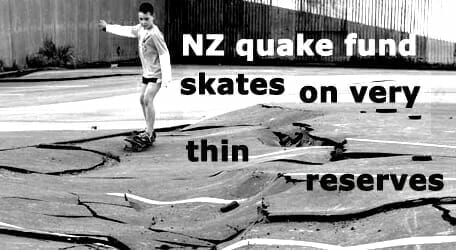

NZ quake fund skates on very thin reserves

New Zealand’s earthquake disaster relief fund could be completely drained following the fatal 6.3 quake that flattened large swathes of central Christchurch on February 22.

The Earthquake Commission (EQC) was already releasing about NZ$1.5 billion ($1.1 billion) of the $4.4 billion disaster fund to pay for claims generated by the 7.1 quake that caused widespread destruction in Christchurch last September.

The latest New Zealand government accounts to the end of January this year show the EQC had budgeted for insurance claims amounting to just over $1.78 billion from the September event.

While the fund itself must meet the first $1.1 billion in claims it had reinsurance in place up to a further $1.85 billion.

The EQC covers residential homeowners up to a value of $74,000 per claim. Owners who had been paid out after the September quake would be able to claim again if their homes sustained fresh damage following the latest catastrophe.

According to latest government estimates, about 10,000 Christchurch homes would have to be demolished while a further 100,000 required some level of repair as a result of the February earthquake.

Sponsored Content

If the latest round of claims exceeded $2.95 billion ($1.1 billion from the fund plus $1.85 billion from reinsurers), the EQC would have to dip into its remaining capital, which would amount to about $2.22 billion of New Zealand fixed-interest investments.

Last year Phil Jacques, EQC chief financial officer, told Top1000Funds’ sister publication, I&T News, the fund would first sell-down its $1.26 billion global equities portfolio to meet claims.

While EQC would not comment, it is understood the global equities sell-down had almost been completed. AXA’s annual accounts to the end of December last year, for example, reveal the EQC redeemed its $237.3 million global equities mandate with AllianceBernstein to cover costs incurred by the September earthquake.

The EQC also had global equity mandates with State Street Global Advisors, Tweedy Browne, T. Rowe Price and Capital International.

The remaining 70 per cent of the EQC portfolio was chiefly invested in a range of New Zealand government securities, including about 20 per cent in inflation-linked bonds.

Russell acts as investment adviser to the EQC fund.

EQC collects about $66.6 million in levies each year but New Zealand Prime Minister, John Key, said that figure could triple next year to replenish the disaster fund.

One response to “NZ quake fund skates on very thin reserves”

  1. Investor need to understand the risk of investing in infrastructure fund.

Leave a Comment

Sort content by

Blinder: a power of paradox at Princeton

Pension funds or any investor holding a slug of long-term fixed income needs to factor in some capital losses soon, says Princeton academic and former vice president of the Federal Reserve, Alan Blinder. “The timing is difficult to predict, but three or 15 months, it doesn’t matter. It is predictable,” he says. “The unpredictable part

UniSuper defies accepted thinking

Mention any asset class to John Pearce, chief investment officer of Australian superannuation fund UniSuper, and he will doggedly set out the good and bad thinking around it. A common source of his ire is the sight of investors herding around a belief based on a lack of rigorous thinking. Good practice for him involves

OTPP deals with underfunding

Even the most successful and well run pension plans are facing underfunding challenges. The $129-billion Ontario Teachers’ Pension Plan is the latest to investigate solutions to solve the mismatch between the pension promise and the funds required to meet that, says Jim Leech, chief executive of the organisation . OTPP has appointed a taskforce – chaired

Fewer, bigger funds for UK?

Australia, the US, Canada and Denmark have all done it. Kazakhstan and even Oman are talking about it. Increasingly, public sector pension funds are merging or pooling their assets into fewer bigger schemes. It’s no surprise the debate is gathering momentum in the United Kingdom, ripe for consolidation with a Local Government Pension Fund Scheme

Scenario analysis: applicable to anything?

Attempts to apply a formula to asset allocation based on an asset’s historical volatility and relationship with other assets tend to fail when presented with black-swan events. Equities tend to rise along with commodities except when presented with political events such as the price hikes in oil in 1973 that sent equities into free fall.

Kurtzer on Holy Land of opportunity

The Middle East is in a state of dynamic flux, with positive change manifesting itself in the countries going through an economic and financial revolution as much as a political one. Institutional investors from all parts of the world have a role to play in that revolution, according to former US ambassador to Egypt and

Previous




