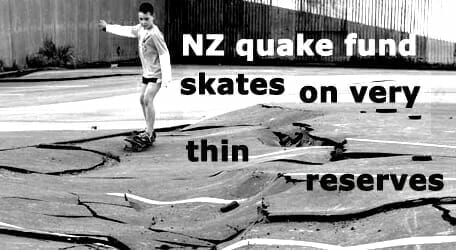

NZ quake fund skates on very thin reserves

New Zealand’s earthquake disaster relief fund could be completely drained following the fatal 6.3 quake that flattened large swathes of central Christchurch on February 22.

The Earthquake Commission (EQC) was already releasing about NZ$1.5 billion ($1.1 billion) of the $4.4 billion disaster fund to pay for claims generated by the 7.1 quake that caused widespread destruction in Christchurch last September.

The latest New Zealand government accounts to the end of January this year show the EQC had budgeted for insurance claims amounting to just over $1.78 billion from the September event.

While the fund itself must meet the first $1.1 billion in claims it had reinsurance in place up to a further $1.85 billion.

The EQC covers residential homeowners up to a value of $74,000 per claim. Owners who had been paid out after the September quake would be able to claim again if their homes sustained fresh damage following the latest catastrophe.

According to latest government estimates, about 10,000 Christchurch homes would have to be demolished while a further 100,000 required some level of repair as a result of the February earthquake.

Sponsored Content

If the latest round of claims exceeded $2.95 billion ($1.1 billion from the fund plus $1.85 billion from reinsurers), the EQC would have to dip into its remaining capital, which would amount to about $2.22 billion of New Zealand fixed-interest investments.

Last year Phil Jacques, EQC chief financial officer, told Top1000Funds’ sister publication, I&T News, the fund would first sell-down its $1.26 billion global equities portfolio to meet claims.

While EQC would not comment, it is understood the global equities sell-down had almost been completed. AXA’s annual accounts to the end of December last year, for example, reveal the EQC redeemed its $237.3 million global equities mandate with AllianceBernstein to cover costs incurred by the September earthquake.

The EQC also had global equity mandates with State Street Global Advisors, Tweedy Browne, T. Rowe Price and Capital International.

The remaining 70 per cent of the EQC portfolio was chiefly invested in a range of New Zealand government securities, including about 20 per cent in inflation-linked bonds.

Russell acts as investment adviser to the EQC fund.

EQC collects about $66.6 million in levies each year but New Zealand Prime Minister, John Key, said that figure could triple next year to replenish the disaster fund.

One response to “NZ quake fund skates on very thin reserves”

  1. Investor need to understand the risk of investing in infrastructure fund.

Leave a Comment

Sort content by

CFA to lead industry out of crisis

Protecting the pension system is one of six key themes at the centre of the CFA Institute’s Future of Finance initiative as it aims to empower the investment industry to take leadership in restoring trust. Speaking at the sixty-sixth annual CFA Institute conference in Singapore this week, president and chief executive of the CFA Institute,

Tail risk parity, V 1.0

Just when you thought you were safe, the next reiteration of risk parity has arrived. AllianceBernstein’s tail risk parity takes the concept of risk parity, reallocating assets uniformly according to risk, but it uses tail risk, not volatility, as the core measure. The concept of risk parity is a portfolio diversified according to risk, rather

Retirement: a cause worth working on

There are two things that drive the newly appointed global chief operating officer of State Street Global Advisors, Greg Ehret, in his bid to improve the client experience: the retirement business is a cause worth working on and the clients are the reason the business exists. Ehret was appointed to the new position at SSgA,

Pension funds, where banks no longer go?

There continues to be potential for pension capital appearing where bank lending no longer wants to go. Commentators in the UK and continental Europe have heightened expectations that pension funds will step in to help fill the continent’s bank financing gap. Societe Generale, for instance, recently predicted further “disintermediation” by investors sidestepping banks and looking

Building consensus for investment beliefs at CalPERS

An investment-beliefs workshop for the CalPERS board, held in April, revealed five areas, including active management, where the views of the board and staff lacked consensus. The contentious, or unsettled, topics for discussion were active management, private asset classes, sustainability (environmental, social and governance), investment performance targets and stakeholder considerations. At the board workshop, Janine

Behind PGGM’s ESG index

In 2010 PGGM conducted a study to see if it was possible to reduce the number of companies it invested in from 4000 to 400, based on its environmental, social and governance leanings, and still maintain it’s beta risk/return profile. The idea was that the €133-billion ($174-billion) fund would better know and understand what it

Previous




