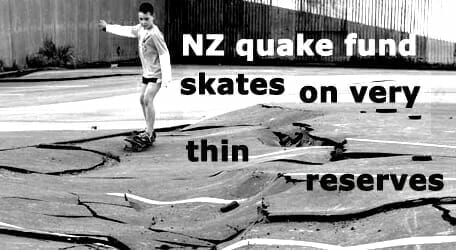

NZ quake fund skates on very thin reserves

New Zealand’s earthquake disaster relief fund could be completely drained following the fatal 6.3 quake that flattened large swathes of central Christchurch on February 22.

The Earthquake Commission (EQC) was already releasing about NZ$1.5 billion ($1.1 billion) of the $4.4 billion disaster fund to pay for claims generated by the 7.1 quake that caused widespread destruction in Christchurch last September.

The latest New Zealand government accounts to the end of January this year show the EQC had budgeted for insurance claims amounting to just over $1.78 billion from the September event.

While the fund itself must meet the first $1.1 billion in claims it had reinsurance in place up to a further $1.85 billion.

The EQC covers residential homeowners up to a value of $74,000 per claim. Owners who had been paid out after the September quake would be able to claim again if their homes sustained fresh damage following the latest catastrophe.

According to latest government estimates, about 10,000 Christchurch homes would have to be demolished while a further 100,000 required some level of repair as a result of the February earthquake.

Sponsored Content

If the latest round of claims exceeded $2.95 billion ($1.1 billion from the fund plus $1.85 billion from reinsurers), the EQC would have to dip into its remaining capital, which would amount to about $2.22 billion of New Zealand fixed-interest investments.

Last year Phil Jacques, EQC chief financial officer, told Top1000Funds’ sister publication, I&T News, the fund would first sell-down its $1.26 billion global equities portfolio to meet claims.

While EQC would not comment, it is understood the global equities sell-down had almost been completed. AXA’s annual accounts to the end of December last year, for example, reveal the EQC redeemed its $237.3 million global equities mandate with AllianceBernstein to cover costs incurred by the September earthquake.

The EQC also had global equity mandates with State Street Global Advisors, Tweedy Browne, T. Rowe Price and Capital International.

The remaining 70 per cent of the EQC portfolio was chiefly invested in a range of New Zealand government securities, including about 20 per cent in inflation-linked bonds.

Russell acts as investment adviser to the EQC fund.

EQC collects about $66.6 million in levies each year but New Zealand Prime Minister, John Key, said that figure could triple next year to replenish the disaster fund.

One response to “NZ quake fund skates on very thin reserves”

  1. Investor need to understand the risk of investing in infrastructure fund.

Leave a Comment

Sort content by

Integrating ESG at Norway’s giant SWF

Behind the Strategy Council’s report to the Norwegian Ministry of Finance on responsible investment for the Norwegian Government Pension Fund Global.

Defining fiduciary duty

What constitutes fiduciary duty is an ongoing discussion in the pension sector. The UK Law Commission has weighed in on the debate with its own interpretation.     Pension funds mulling the definition and obligations of their fiduciary duty can now refer to a consultation paper from the Law Commission, Fiduciary Duties of Investment Intermediaries.

Investors call for conflict of interest code

As an outsourced provider, fund managers make a series of promises to investors. Anything that tempts the promise to be broken is a conflict of interest, according to chief executive of Carne Group, John Donohoe, whose organisation has conducted a survey of institutional investors’ attitudes to conflicts of interest. In a survey of global allocators

Stock exchanges ‘need nudge on sustainability disclosure’

 A study ranking the world’s stock exchanges against disclosure on sustainability themes ranks the BME Spanish Exchange at the top. But the study’s author managing director of CK Capital, Doug Morrow, says stock exchanges need a nudge by regulators to enforce tougher disclosure standards.   The world’s stock exchanges “need a bit of a nudge”

Dry up: how investors assess water risks

The world is running short of water, but what does that mean for investors? Asset owners in the Netherlands and Norway assess and manage the water-related risks in their portfolios, including the measurement of portfolio companies’ water dependence and water security. The drought hitting South Africa’s North West Province sounds another warning shot around the

Serving itself: why the financial services industry needs reform

What would the financial services industry look like if it was structured to service the non-financial services sector, rather than itself? Economist John Kay, author of the Kay Review into short termism in UK equity markets, aims to find out.   In an ideal world there would be one, maybe two, intermediaries between the saver

Previous




