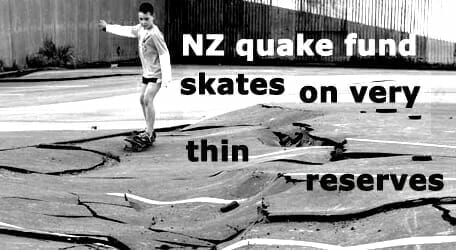

NZ quake fund skates on very thin reserves

New Zealand’s earthquake disaster relief fund could be completely drained following the fatal 6.3 quake that flattened large swathes of central Christchurch on February 22.

The Earthquake Commission (EQC) was already releasing about NZ$1.5 billion ($1.1 billion) of the $4.4 billion disaster fund to pay for claims generated by the 7.1 quake that caused widespread destruction in Christchurch last September.

The latest New Zealand government accounts to the end of January this year show the EQC had budgeted for insurance claims amounting to just over $1.78 billion from the September event.

While the fund itself must meet the first $1.1 billion in claims it had reinsurance in place up to a further $1.85 billion.

The EQC covers residential homeowners up to a value of $74,000 per claim. Owners who had been paid out after the September quake would be able to claim again if their homes sustained fresh damage following the latest catastrophe.

According to latest government estimates, about 10,000 Christchurch homes would have to be demolished while a further 100,000 required some level of repair as a result of the February earthquake.

Sponsored Content

If the latest round of claims exceeded $2.95 billion ($1.1 billion from the fund plus $1.85 billion from reinsurers), the EQC would have to dip into its remaining capital, which would amount to about $2.22 billion of New Zealand fixed-interest investments.

Last year Phil Jacques, EQC chief financial officer, told Top1000Funds’ sister publication, I&T News, the fund would first sell-down its $1.26 billion global equities portfolio to meet claims.

While EQC would not comment, it is understood the global equities sell-down had almost been completed. AXA’s annual accounts to the end of December last year, for example, reveal the EQC redeemed its $237.3 million global equities mandate with AllianceBernstein to cover costs incurred by the September earthquake.

The EQC also had global equity mandates with State Street Global Advisors, Tweedy Browne, T. Rowe Price and Capital International.

The remaining 70 per cent of the EQC portfolio was chiefly invested in a range of New Zealand government securities, including about 20 per cent in inflation-linked bonds.

Russell acts as investment adviser to the EQC fund.

EQC collects about $66.6 million in levies each year but New Zealand Prime Minister, John Key, said that figure could triple next year to replenish the disaster fund.

One response to “NZ quake fund skates on very thin reserves”

  1. Investor need to understand the risk of investing in infrastructure fund.

Leave a Comment

Sort content by

Lepelmeier: interest rates ruin German strategy

German institutional investors face an urgent need to reconsider their bond-heavy investment strategies, argues Dirk Lepelmeier, a former investment head at one of the country’s largest pension funds. Herr Prof Dr Dirk Lepelmeier, to use his appropriate German titles, would rather be addressed as Dirk. That might be of no surprise to many, but it

2013 Nobel Prize in economics split three ways

There is no way to predict whether the price of stocks and bonds will go up or down over the next few days or weeks. However, it is quite possible to foresee the broad course of the prices of these assets over longer time periods, such as the next three-to-five years. These findings, which may

ATP: experiments with alpha and beta

“There is very little pure alpha” said Henrik Jepsen, chief investment officer of ATP, at the Fiduciary Investors Symposium in Amsterdam when reflecting on the giant Danish fund’s experiences with the return class. The DKK 624-billion ($114-billion) ATP decided to merge the alpha and beta platforms of its investment portfolio earlier this year. This wound

New NAPF chair to build trust in UK pensions

New chairman Ruston Smith’s inaugural speech at the United Kingdom’s National Association of Pension Fund annual conference in Manchester focused on building trust in the pensions industry. Talking about the need to create “pensions people trust to deliver a decent income, pensions people trust to be there when they retire and pensions people trust not

The Fama of modern finance

When Eugene Fama enrolled at Chicago Booth School of Business in 1960, “finance was a joke”, he says in a candid and fascinating insight into his more than 50 years as a student, academic and teacher at the university. The essay, published by Chicago Booth’s Capital Ideas, details Fama’s own history but also a short

Walmart takes divestment blows to the body

Two more high profile investors have punished US retailer Walmart for its anti-union stance and poor labour practices by divesting their holdings in the company. AP Funds, Sweden’s cluster of state pension funds named AP1 through to AP4 and AP6 (there is no AP5) worth a combined $140 billion, sold its equity and corporate bond

Previous




