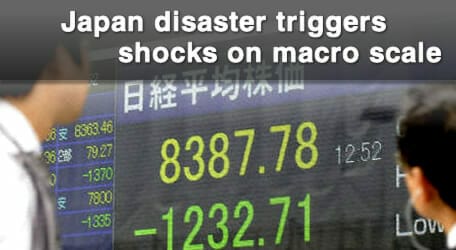

Japan disaster registers shocks on the Macro Scale

The natural disaster in Japan, that has tragically killed more than 3,000 people, caused millions of dollars damage and thrown the Middle East off the front pages, could also mark a pivotal moment in investments, with markets back to being triggered by macro concerns.

At the market close on Tuesday March 15, the Nikkei 225 had fallen 10.5 per cent (30 minutes after opening on Wednesday the market was up 6 per cent), but funds managers such as BlackRock and Franklin Templeton are still positive in their long-term outlook for Japanese equities and bond yields, with the impact on the economy dependent on how quickly affected areas recover.

Managing director of Asia Pacific at Lazard Asset Management, Rob Prugue, says “contrary to what we’re told, Japan is NOT in lock-down/closure mode”.

“One really needs to assess Japan on the rebuild, the funding therein, and its domestic and global implications,” he says.

“As Japan is still the third largest economy, how it finances this is key. But equally so, and aside from the obvious emotional and personal implications, the tsunami-affected area represents only 7 per cent of Japanese GDP (against 15 per cent of GDP for Kobe’s 1995 quake).”

Prugue says that Japan is still a net saver, and those billions can be redirected to rebuild the nation.

Sponsored Content

“As investors, one needs to assess what impact any repatriation of funds could mean on the off shore assets sold, let alone buying back Japanese Yen. Far from suggesting Japanese would repatriate all, even a very small percentage still equates to billions of dollars. So  the question I ask myself is if the US authorities may be tempted to extend Quantitative Easing 2 to say QE2.1?  Who else would be the natural buyers?”

Prugue, who spends a great deal of time in Japan, points out, the longer term problem is what to do with the Japanese national debt.

“Will this Keynesian-like rebuild flow into national economic growth? Roubini’s wailing aside, Japan is still a long way from tipping point, and the main thing which is likely to keep bond rates low is the short-term lack of attractive investments – hence this being an asset deflation situation, not an income/cost one.”

At the end of September last year the world’s largest investor, the ¥117,643 billion ($1.43 trillion) Government Pension Investment Fund of Japan (GPIF), had a whopping 70 per cent invested in domestic bonds.

The domestic bond allocation has been as high as 72 per cent, but at the end of fiscal 2009 was a relatively low 67.54 per cent. The allocation to international bonds (8.16 per cent) and international stocks (9.74 per cent) were also up slightly for the September 2010 quarter.

Despite the media’s focus on the short-term devastation, PIMCO is also buoyant on the long-term outlook for Japan, which is a rich country able to borrow at relatively low interest rates. Chief executive and co-chief investment officer, Mohamed A. El-Erian, predicts that Japan’s economic growth rate will fall in the immediate aftermath of the natural disasters before rising sharply due to reconstruction activities.

El-Erian says the experience of other countries suggests that the economic outlook for Japan will be dominated by five factors.

  • Japan’s economic growth rate will fall in the immediate aftermath of the natural disasters before rising sharply due to reconstruction activities.
  • Disruptions to supply chains and the loss of inventories will cause shortages and inflation to spike temporarily from very low levels.
  • The fiscal deficit and public debt will rise meaningfully due to lost revenues and, more importantly, emergency spending.
  • The central bank will ease monetary policy which, given policy interest rates floored at zero, will involve the provision of extraordinary credit and liquidity facilities.
  • Last, the country will receive transfers from abroad, including the repatriation of funds held outside the country by Japanese residents.

Leave a Comment

Sort content by

Alecta doubles down on governance, risk management and culture

Sweden’s largest pension fund, the $126 billion Alecta, has spent much of the last year continuing to work on improving governance, risk management, competence and culture in the wake of a $2 billion loss in 2023 attributable to investments in US regional banks, including Silicon Valley Bank, turning sour.

Japan’s trifecta of challenges

After 18 years working with Japan’s leading pension funds and asset managers Chris Battaglia, president of the Global Fiduciary Symposium in Japan, is well placed to observe the pressures on the country’s retirement system and observes its evolution. mrec4inarticleinline Sponsored Content scnative1 scnative2 scnative3

日本が直面する3つの課題

グローバル・フィデューシャリー・シンポジウム代表を務めるクリス・バッタリア氏は、日本の大手年金基金や資産運用会社と18年間仕事をする中で、日本の退職金制度の課題、その進化を観察してきた。 mrec4inarticleinline Sponsored Content scnative1 scnative2 scnative3

A lot of regulation incoming for crypto, predicts former Fed governor

Former Federal Reserve governor Randall Kroszner argues crypto assets are mislabelled as “currencies”, and said digital currencies like China’s digital Renminbi could one day challenge the primacy of the US dollar, in a wide-ranging conversation.

Portfolios of the future

This session drew on themes of the conference and discuss with asset owners what the portfolios of the future will look like, particularly examining how investors plan to build robust portfolios to meet changing investment regimes.

Fiona Reynolds joins Conexus as CEO

Conexus Financial, publisher of Top1000funds.com, further cements its position as a global influencer with the appointment of Fiona Reynolds as chief executive.




