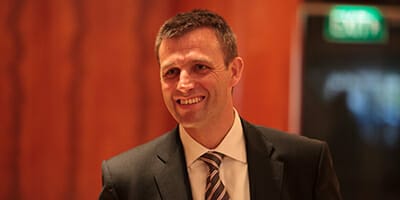

How the Future Fund found agility

Using a fund of funds enabled the Future Fund to build a large exposure to hedge funds quickly during the global financial crisis, chief investment officer of the Future Fund, David Neal says.

The Future Fund, which uses a combination of fund of funds and direct hedge fund investments, decided it did not have the breadth of skill and research to entirely invest directly.

“Could we realistically, or want to, try to build a team with enough talent and size to cover the industry? It’s not consistent with our notion to keep the investment team small enough to sit around a table and talk about all of the opportunities and strategies to build our portfolio,” Neal says.

“We thought with fund of funds, and the extra edge of someone who’s actually doing it, was worth exploring. As we started, we found other benefits of fund of funds, for example, in the crisis we were able to move quickly. We had one investment-management agreement with one organisation, which has relationships, and we can throw money at them quickly and could build a large exposure quickly. There was an execution service that came from it that would have taken a long time.”

Environment-specific risk

Neal says the Future Fund, which has almost 20 per cent exposure to hedge funds, is looking to expand its exposure and invest in commodities, catastrophe bonds and macro managers.

Sponsored Content

The fund has generated 4.9 per cent since inception, well below its mandate of consumer-price index plus 4.5 to 5.5 per cent

“We are clearly behind, but we don’t think there is much more we could have done. It is very dangerous to play catch-up. If you load up more risk, you’ll blow it,” Neal says. “You have to take the right amount of risk given the environment.”

Investors must manage the risk profile to the prevailing landscape, Neal says, but he believes there will be opportunity to take more risk in the next decade.

Meritocracy for assets

The Future Fund has a “dynamic” allocation process, but it is not relative to a benchmark. Rather, all investment opportunities are assessed on their merit.

“Long-term characteristics can change quickly, the GFC showed that,” he says. “It is not about active tilting but managing risk/return and adjusting accordingly.”

Because of this dynamic nature, the funds are shifted from one opportunity to another.

“There are managers we are happy with who we take money from because the opportunity changes,” Neal says.

The Future Fund considers every investment opportunity on a hedged basis, so each investment can be compared on a like-for-like basis. The fund then decides how much currency to hold.

At the moment it has 12.5 per cent in emerging-market currencies and 18 per cent in developed-market currencies

“Currency is the risk I worry about the most – or it is the cause and solution of the risk I worry about the most – liquidity.”

Neal sits on the Hedge Fund Standards Board and encourages investors to sign the standards’ investor chapter.

“The more investors that sign, the more that managers are interested.”

Asset Owner:Future Fund

Leave a Comment

Sort content by

Lepelmeier: interest rates ruin German strategy

German institutional investors face an urgent need to reconsider their bond-heavy investment strategies, argues Dirk Lepelmeier, a former investment head at one of the country’s largest pension funds. Herr Prof Dr Dirk Lepelmeier, to use his appropriate German titles, would rather be addressed as Dirk. That might be of no surprise to many, but it

2013 Nobel Prize in economics split three ways

There is no way to predict whether the price of stocks and bonds will go up or down over the next few days or weeks. However, it is quite possible to foresee the broad course of the prices of these assets over longer time periods, such as the next three-to-five years. These findings, which may

ATP: experiments with alpha and beta

“There is very little pure alpha” said Henrik Jepsen, chief investment officer of ATP, at the Fiduciary Investors Symposium in Amsterdam when reflecting on the giant Danish fund’s experiences with the return class. The DKK 624-billion ($114-billion) ATP decided to merge the alpha and beta platforms of its investment portfolio earlier this year. This wound

New NAPF chair to build trust in UK pensions

New chairman Ruston Smith’s inaugural speech at the United Kingdom’s National Association of Pension Fund annual conference in Manchester focused on building trust in the pensions industry. Talking about the need to create “pensions people trust to deliver a decent income, pensions people trust to be there when they retire and pensions people trust not

The Fama of modern finance

When Eugene Fama enrolled at Chicago Booth School of Business in 1960, “finance was a joke”, he says in a candid and fascinating insight into his more than 50 years as a student, academic and teacher at the university. The essay, published by Chicago Booth’s Capital Ideas, details Fama’s own history but also a short

Walmart takes divestment blows to the body

Two more high profile investors have punished US retailer Walmart for its anti-union stance and poor labour practices by divesting their holdings in the company. AP Funds, Sweden’s cluster of state pension funds named AP1 through to AP4 and AP6 (there is no AP5) worth a combined $140 billion, sold its equity and corporate bond

Previous




