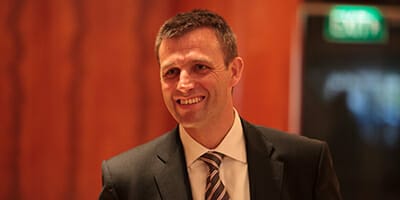

How the Future Fund found agility

Using a fund of funds enabled the Future Fund to build a large exposure to hedge funds quickly during the global financial crisis, chief investment officer of the Future Fund, David Neal says.

The Future Fund, which uses a combination of fund of funds and direct hedge fund investments, decided it did not have the breadth of skill and research to entirely invest directly.

“Could we realistically, or want to, try to build a team with enough talent and size to cover the industry? It’s not consistent with our notion to keep the investment team small enough to sit around a table and talk about all of the opportunities and strategies to build our portfolio,” Neal says.

“We thought with fund of funds, and the extra edge of someone who’s actually doing it, was worth exploring. As we started, we found other benefits of fund of funds, for example, in the crisis we were able to move quickly. We had one investment-management agreement with one organisation, which has relationships, and we can throw money at them quickly and could build a large exposure quickly. There was an execution service that came from it that would have taken a long time.”

Environment-specific risk

Neal says the Future Fund, which has almost 20 per cent exposure to hedge funds, is looking to expand its exposure and invest in commodities, catastrophe bonds and macro managers.

Sponsored Content

The fund has generated 4.9 per cent since inception, well below its mandate of consumer-price index plus 4.5 to 5.5 per cent

“We are clearly behind, but we don’t think there is much more we could have done. It is very dangerous to play catch-up. If you load up more risk, you’ll blow it,” Neal says. “You have to take the right amount of risk given the environment.”

Investors must manage the risk profile to the prevailing landscape, Neal says, but he believes there will be opportunity to take more risk in the next decade.

Meritocracy for assets

The Future Fund has a “dynamic” allocation process, but it is not relative to a benchmark. Rather, all investment opportunities are assessed on their merit.

“Long-term characteristics can change quickly, the GFC showed that,” he says. “It is not about active tilting but managing risk/return and adjusting accordingly.”

Because of this dynamic nature, the funds are shifted from one opportunity to another.

“There are managers we are happy with who we take money from because the opportunity changes,” Neal says.

The Future Fund considers every investment opportunity on a hedged basis, so each investment can be compared on a like-for-like basis. The fund then decides how much currency to hold.

At the moment it has 12.5 per cent in emerging-market currencies and 18 per cent in developed-market currencies

“Currency is the risk I worry about the most – or it is the cause and solution of the risk I worry about the most – liquidity.”

Neal sits on the Hedge Fund Standards Board and encourages investors to sign the standards’ investor chapter.

“The more investors that sign, the more that managers are interested.”

Asset Owner:Future Fund

Leave a Comment

Sort content by

A sustainable financial system on the agenda at Davos

The United Nations Environment Programme’s Inquiry into the Design of a Sustainable Financial System will present its interim report in Davos this week. The report has been initiated to advance policy options to improve the financial system’s effectiveness in mobilising capital towards a green and inclusive economy, and the interim report profiles innovations in five

Do pension funds add value?

Asset owners, on average, add 15 basis points of value above their asset class benchmarks after fees, according to an extensive study by CEM Benchmarking. The survey, which measured 6,666 data points from a global set of defined benefit plans, and some sovereign wealth funds and buffer funds, from 1992-2013. Gross of investment fees, funds

OECD calls for policy solution to long term investing barriers

Governance of institutional investors and the lengthening investment chain causing  bigger distances between assets’ beneficial owners and those involved in executing investment strategies was one of three practical issues raised by the OECD general secretary as a barrier to more investment in long-term investing financing. Speaking at the OECD Project on Institutional Investors and Long-term

2014: the year in words

In 2014 we have delivered to our readers more than 200 in-depth investor profiles, analytical and research-driven stories on the global institutional investment universe.  The most popular investment stories have been about private equity, ESG integration and how to find the ever-elusive alpha. But asset owners have also liked stories on how to improve their

Traditional risk measures flawed

The traditional method of using aggregated monthly data to measure long run risk is flawed and inaccurate, according to important new research by State Street. Co-authors David Turkington, Will Kinlaw and Mark Kritzman have found that there is a huge divergence in risk and return over long periods, which is not visible when using measures

Divestment of fossil fuels inappropriate for Norway’s SWF: expert group

Automatic exclusion of coal or petroleum producers is not an effective way for the Norwegian Sovereign Wealth Fund of addressing climate issues, according the report of the expert group on investments in coal and petroleum to the Norwegian Ministry of Finance. “We believe the use of the Fund as a climate policy instrument beyond what

Previous




