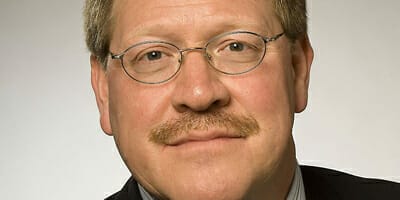
Eijffinger’s decade of financial repression

Financial repression will define the economic landscape for at least another decade, according to professor of financial economics at Tilburg University, Sylvester Eijffinger, which has serious implications for institutional investors.

Eijffinger, who also is also a visiting professor at Harvard, sits on the monetary experts panel of the European Union and is an adviser to the International Monetary Fund, says negative interest rates are the major issue of our time.

Negative real interest rates are here to stay, a realisation that has huge implications for investors.

“Governments have to de-leverage risk in times of low growth and they are not prepared to increase taxes; they have to do it with financial repression,” he says. “As an investor, be prepared. You have to realise that low interest rates are here to stay at the short-end and possibly at the long-end of the yield curve. This has huge implications for investments.”

By way of example, he says the European Central Bank’s policy rate stands at 0.5 per cent, while the eurozone’s annual inflation rate is 2.5 per cent. The Bank of England keeps its policy rate at only 0.5 per cent, despite an inflation rate that hovers above 2 per cent. And, in the United States, where inflation exceeds 2 per cent, the Federal Reserve’s benchmark federal funds rate remains at an historic low of 0 to 0.25 per cent.

This will be the financial and economic environment of the immediate future.

Sponsored Content

He says negative interest rates, which he describes as a kind of wealth tax, are necessary for governments to de-risk, but they come at the expense of savers.

“People who save should be aware that governments need to do this for at least a decade,” he says.

Eijffinger will give a keynote address at the Fiduciary Investors Symposium, an event that brings together institutional investors to examine the power and responsibility of fiduciary investment.

The event, which is convened by Conexus Financial, the publisher of conexust1f.flywheelstaging.com, will be held in Amsterdam from October 20 to 22, 2013. www.fiduciaryinvestor.com

Read an article by Eijffinger on the subject here.



Leave a Comment

Sort content by

OMERS’ new CIO to focus on in-house management

Bringing externally managed funds under the guidance of the internal investment team is a key component of OMERS’ growth plans, with the fund moving to having more direct control over its investments, according to new chief investment officer, Michael Latimer. mrec4inarticleinline Sponsored Content scnative1 scnative2 scnative3

The hidden risks of risk parity portfolios

The benefits of risk parity portfolios are largely an illusion and contain hidden risks such as confusing volatility with risk and including asset classes that have significant negative skew, which combined with leverage could be painful for investors, according to director of asset allocation at GMO, Ben Inker. mrec4inarticleinline Sponsored Content scnative1 scnative2 scnative3

Performance-based pay should be abolished: ICGN

Non-executive directors’ pay should consist solely of a combination of a cash retainer and equity-based remuneration, according to the International Corporate Governance Network’s new guidelines for non-executive director pay crafted over the past several years in consultation with, and on behalf of, many of the largest global shareowners. mrec4inarticleinline Sponsored Content scnative1 scnative2 scnative3

Abu Dhabi fund doubles revenue in 2009

Abu Dhabi’s (AED88.5) $24 billion strategic investment arm, Mubadala Development, reaped nearly twice as much revenue from portfolio companies in 2009 than in the previous year. mrec4inarticleinline Sponsored Content scnative1 scnative2 scnative3

High FX costs drag on returns

Higher than expected foreign exchange transaction costs can result in a long-term return drag on a portfolio of up to 2 per cent over 40 years according to new research by Russell Investments, which urges investors to review and measure foreign exchange costs. mrec4inarticleinline Sponsored Content scnative1 scnative2 scnative3

Diversity is power, says Zink

A typical pension fund portfolio is so dominated by equity risk that returns will fluctuate widely according to economic conditions which affect equity markets. Amanda White spoke to Rob Zink, portfolio strategist and now consultant for Bridgewater Associates about why most investors have a flawed approach to asset allocation. mrec4inarticleinline Sponsored Content scnative1 scnative2 scnative3

Previous




