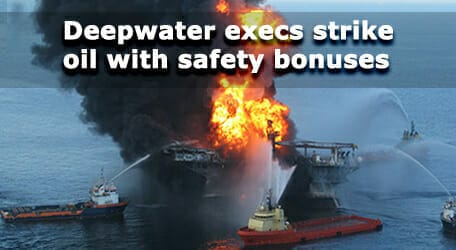
Deepwater execs strike oil with safety bonuses

As incongruous as it sounds, executives at Transocean Ltd – the company that owns the Deepwater Horizon oil rig which exploded in the Gulf of Mexico last year killing 11 people – have been paid bonuses for their improved safety performance.

According to a company SEC filing last week, last year was its best-ever for safety, “notwithstanding the tragic loss of life in the Gulf of Mexico”.

Executives receive 25 per cent of their bonuses based on the company’s safety performance in a given year.

Last year, they were given two-thirds of this. In 2009, the company withheld all bonuses after four deaths.

The calculation for overall safety performance is not based on deaths alone, but rather the number of “incidents” and their “potential severity”.

The number of incidents fell 4 per cent in 2010 and their potential severity fell 15 per cent.

Sponsored Content

The Deepwater Horizon rig was leased by BP, which operated the rig. Transocean blames BP for the damage.

The US Government is continuing its investigation into the cause of the explosion.

Leave a Comment

Sort content by

Did S&P downgrade democracy?

Rogerscasey chief executive, Tim Barron (pictured), provides a different perspective on the S&P downgrade of US Treasuries, asking whether the act was actually a downgrade of democracy in that country.mrec4inarticleinline Sponsored Content scnative1 scnative2 scnative3

Harvard favours emerging markets and absolute returns over fixed income

Harvard Management Company (HMC), which manages the $32 billion Harvard endowment, has made significant alterations to its policy portfolio, including increasing allocations to emerging market equities and the externally-managed absolute returns program, while slashing fixed income allocations.mrec4inarticleinline Sponsored Content scnative1 scnative2 scnative3

CII releases “say on pay” report examining investor voting motivations

The Council of Institutional Investors (CII) has released a report analysing investor motivation for voting against the “say on pay” proposal at companies where the motion failed to receive majority support at annual meetings this year. The study, conducted by independent executive compensation and performance consultancy Farient Advisors, examines how the new “say on pay”

Florida looking for managers for $6 billion alternatives push

The Florida State Board of Administration (SBA) is looking for managers to run up to $6 billion in mandates as it expands its allocations to alternative assets such as private equity, hedge funds, real estate, infrastructure and commodities.mrec4inarticleinline Sponsored Content scnative1 scnative2 scnative3

What is the future of hedge funds at CalPERS?

A rigorous debate between staff, consultant and investment committee has resulted in the $224-billion CalPERS deciding to fund an allocation to hedge funds from its global equities allocation, using futures to neutralise the policy allocation, rather than have a separate strategic asset class. But the strategy is on watch, and will be reviewed mid-next year.mrec4inarticleinline

APG beefs up corporate governance policies

APG, one of the world’s largest institutional investors, has released a corporate governance policy in which it makes clear that the boards of companies must take sustainability, shareholder and stakeholder interests into account when making decisions.mrec4inarticleinline Sponsored Content scnative1 scnative2 scnative3

Previous




