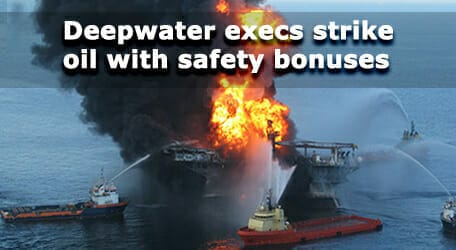
Deepwater execs strike oil with safety bonuses

As incongruous as it sounds, executives at Transocean Ltd – the company that owns the Deepwater Horizon oil rig which exploded in the Gulf of Mexico last year killing 11 people – have been paid bonuses for their improved safety performance.

According to a company SEC filing last week, last year was its best-ever for safety, “notwithstanding the tragic loss of life in the Gulf of Mexico”.

Executives receive 25 per cent of their bonuses based on the company’s safety performance in a given year.

Last year, they were given two-thirds of this. In 2009, the company withheld all bonuses after four deaths.

The calculation for overall safety performance is not based on deaths alone, but rather the number of “incidents” and their “potential severity”.

The number of incidents fell 4 per cent in 2010 and their potential severity fell 15 per cent.

Sponsored Content

The Deepwater Horizon rig was leased by BP, which operated the rig. Transocean blames BP for the damage.

The US Government is continuing its investigation into the cause of the explosion.

Leave a Comment

Sort content by

UK pension battle heats up

On Wednesday last week (November 2) the UK Government set out an offer – widely regarded as generous – to workers on public service pensions. However, unions still plan to go ahead with a “day of action” on November 30 – considered to be the widest industrial action in the country since the 1920s.mrec4inarticleinline Sponsored

Oxford seeks global property opps

Oxford Properties Group – the real estate arm of Canadian pension fund OMERS – has an ambitious growth plan that includes expanding its footprint globally and growing its portfolio of properties to more than $30 billion. Oxford’s president and chief executive Blake Hutcheson (pictured) says that the fund is patiently building out its portfolio of

How sovereign risk hits equities

The severe impact of the European debt crisis on financial markets has spurred EDHEC-Risk Institute to investigate whether equity investors can earn a premium through sovereign risk. Professor Nöel Amenc, EDHEC-Risk Institute director, speaks about the emergence of what could be a new risk factor and other research focusing on Asia.

State Street: DC plans better by default?

After seeing more than a decade of change in the role of defined contribution plans in the US, the pace of innovation will continue unabated as funds look to diversify their investment approach and improve fund structures, State Street Global Advisors predicts.mrec4inarticleinline Sponsored Content scnative1 scnative2 scnative3

Norway’s SWF 8.8% loss in Q3

The Norwegian Government’s 3055 billion kroner ($544.9 billion) pension fund lost 8.8 per cent during the third quarter of this year, on the back of falling share markets. But its fund manager says most of the fund’s new capital inflows are still being pumped into global share markets.mrec4inarticleinline Sponsored Content scnative1 scnative2 scnative3

Pensions and protests demands action

Sitting on the steps of St Paul’s Cathedral, London, looking over the sea of tents “occupying” the forecourt, I wondered what 2011 would be remembered for. Certainly this movement is highlighting that the people on the street see a disconnect between the financial and real economies. But what are pension funds doing to take action?mrec4inarticleinline

Previous




