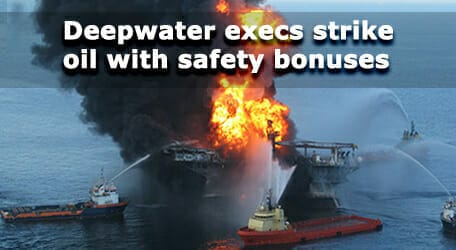
Deepwater execs strike oil with safety bonuses

As incongruous as it sounds, executives at Transocean Ltd – the company that owns the Deepwater Horizon oil rig which exploded in the Gulf of Mexico last year killing 11 people – have been paid bonuses for their improved safety performance.

According to a company SEC filing last week, last year was its best-ever for safety, “notwithstanding the tragic loss of life in the Gulf of Mexico”.

Executives receive 25 per cent of their bonuses based on the company’s safety performance in a given year.

Last year, they were given two-thirds of this. In 2009, the company withheld all bonuses after four deaths.

The calculation for overall safety performance is not based on deaths alone, but rather the number of “incidents” and their “potential severity”.

The number of incidents fell 4 per cent in 2010 and their potential severity fell 15 per cent.

Sponsored Content

The Deepwater Horizon rig was leased by BP, which operated the rig. Transocean blames BP for the damage.

The US Government is continuing its investigation into the cause of the explosion.

Leave a Comment

Sort content by

A sustainable financial system on the agenda at Davos

The United Nations Environment Programme’s Inquiry into the Design of a Sustainable Financial System will present its interim report in Davos this week. The report has been initiated to advance policy options to improve the financial system’s effectiveness in mobilising capital towards a green and inclusive economy, and the interim report profiles innovations in five

Do pension funds add value?

Asset owners, on average, add 15 basis points of value above their asset class benchmarks after fees, according to an extensive study by CEM Benchmarking. The survey, which measured 6,666 data points from a global set of defined benefit plans, and some sovereign wealth funds and buffer funds, from 1992-2013. Gross of investment fees, funds

OECD calls for policy solution to long term investing barriers

Governance of institutional investors and the lengthening investment chain causing  bigger distances between assets’ beneficial owners and those involved in executing investment strategies was one of three practical issues raised by the OECD general secretary as a barrier to more investment in long-term investing financing. Speaking at the OECD Project on Institutional Investors and Long-term

2014: the year in words

In 2014 we have delivered to our readers more than 200 in-depth investor profiles, analytical and research-driven stories on the global institutional investment universe.  The most popular investment stories have been about private equity, ESG integration and how to find the ever-elusive alpha. But asset owners have also liked stories on how to improve their

Traditional risk measures flawed

The traditional method of using aggregated monthly data to measure long run risk is flawed and inaccurate, according to important new research by State Street. Co-authors David Turkington, Will Kinlaw and Mark Kritzman have found that there is a huge divergence in risk and return over long periods, which is not visible when using measures

Divestment of fossil fuels inappropriate for Norway’s SWF: expert group

Automatic exclusion of coal or petroleum producers is not an effective way for the Norwegian Sovereign Wealth Fund of addressing climate issues, according the report of the expert group on investments in coal and petroleum to the Norwegian Ministry of Finance. “We believe the use of the Fund as a climate policy instrument beyond what

Previous




