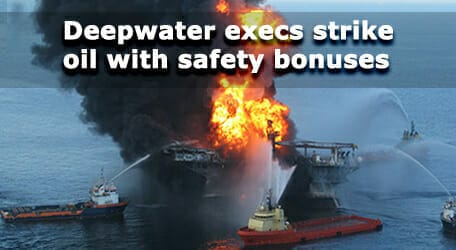
Deepwater execs strike oil with safety bonuses

As incongruous as it sounds, executives at Transocean Ltd – the company that owns the Deepwater Horizon oil rig which exploded in the Gulf of Mexico last year killing 11 people – have been paid bonuses for their improved safety performance.

According to a company SEC filing last week, last year was its best-ever for safety, “notwithstanding the tragic loss of life in the Gulf of Mexico”.

Executives receive 25 per cent of their bonuses based on the company’s safety performance in a given year.

Last year, they were given two-thirds of this. In 2009, the company withheld all bonuses after four deaths.

The calculation for overall safety performance is not based on deaths alone, but rather the number of “incidents” and their “potential severity”.

The number of incidents fell 4 per cent in 2010 and their potential severity fell 15 per cent.

Sponsored Content

The Deepwater Horizon rig was leased by BP, which operated the rig. Transocean blames BP for the damage.

The US Government is continuing its investigation into the cause of the explosion.

Leave a Comment

Sort content by

AP2 appoints another new CIO

The SEK 204 billion ($28 billion) Second Swedish National Pension Fund/AP2 has appointed its fourth chief investment officer in four years, as the fund reports its best annual return since inception. mrec4inarticleinline Sponsored Content scnative1 scnative2 scnative3

France’s SWF names manager selection committee

France’s €33 billion Sovereign Wealth Fund, the Fonds de Reserve Pour Les Retraites, has made four appointments to its independent manager selection committee tasked with reviewing all mandate bids by funds managers. mrec4inarticleinline Sponsored Content scnative1 scnative2 scnative3

Climate change expert upbeat on post-Copenhagen opportunities

Global head of climate change investment research at DB Climate Change Advisors, Mark Fulton, has a contrary view to most observers, post-Copenhagen. He spoke to Amanda White about the climate change market and the asset allocation implications for investors. mrec4inarticleinline Sponsored Content scnative1 scnative2 scnative3

ATP’s split portfolio

The performance of the hedging portfolio and a 43 per cent allocation to interest-rate sensitive bonds in the investment beta portfolio of the DKK352 billion ($65 billion) ATP were the main contributors to the group increasing pension reserves by one third last year. mrec4inarticleinline Sponsored Content scnative1 scnative2 scnative3

Ibbotson reveals the ABCs – alphas, betas and costs – of hedge funds

Hedge funds, in aggregate, have generated positive alpha in the past 11 years. This finding, made by Roger Ibbotson, founder of Ibbotson Associates and Professor of Finance at Yale University, proves the strategies can resist powerful market declines but often fall short of providing absolute returns to investors. He spoke with Simon Mumme about the

CalPERS rates reputational risk above investments

Risk to reputation is more important than risk to investments according to a survey of internal staff at CalPERS completed as part of its governance/risk management initiative. mrec4inarticleinline Sponsored Content scnative1 scnative2 scnative3

Previous




