
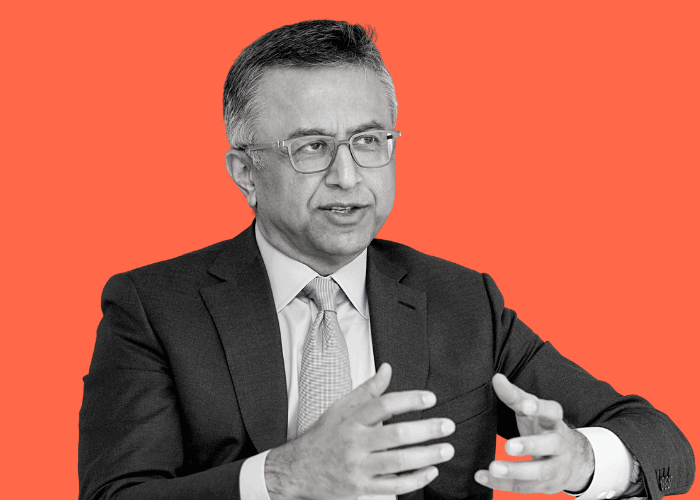

The sharp market falls triggered by the pandemic brought the longest recovery ever in modern finance to an abrupt end. But despite the turmoil unleashed by COVID, it has not wrung out the market excesses of the last 13-year cycle. It means another wave of corporate failures could appear on the horizon in a shorter timeframe than expected, and offer more opportunities for distressed debt investors, according to Victor Khosla founder of SVP Global.
Speaking at FIS Digital 2021, Victor Khosla, founder and chief executive of SVP Global said that because the ECB and Fed have written such massive cheques, many people “got a pass.” For sure, sectors like leisure, travel and real estate have had to restructure, but other businesses never got fixed.
It means all the ingredients are in place for another, more real correction, he said.
As for the catalyst, changes in inflation and interest rates are obvious contenders, but other factors that investors “can’t figure out” (like COVID) could just as easily surprise. That said, he warned that central banks are not letting go of the policy levers, and counselled against betting against the Fed.
Opportunities
The most obvious opportunities at the beginning of the crisis lay in liquid large cap companies. These companies were not filing for bankruptcy, but typically looking to sell assets. Next, the opportunity evolved with corporate restructuring by another swathe of companies (Virgin Atlantic and JCPenney, for example) running out of money although Khosla noted that these businesses don’t offer the best opportunities.
The second half of 2020 and this year have seen more exciting opportunities, whereby good companies with capital structure problems provide investor opportunities. Most of the early opportunity was in the US, he said noting how good the US is at creative destruction whereby sectors take on losses clear up and move on. In contrast, that process is not as advanced in Europe he said, reflecting on how SVP Global has a 75:25 US/Europe bias today in contrast to its usual 50:50 US/Europe split.
When it comes to opportunities, Khosla looks for specific characteristics, choosing businesses that are either resilient through a recession or which if cyclical, bounce back after a crisis because of their strong market share.
“We get a chance to buy them at their lowest,” he said, describing the firm’s ability to take ownership of the majority of debt and equity in the restructuring process as a broad hunting license.
For example, the firm has a large equity stake in Swissport International, part of debt-laden Chinese conglomerate HNA Group following debt equity restructuring. Elsewhere, the firm is a creditor of Washington Prime Group’s open air mall business where he sees steady and growing traffic. Other opportunities include telecoms and packaging businesses and a building products company, all typically characterised as private deals and not on the radar.
European lag
Khosla explained further how opportunities in Europe have lagged the US. Europe’s recession has been much worse than the US where 2020 GDP declines have not been as steep and the 2021 recovery much stronger. In contrast he described the European recovery as anaemic, adding that Europe was in an economically worse position that the US pre-crisis, not helped by Germany and Italy being close to recession and the travails of the region’s banking sector.
In conversation with Kristian Fok, chief investment officer at Cbus Super Fund, Khosla said that although distressed debt investment sounded brave it didn’t involve catching falling knives.
“The asset class has a good sense of its own limitations,” he said. For example, he counsels against investing in distressed tech assets because the pace of change is so rapid, by the time bankruptcy and restructuring processes are over the technology has changed.
“This is not for us,” he said.
Elsewhere, he noted how many hard asset businesses are in secular decline and should therefore also be avoided – here he cited the falling demand for paper as having an impact on the paper and pulp business.
He also described emerging markets as way above our pay grade given the different bankruptcy codes and challenges around fixing businesses in emerging markets.
To further illustrate the caution inherent to distressed investment, he said cash flows in many of the companies the firm has stakes in actually spiked through the 2019 and 2020 recession. He also noted that the real opportunities in the sector exist for investors who have operating teams to fix and improve businesses, and who are more than paper investors. For these investors, opportunities will continue to exist despite the overall level of defaults coming down, he concluded.







Leave a Comment
You must be logged in to post a comment.
Login