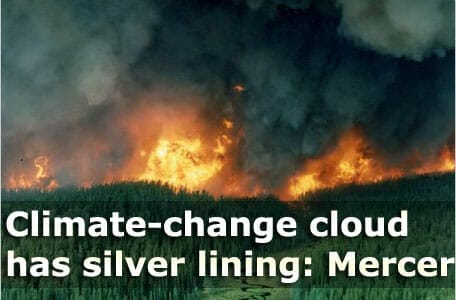
Climate-change cloud has silver lining: Mercer

Climate change could slash as much as 10 per cent off portfolios in the next 20 years, according to Mercer’s much-anticipated climate change report, the result of an 18-month collaboration with 14 institutional investors from around the globe.

With support from the International Finance Corporation and the Carbon Trust, the report, ‘Climate Change Scenarios – implications for strategic asset allocation’, had three broad objectives:

1.      To investigate and analyse the potential investment risk from climate change

2.      Look at the key performance drivers for markets

3.      Identify scenarios around climate change that help in understanding and framing climate change as a strategic investment priority.

Sponsored Content

“It is about setting the framework so institutional investors can transform to a low carbon economy,” Danyelle Guyatt, head of global research in Mercer’s responsible investment team, said.

The report looks at the impact of climate change on investments, concluding it could contribute as much as 10 per cent to portfolio risks.

Guyatt said Mercer would research managers with the best ideas across ideas and regions, and urged investors to introduce climate risk into reviews and strategic asset allocation.

Mercer’s chief investment officer, Andrew Kirton, said investors should look to allocate more to infrastructure, real estate, private equity, agriculture land, timberland, and sustainable assets.

The 14 global institutional investors, representing more than $2 trillion in AUM, are: AP1, APG, AustralianSuper, British Columbia Investment Management Corporation, British Telecom Pension Scheme, CalPERS, CalSTRS, Environment Agency Pension Scheme, Government of Singapore Investment Corporation, Maryland State Retirement and Pension System, Norwegian Government Pension Fund, Ontario Municipal Employees Retirement System, PGGM and VicSuper.


Leave a Comment

Sort content by

Gunning for diversity, dynamism and due diligence

The new low-return, high-volatility environment requires broadly diversified portfolios, dynamic decision-making and rigorous due diligence, which is beyond the internal capacity of most small funds under $10 billion, warns Russell Investment’s global chief investment officer Peter Gunning. He says smaller funds must decide if it is cost effective and even possible to internally manage investment

ESG here to stay

Anyone who thought ESG was a passing fad can think again. The announcement this week that Mercer, which has led the consulting industry on standalone ESG ratings, will now integrate those factors across its ratings process has cemented ESG as an important investment risk and return consideration. The consultant rates more than 20,000 investment strategies

Mercer integrates ESG

Mercer will integrate its proprietary environmental, social and governance (ESG) ratings across all of its manager-search and performance data, cementing ESG as a key investment consideration. The consultant rates more than 20,000 strategies, oversees more than $5 trillion of assets under advice and has $60 billion in its multi-manager products. Mercer has led the consulting

Modern portfolio theory, risk and fiduciary duty

It was only a few decades ago that trustees in many jurisdictions were restricted from investing in certain assets. Fiduciary duty has evolved as the thinking about investments has changed. This is true, then, of how trustees should be applying fiduciary duty to current day investment challenges, including systemic risk and climate change risk. Ed

Singapore’s GIC stashes cash

The Government of Singapore Investment Corporation (GIC) is stockpiling cash as it positions itself to take advantage of any potential opportunities, lifting its cash allocation from 3 per cent at the start of 2011 to 11 per cent of its total portfolio by the earlier part of this year. The sovereign wealth fund’s chief investment

GMO boss warns of food crisis

Global investors should have as much as 30 per cent of their portfolios exposed to natural resources, more than double the current market average, because of a burgeoning worldwide food crisis, GMO’s Jeremy Grantham says. The droughts afflicting farmers in the US and the subsequent spike in food commodity prices are just forerunners to the

Previous



