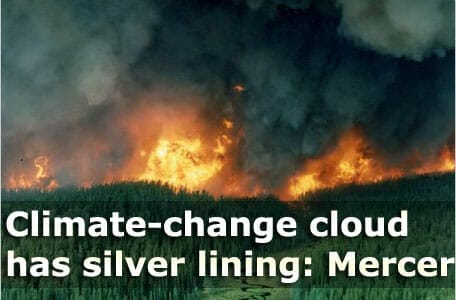
Climate-change cloud has silver lining: Mercer

Climate change could slash as much as 10 per cent off portfolios in the next 20 years, according to Mercer’s much-anticipated climate change report, the result of an 18-month collaboration with 14 institutional investors from around the globe.

With support from the International Finance Corporation and the Carbon Trust, the report, ‘Climate Change Scenarios – implications for strategic asset allocation’, had three broad objectives:

1.      To investigate and analyse the potential investment risk from climate change

2.      Look at the key performance drivers for markets

3.      Identify scenarios around climate change that help in understanding and framing climate change as a strategic investment priority.

Sponsored Content

“It is about setting the framework so institutional investors can transform to a low carbon economy,” Danyelle Guyatt, head of global research in Mercer’s responsible investment team, said.

The report looks at the impact of climate change on investments, concluding it could contribute as much as 10 per cent to portfolio risks.

Guyatt said Mercer would research managers with the best ideas across ideas and regions, and urged investors to introduce climate risk into reviews and strategic asset allocation.

Mercer’s chief investment officer, Andrew Kirton, said investors should look to allocate more to infrastructure, real estate, private equity, agriculture land, timberland, and sustainable assets.

The 14 global institutional investors, representing more than $2 trillion in AUM, are: AP1, APG, AustralianSuper, British Columbia Investment Management Corporation, British Telecom Pension Scheme, CalPERS, CalSTRS, Environment Agency Pension Scheme, Government of Singapore Investment Corporation, Maryland State Retirement and Pension System, Norwegian Government Pension Fund, Ontario Municipal Employees Retirement System, PGGM and VicSuper.


Leave a Comment

Sort content by

Efficient indices outperform cap-weighted

A new series of efficient indices, launched by FTSE and the EDHEC-Risk Institute, which aims to capture equity market returns with an improved risk/reward efficiency, outperform their market-cap weighted counterparts over five years in every region except Asia Pacific ex-Japan. mrec4inarticleinline Sponsored Content scnative1 scnative2 scnative3

Mercer survey compares use of active management

In analysis completed for the Norwegian Ministry of Finance, Mercer has conducted a survey of active management, assessing the use and performance of active management at the total fund and asset class levels for 14 pension funds with combined assets of $950 billion, including eight funds from Europe and three from North America. mrec4inarticleinline Sponsored

Norway’s largest fund rejects passive management

A complete evaluation of active management including reports by Mercer and an international group of professors, has resulted in the Norges Bank Investment Management, manager of the $375 billion Government Pension Fund-Global, staunchly favouring active management, with the bank’s Governor and executive director of the NBIM describing “a passive, uninformed approach to operational decisions is

Hermes ready for institutions worldwide

Following the purchase of European equities manager Sourcecap International, Hermes Pensions Management, the fund manager for the £32 billion ($51.8 billion) BT Pension Scheme, is preparing to market its diverse array of boutique managers to institutions worldwide.   mrec4inarticleinline Sponsored Content scnative1 scnative2 scnative3

CPPIB restructures investment department

The C$123 billion ($118 billion) Canada Pension Plan Investment Board has undergone an executive restructure including the creation of two new positions reporting to the chief executive: executive vice president, investments; and chief investment strategist. mrec4inarticleinline Sponsored Content scnative1 scnative2 scnative3

Spotlight on Copenhagen

Convener of the P8 Summits- a group of 12 of the world’s largest pension funds tasked with influencing policy makers on climate change – and deputy director of the University of Cambridge Programme for Sustainability Leadership, Aled Jones, examines the Copenhagen Accord and what it means for investors. mrec4inarticleinline Sponsored Content scnative1 scnative2 scnative3

Previous



