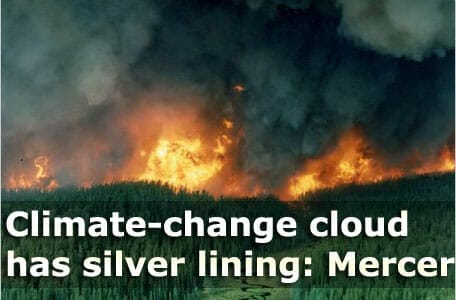
Climate-change cloud has silver lining: Mercer

Climate change could slash as much as 10 per cent off portfolios in the next 20 years, according to Mercer’s much-anticipated climate change report, the result of an 18-month collaboration with 14 institutional investors from around the globe.

With support from the International Finance Corporation and the Carbon Trust, the report, ‘Climate Change Scenarios – implications for strategic asset allocation’, had three broad objectives:

1.      To investigate and analyse the potential investment risk from climate change

2.      Look at the key performance drivers for markets

3.      Identify scenarios around climate change that help in understanding and framing climate change as a strategic investment priority.

Sponsored Content

“It is about setting the framework so institutional investors can transform to a low carbon economy,” Danyelle Guyatt, head of global research in Mercer’s responsible investment team, said.

The report looks at the impact of climate change on investments, concluding it could contribute as much as 10 per cent to portfolio risks.

Guyatt said Mercer would research managers with the best ideas across ideas and regions, and urged investors to introduce climate risk into reviews and strategic asset allocation.

Mercer’s chief investment officer, Andrew Kirton, said investors should look to allocate more to infrastructure, real estate, private equity, agriculture land, timberland, and sustainable assets.

The 14 global institutional investors, representing more than $2 trillion in AUM, are: AP1, APG, AustralianSuper, British Columbia Investment Management Corporation, British Telecom Pension Scheme, CalPERS, CalSTRS, Environment Agency Pension Scheme, Government of Singapore Investment Corporation, Maryland State Retirement and Pension System, Norwegian Government Pension Fund, Ontario Municipal Employees Retirement System, PGGM and VicSuper.


Leave a Comment

Sort content by

US ivy league endowments cling to returns … just

Endowments are back, just. The annual survey of their returns by NACUBO-Commonfund showed an average return of 11.9 per cent for the 850 college and university endowments in the study for the year to June 2010.mrec4inarticleinline Sponsored Content scnative1 scnative2 scnative3

Forget sovereign debt as a safe haven: Mercer

The status of sovereign debt as a safe-haven investment has been put into question and the whole approach to bond investing may need to be revisited, according to Mercer, which has urged institutional investors to focus in the coming year on the ‘new realities’ of the global marketplace, which includes sufficient flexibility in their portfolios.mrec4inarticleinline

Israel’s offshore resources to secure SWF future

Israel is considering establishing its first sovereign wealth fund within one year using revenues from recent offshore natural-gas finds, following calls by the International Monetary Fund to do so.mrec4inarticleinline Sponsored Content scnative1 scnative2 scnative3

Putting your footprint where your mouth is: CalSTRS reports on carbon emissions

In the latest move to demonstrate the same commitment to climate change it expects from its portfolio companies, CalSTRS has signed The Climate Registry, a leading voluntary greenhouse gas registry in North America. The $147 billion fund will report on its carbon footprint, which was dramatically reduced when it moved into its new building in

New Jersey chair calls for allocation review

Chair of the investment council of the $70 billion State of New Jersey’s Division of Investment, Robert Grady, has called for a new asset allocation plan, pointing in particular to the fund’s cash position which sits at around 2.75 per cent. The fund has also been overweight its domestic equity allocation by about 6 per

Islamic laws highlight government fund restrictions

Malaysia’s $130 billion Employees Provident Fund plans to expand its global Islamic bond program by about 50 per cent this year in a move which highlights some of the challenges faced by fiduciary investors at many of the world’s government-controlled funds.mrec4inarticleinline Sponsored Content scnative1 scnative2 scnative3

Previous



