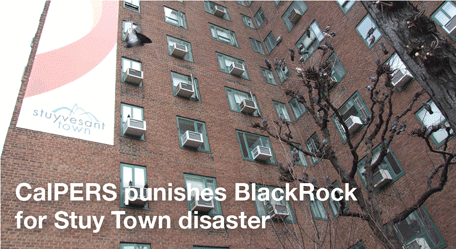
CalPERS punishes BlackRock for Stuy Town disaster

Another page has turned in the history of the Stuyvesant Town – Peter Cooper Village apartment buildings in New York, as iconic as they have been controversial since their initial construction in the 1940s. CalPERS, America’s largest pension fund, has terminated BlackRock, one of its property managers which led a 2006 purchase of the 80-acre site, after a 12-year relationship.

CalPERS wrote off US$500 million of its apartment portfolio after real estate manager Tishman Speyer Properties, which together with BlackRock and investors paid $5.4 billion for what the residents call “Stuy Town”, had given up control of the properties to avoid bankruptcy in January this year.

This week CalPERS terminated a $1 billion apartment management mandate with BlackRock, which had dated back to 1998. The fund has consolidated this with another long-time manager, the privately owned GID Investment Advisers.

The Stuy Town development marked the first major clearing of slum dwellings in New York, starting in 1943, financed largely by the insurer MetLife, which was awarded tax breaks and other government assistance.

It has been the subject of many court actions over the years, some on the basis of race. Courts ruled that the managers did not have to adhere to race discrimination laws applicable for public landlords, despite the government assistance in the development, and almost all the early tenants in the rent-controlled apartments were white.

CalPERS reported a loss of 37 per cent in its total real estate portfolio in the year to June. The fund is anticipating reduced costs and improved efficiency from consolidating its mandates under one partner/manager.


Sponsored Content

Leave a Comment

Sort content by

Is the financial services sector serving the public interest?

Fiduciary law, which creates the boundaries and rules for asset owners managing other people’s money, is evolving. The short-termism, misaligned incentives and complex and over-supply of services that characterises financial services, is under fire. Regulators around the world are increasingly looking at how to change the behaviour and supply chain dynamics in the industry, and

The impact of the mega manager

The impact of size is a delicate point for asset managers. For specialist asset classes, and boutique managers, being small and nimble can be a source of alpha. On the other hand, being large can reduce fees and increase innovation and product offering. But now there is evidence to show that the emergence of the

The contested role of asset consultants

Asset consultants are a key part of the investment chain, providing small funds with services that include decision making processes and strategic asset allocation, and for larger funds traditionally playing a key role in manager and strategy selection. But a study by Gordon Clark and Ashby Monk, which is part of a broader look by

Demystifying private equity

US public pension funds, on average, have around 9.4 per cent allocated to private equity but for many public funds monitoring the firms that manage these investments – including the transparency of underlying investments, fees, performance and benchmarking – as well justifying these investments to boards and stakeholders, takes up more than 10 per cent

Why investors employ smart beta strategies

The common view is smart beta is used to side step expensive active equity managers or hedge fund managers whose processes are on the surface opaque, but on close investigation turn out to be largely beta like in approach. As investors have gained experience and familiarity they have also learnt about how it offers greater

Managing culture with risk management techniques

The interaction between governance, culture and performance is increasingly a topic around asset owner board tables. But little has been written about the relationship between culture and the financial crisis, and how to change culture in financial services organisations. Andrew Lo, professor of finance at MIT, has come up with a proposal to change culture

Previous



