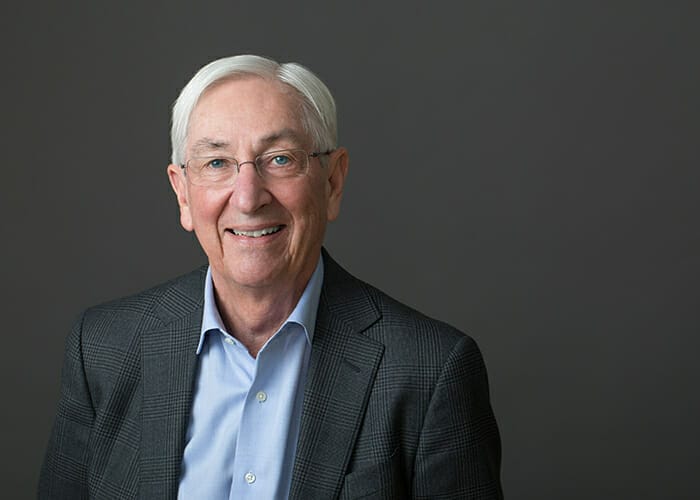

Ambachtsheer’s long-term premium

Long-term investors know sharemarkets are overvalued but they are struggling to work out when, or if, a crash will come. By looking back through recent capital markets history, Keith Ambachtsheer, professor of finance at the University of Toronto’s Rotman School of Management and a frequent adviser to pension funds and governments, throws a ray of light on what the future holds and how long the good times, and the bad, might last.

In the latest Ambachtsheer Letter, he argues that even with an uncomfortable downturn, long-term equity investors will still come out ahead. But he warns to batten down because a difficult bout could last for 10 years.

His analysis applies to investors with 30-year horizons, free from short-term drawdown risks. Examples include sovereign wealth funds and the likes of the giant $C337.1 billion ($265.5 billion) Canada Pension Plan Investment Board or the $NZ38.4 billion ($28.1 billion) New Zealand Super Fund, plus the raft of pension funds that now put conditions on how much they pay out.

“A large part of the institutional world is now managing truly long-term money,” Ambachtsheer says.

By constructing multi-decade scenarios for capital markets, Ambachtsheer looks ahead to share and bond return prospects and their implications on strategy for long-term investors. He frames his research on the Gordon model for long-term equity investment. The formula, developed by academic Myron Gordon, who was also based at Toronto University before he died in 2010, is a renowned method for calculating the fair value of shares.

Ups and downs

Sponsored Content

To help construct his future scenarios, Ambachtsheer looks back at how capital markets have behaved since WWII. The ’50s and ’60s brought steady economic growth and modest inflation. The ‘Scary ’70s’ followed, with energy wars and accelerating price and wage inflation, which led to 20 years of steady economic growth and modest inflation in the ’80s and ’90s. Excessive optimism at the turn of the century led to the ‘double bubble blues decade’ with its dot.com bubble followed mid-decade by the housing finance bubble – leading to the global financial crisis. Since then, concerted global monetary action has set the stage for the current, optimistic mature capitalism era, now 8 years old.

With this context in mind, Ambachtsheer sees three possible scenarios playing out in the decades ahead – which one will come true is difficult to predict.

“We know how something will happen and the consequences, but I can’t give the probability,” he says.

Mature capitalism scenario

First, mature capitalism could continue. In this scenario, robust productivity and profit growth remain, accompanied by less of a boom-bust cycle, thanks to a lack of correlation across geographical and economic sectors, continued subdued inflation, continued low nominal and real interest rates by historical standards, and relatively high equity prices. How long mature capitalism would last is difficult to gauge. Some optimist-driven periods have lasted 20 years but that isn’t cast-iron reassurance, Ambachtsheer says. Looking back before WWII, the Roaring ’20s era lasted only a decade before the nasty, capital value-destroying Dirty ’30s.

The bubble scenario

A second scenario suggests another bubble decade. Investors would once again buy into a high-tech narrative, as they did in the ’90s, this time led by Apple, Amazon, Google, Facebook, Tesla, Bitcoin and their younger brothers, sisters and cousins. Share prices would once again levitate into materially over-valued territory. As happened in the first decade of the 2000s, the return of equity prices to economically justified levels would be ugly, leading to financial distress for many equity investors, while yields on high-quality bonds would fall once again.

Scary ’70s redux

Ambachtsheer’s third scenario is a replay of the Scary ’70s. After ultimately futile negotiations, a new global trade war would erupt, leading to faltering economic growth and rising inflation across the world. At the same time, the climate change targets of the Paris Accord would be breached, damaging food production, water supplies, and the viability of living in low-level coastal areas and high-pollution urban areas. Financial markets would react negatively, with falling share prices and rising nominal and real interest rates.

A downturn could last a while, Ambachtsheer warns. History suggests it may take as long as a decade for things to return to normal.

In two recent cases, it’s been 10 years, he says. “The crisis in the ’70s resolved in the ’80s and the crisis in the late ’90s resolved with the financial crisis in 2008-09.”

Forecasts based on scenarios

Ambachtsheer turns these narratives into long-term return forecasts, applying the Gordon model to various projections that capture the S&P income yield and shares’ productivity and profit growth. In the bubble scenario, the dynamics create a timing opportunity even for long-term investors: selling shares at bubble prices and buying them back later at ‘normal’ prices.

In the Scary ’70s scenario, share prices continue to be bid down, price and wage inflation accelerate and nominal and real interest rates rise, squeezing the equity risk premium. But in all three scenarios, even these two most gloomy forecasts, the Gordon model ultimately calculates that long-term investors with no exposure to drawdown risk can expect a long-term positive equity risk premium.

“Long-term equity investors with a 30-year-plus timeframe will end up ahead, even if there is a bad decade,” he says. However, Ambachtsheer warns that the projected equity risk premium is “well below” the average post-WWII experience.

He is upbeat about governments’ ability to navigate downturns. Successful monetary and fiscal policies since WWII include the Volcker intervention in the early 1980s and the intervention to contain the global financial crisis in 2008-09.

“We’ve learnt how to take the sharp edges off bad outcomes,” he says.

The challenge for long-term investors would be to “keep calm and carry on” as these pessimistic scenarios play out, avoiding getting caught up in panic selling and keeping track of the Gordon model for its clues what share prices suggest for the direction of the economy.

“When moving into bubble land, pull back until prices are more sensible,” he says. And investors with shorter time horizons must question how much they need in bonds to protect against drawdown risk.

Leave a Comment

Sort content by

Real credit the only opportunity in the new regime: Watson Wyatt

Investors must recognise that the economic world has changed and not expect normal asset price reversion in the future, says Carl Hess, Watson Wyatt’s global head of investment consulting. mrec4inarticleinline Sponsored Content scnative1 scnative2 scnative3

Swedish AP funds exclude 10 companies due to ethical breaches

Sweden’s first four buffer funds, with combined assets of SEK 690.6 billion (US$83 billion) have demonstrated a lack of tolerance for companies that continue to breach ethical guidelines despite the funds’ governance efforts to bring about change, excluding 10 companies from their investment universe. mrec4inarticleinline Sponsored Content scnative1 scnative2 scnative3

…while ICGN urges IASC to prioritise investors’ views in accounting

The International Corporate Governance Network (ICGN), with members from 47 countries responsible for global assets of US$15 trillion, has urged the International Accounting Standards Committee (IASC) to prioritise investors, not auditors, as the key stakeholders in the setting of global financial reporting standards. mrec4inarticleinline Sponsored Content scnative1 scnative2 scnative3

Modern Portfolio Theory still holds up Harry Markowitz says so.

In an exclusive interview, Amanda White, editor of top1000funds.com, talks to the modern portfolio theorist about markets, portfolio rebalancing, Madoff and more. mrec4inarticleinline Sponsored Content scnative1 scnative2 scnative3

Economic recovery will bring inflation back from the dead: Partners Group

Government efforts to defend economies from the global downturn – primarily official interest rate cuts and spending packages – could make inflation a significant threat to investors’ portfolios once the crisis has run its course, according to Urs Wietlisbach, executive vice chairman of Partners Group, a CHF24 billion (US$21 billion) alternatives manager. mrec4inarticleinline Sponsored Content

SWFs eye private real estate funds

New research reveals many sovereign wealth funds (SWFs) have entered the private fund arena and more are planning to invest through private equity funds in the future. According to analysis from the 2009 Preqin Sovereign Wealth Fund Review, which contains investment plans for all SWFs active in the real estate sector, 13 per cent invest

Previous




