Big data, ESG ratings help find alpha

It is possible to unlock significant positive alpha using a combination of big data and traditional ESG ratings.
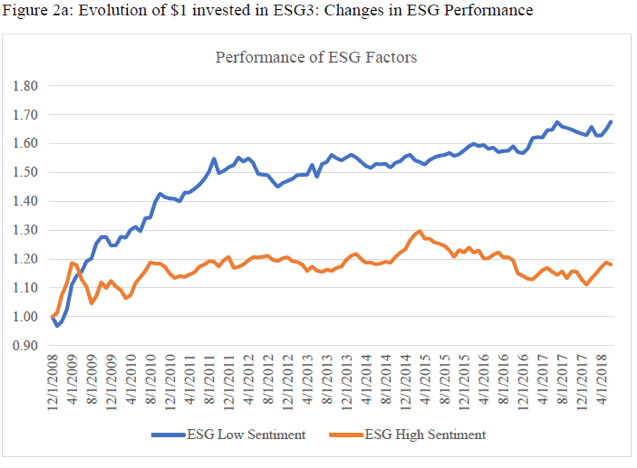
By combining big data and analyst-driven ESG information, investors can identify value opportunities in ESG and construct a strategy that delivers alpha while investing in companies with superior ESG performance scores. The combination yields significant positive alpha of about 4-5 per cent annually.
My paper “Public sentiment and the price of corporate sustainability” analyses data for the years 2009-18 provided by MSCI and TruValue Labs, the pioneer in artificial intelligence-driven ESG data. I use MSCI ratings for ESG performance due to their industry-wide prevalence and employ TruValue Labs’ data to find sentiment in semantic big data for ESG topics.
ESG ratings were paired with TruValue Labs’ sentiment data about a company’s sustainability performance. That data is drawn from sophisticated sources, including industry analysts, non-government organisations, media reports and think-tank analysis. The alpha came from a strategy of going long on firms with strong ESG performance and negative TruValue Labs’ ESG Momentum performance; there was also alpha found by going short on firms with the reverse.
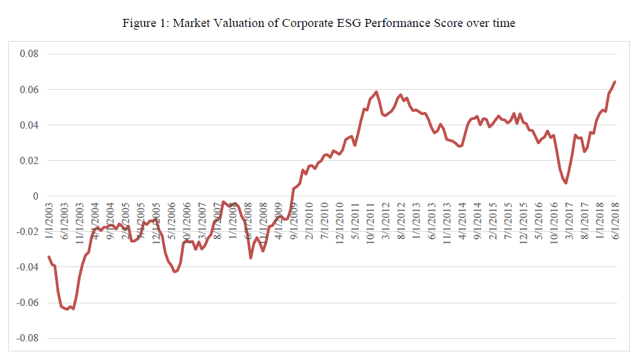
The first main result of the research shows the price of companies that display sustainability performance has increased over time. This is the estimated premium (if positive) or discount (if negative) that firms with better sustainability performance trade at relative to peers after accounting for several factors such as current profitability, size, leverage, past returns and other firm characteristics. This is good news for companies that perform better on material sustainability dimensions (as defined by MSCI), as the market rewards them with a higher multiple.
This higher multiple is even greater in the presence of positive public sentiment about a company’s sustainability performance from these sophisticated sources, as captured by TruValue Labs. In the presence of negative sentiment, a firm’s sustainability performance is largely discounted.
This has fundamental implications for how chief sustainability officers and business leaders work with the broader ecosystem. The higher price of corporate sustainability poses a challenge for ESG investors: they need to ask if they are getting good value for money. It is not only a matter of the value of corporate sustainability anymore, it is also a function of the price you are paying for it. Value for price is key.
I believe this research highlights the next stage in the evolution of ESG data and shows the power of combining traditional ratings with new, innovative datasets to fully understand the contribution of intangible value to firm valuations.

George Serafeim is a professor of business administration at Harvard Business School.
Sponsored Content

Leave a Comment

La Caisse’s oil exit pays off as renewables portfolio pulls ahead of fossil fuels

La Caisse’s oil exit pays off as renewables portfolio pulls ahead of fossil fuels

Divesting from the oil sector has been a boon for La Caisse’s performance, as the Canadian pension giant says its energy investments have earned billions in value-add compared to the benchmark since the inception of its climate strategy. Head of sustainability Bertrand Millot unpacks the fund’s approach in an interview with Top1000funds.com.

Sort content by

Methodist morality delivers mainstream returns

When John Wesley, the 18th century Anglican cleric, preached that business practices should not harm one’s neighbour, he never imagined that his principles would guide the global investment strategy of an $18.4-billion pension fund. Today, the General Board of Pension and Health Benefits of the United Methodist Church, based in Chicago, ranks as one of

Taking RI from in-house to front of mind

The industry needs to be better at thinking how responsible investing can be accessed by smaller funds or those lacking sufficient internal resources, David Russell, co-head of responsible investment at the UK’s Universities Superannuation Scheme, says. Russell, who will join a panel at the Fiduciary Investors Symposium in Santa Monica produced by Conexus Financial, publisher

Mercer integrates ESG

Mercer will integrate its proprietary environmental, social and governance (ESG) ratings across all of its manager-search and performance data, cementing ESG as a key investment consideration. The consultant rates more than 20,000 strategies, oversees more than $5 trillion of assets under advice and has $60 billion in its multi-manager products. Mercer has led the consulting

Mercer lists priorities for Norway’s GPFG

A report finding Norway’s $582.7-billion sovereign wealth fund could face significant losses in a range of climate-change scenarios is unlikely to result in changes to the fund’s investment strategy, Norway’s state secretary Hilde Singsaas says. Norway’s Ministry of Finance released the report into the Government Pension Fund Global’s (GPFG) that it commissioned from Mercer and

ESG and alpha

Academics collide on the relationship between environmental, social and corporate governance (ESG), and alpha. One view is there is a clear link that can be uncovered by a deep dive into the underlying factors using a sophisticated operating engine. The other perspective is that the market will price in environmental and social factors, the way

Real estate sustainability

The Global Real Estate Sustainability Benchmark (GRESB), which will launch its third annual sustainability survey today, has announced a partnership with the Global Reporting Initiative to enhance sustainability reporting. The survey allows participating fund managers to benchmark their portfolio on environmental and social performance against their peers. The GRESB Foundation is backed by 30 institutional

Previous