Big data, ESG ratings help find alpha

It is possible to unlock significant positive alpha using a combination of big data and traditional ESG ratings.
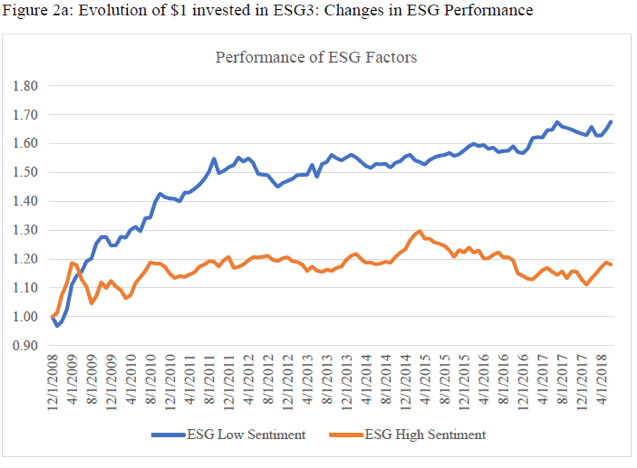
By combining big data and analyst-driven ESG information, investors can identify value opportunities in ESG and construct a strategy that delivers alpha while investing in companies with superior ESG performance scores. The combination yields significant positive alpha of about 4-5 per cent annually.
My paper “Public sentiment and the price of corporate sustainability” analyses data for the years 2009-18 provided by MSCI and TruValue Labs, the pioneer in artificial intelligence-driven ESG data. I use MSCI ratings for ESG performance due to their industry-wide prevalence and employ TruValue Labs’ data to find sentiment in semantic big data for ESG topics.
ESG ratings were paired with TruValue Labs’ sentiment data about a company’s sustainability performance. That data is drawn from sophisticated sources, including industry analysts, non-government organisations, media reports and think-tank analysis. The alpha came from a strategy of going long on firms with strong ESG performance and negative TruValue Labs’ ESG Momentum performance; there was also alpha found by going short on firms with the reverse.
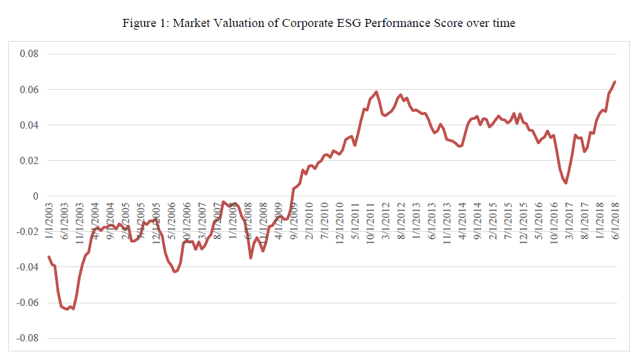
The first main result of the research shows the price of companies that display sustainability performance has increased over time. This is the estimated premium (if positive) or discount (if negative) that firms with better sustainability performance trade at relative to peers after accounting for several factors such as current profitability, size, leverage, past returns and other firm characteristics. This is good news for companies that perform better on material sustainability dimensions (as defined by MSCI), as the market rewards them with a higher multiple.
This higher multiple is even greater in the presence of positive public sentiment about a company’s sustainability performance from these sophisticated sources, as captured by TruValue Labs. In the presence of negative sentiment, a firm’s sustainability performance is largely discounted.
This has fundamental implications for how chief sustainability officers and business leaders work with the broader ecosystem. The higher price of corporate sustainability poses a challenge for ESG investors: they need to ask if they are getting good value for money. It is not only a matter of the value of corporate sustainability anymore, it is also a function of the price you are paying for it. Value for price is key.
I believe this research highlights the next stage in the evolution of ESG data and shows the power of combining traditional ratings with new, innovative datasets to fully understand the contribution of intangible value to firm valuations.

George Serafeim is a professor of business administration at Harvard Business School.
Sponsored Content

Leave a Comment

La Caisse’s oil exit pays off as renewables portfolio pulls ahead of fossil fuels

La Caisse’s oil exit pays off as renewables portfolio pulls ahead of fossil fuels

Divesting from the oil sector has been a boon for La Caisse’s performance, as the Canadian pension giant says its energy investments have earned billions in value-add compared to the benchmark since the inception of its climate strategy. Head of sustainability Bertrand Millot unpacks the fund’s approach in an interview with Top1000funds.com.

Sort content by

Focusing on the long term: a guide

Investors say they  like to, and want to, focus on the long term, but they often don’t know how to change their practices to orient their governance and investments to do so. Now, finally, a guide has been developed for investors to use as benchmark for implementing strategies for long-term investment. The guide is an

London investment think-tank

Investment professionals from pension funds, endowments and family offices in the UK and Europe were brought together for an investment think-tank with leading academics from London Business School and Cambridge University to discuss the latest investment thinking and application to institutional investors’ portfolios. The academics presented to the investors who then discussed the outtakes and

2015 could be watershed year for ESG issues

2015 is poised to be the turning point as a number of key issues relating to environmental, social and governance (ESG) issues take centre stage says Fiona Reynolds, managing director of the Principles for Responsible Investment.   First and foremost is climate change. With the Paris talks scheduled for December 2015, it’s an issue that

ESG factors take centre stage in the evolving world of the fiduciary

The modern responsibilities of the fiduciary investor extend beyond what are perceived as the “mainstream” investment issues to those related to environment, society and governance (ESG) factors. But there is a growing understanding among fiduciaries that ESG considerations are now equally important in discharging their obligations. David Wood, adjunct lecturer in public policy and director of the Initiative for Responsible

Investigating long-term mandates

The PRI is investigating the experiences of asset owners that have engaged service providers in long-term mandates, and conducting a literature review on long-termism, in a bid to develop a reference guide on how to implement a long-term mandate and drive long-term behaviour.   Managing director of PRI, Fiona Reynolds, said the starting point, and

Risks are multi-faceted and evolving: Litterman

If Robert Litterman were a CIO of a public pension plan he would not try to hit an “unrealistic return target”. Amanda White speaks to him about risk, quants, asset allocation and climate change. There is a serious problem with US public pension funds and the “unrealistic commitments and unrealistic return targets” they have set,

Previous