
Emerging market funds need to diversify

Rush hour people movement during Lathmaar Holi Barsana

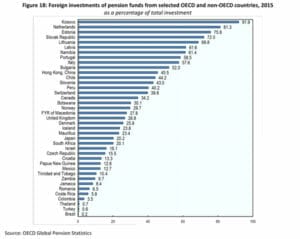
The extremely low levels of foreign investments in pension funds in emerging countries is cause for concern, according to the World Bank, which is calling for more diversification of portfolios.

A new paper by the World Bank, Pension funds capital markets and the power of diversification, outlines the need for pension funds, in emerging markets in particular, to invest more of their assets internationally in order to achieve higher returns with potentially lower volatility.

The paper calls for a deliberate creation of innovative domestic investment vehicles combined with more reasonable overseas investment limits, based on the size of the pension fund assets relative to macroeconomic and market factors.

Some countries, including Brazil, Turkey, Thailand, Colombia, Costa Rica and Romania, have less than 7 per cent of their pension assets in foreign investments.

Brazil has less than 0.2 per cent investing offshore, according to the OECD global pension statistics. This compares to the Netherlands, which has 81 per cent of its pension assets invested outside the country.

Some emerging market countries have restrictions on the amount of foreign investments, notably some African countries and India which have a limit of zero.

Sponsored Content

“There is often much resistance to allowing pension fund assets to invest overseas as governments and authorities wish to see domestic savings used for domestic purposes,” the paper says. “Macroeconomic factors clearly play an important role – including foreign exchange regime, capital flows and policy and availability of foreign currency held by a country’s central bank … however, deciding on the amount and allocation of these international investments should be done in a systematic fashion.”

In particular it says that the amount of foreign investment allowed should be linked to the size of a pension fund’s assets compared to the size and turnover of domestic capital markets or flows, and currency movements.

The paper looks at Chile as an example of a country that has more systematically increased its overseas investment limits, raising them as the pension fund assets have grown and become too large for the domestic market.

The regulatory authorities in Peru have also gradually increased their limits on several asset classes.

The paper also points out that improving governance and management is an important precondition for diversifying these portfolios.



Asset Owner:World Bank

Leave a Comment

GIC, Temasek eye trillions of growth in climate adaptation market

GIC, Temasek eye trillions of growth in climate adaptation market

Singapore’s two largest asset owners, GIC and Temasek, see attractive opportunities in climate adaptation solutions – a relatively underfunded area compared to decarbonisation. The former has already made selective adaptation investments and said the opportunity set across public and private debt and equity could increase to $9 trillion by 2050.

Sort content by

Refining portfolio construction when alphas and risk factors are misaligned

In this research insight MSCI Barra explores the mitigation of misaligned risk and alpha factors by modifying the optimisation process. Firstly it reviews how to decompose a set of alphas into two components – one that is related to risk model factors, and one that is not. Then it shows how penalising the residual alpha

Alternative investments for institutional investors: risk budgeting techniques

This paper, produced by EDHEC Risk and Asset Management Research, presents an empirical analysis of the benefits of alternative forms of investment strategies from an asset-liability management perspective. Using a vector error correction model that explicitly distinguishes between short-term and long-term dynamics in the joint distribution of asset returns and inflation, we identify the presence

ESG in emerging markets comes of age

Gaining Ground is a report by Mercer, in conjunction with the World Bank’s International Finance Corporation, examining the integration of environmental, social and governance factors into investment processes in emerging markets. It includes the first ever rating on ESG practices in China, India, South Korea and Brazil. mrec4inarticleinline Sponsored Content scnative1 scnative2 scnative3

Structured products: risk sharing or risk shifting?

In a research paper entitled “Tumbling Tower of Babel: Subprime Securitization and the Credit Crisis” in the latest Financial Analysts Journal, Bruce Jacobs argues that highly complex financial instruments, were devised to shift risk from one part of the financial system to another, but the underlying systematic risk remained. And when magnified by huge amounts

Future looks bright for hedge funds

US consulting firm, Hammond Associates’ most recent alternative investments report, which highlights the fact there were very few places to hide in 2008, outlines the performance of the various asset classes and the outlook for the sector. mrec4inarticleinline Sponsored Content scnative1 scnative2 scnative3

Casey Quirk’s Global Asset and Flows Review

Casey Quirk has released its inaugural Global Asset & Flows Review, powered by eVestment Alliance. This new publication, issued quarterly, provides key information about estimated assets under management and net new inflows reported by fund managers worldwide, with a particular focus on the U.S. institutional fund management marketplace.mrec4inarticleinline Sponsored Content scnative1 scnative2 scnative3

Previous




