
Emerging market funds need to diversify

Rush hour people movement during Lathmaar Holi Barsana

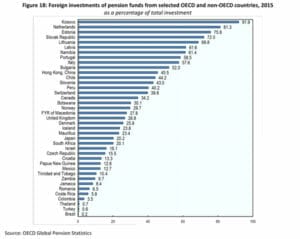
The extremely low levels of foreign investments in pension funds in emerging countries is cause for concern, according to the World Bank, which is calling for more diversification of portfolios.

A new paper by the World Bank, Pension funds capital markets and the power of diversification, outlines the need for pension funds, in emerging markets in particular, to invest more of their assets internationally in order to achieve higher returns with potentially lower volatility.

The paper calls for a deliberate creation of innovative domestic investment vehicles combined with more reasonable overseas investment limits, based on the size of the pension fund assets relative to macroeconomic and market factors.

Some countries, including Brazil, Turkey, Thailand, Colombia, Costa Rica and Romania, have less than 7 per cent of their pension assets in foreign investments.

Brazil has less than 0.2 per cent investing offshore, according to the OECD global pension statistics. This compares to the Netherlands, which has 81 per cent of its pension assets invested outside the country.

Some emerging market countries have restrictions on the amount of foreign investments, notably some African countries and India which have a limit of zero.

Sponsored Content

“There is often much resistance to allowing pension fund assets to invest overseas as governments and authorities wish to see domestic savings used for domestic purposes,” the paper says. “Macroeconomic factors clearly play an important role – including foreign exchange regime, capital flows and policy and availability of foreign currency held by a country’s central bank … however, deciding on the amount and allocation of these international investments should be done in a systematic fashion.”

In particular it says that the amount of foreign investment allowed should be linked to the size of a pension fund’s assets compared to the size and turnover of domestic capital markets or flows, and currency movements.

The paper looks at Chile as an example of a country that has more systematically increased its overseas investment limits, raising them as the pension fund assets have grown and become too large for the domestic market.

The regulatory authorities in Peru have also gradually increased their limits on several asset classes.

The paper also points out that improving governance and management is an important precondition for diversifying these portfolios.



Asset Owner:World Bank

Leave a Comment

GIC, Temasek eye trillions of growth in climate adaptation market

GIC, Temasek eye trillions of growth in climate adaptation market

Singapore’s two largest asset owners, GIC and Temasek, see attractive opportunities in climate adaptation solutions – a relatively underfunded area compared to decarbonisation. The former has already made selective adaptation investments and said the opportunity set across public and private debt and equity could increase to $9 trillion by 2050.

Sort content by

Happy workers make investors happy too

Good companies to work for are also good companies to invest in, according to new research by Alex Edman of the Wharton School, University of Pennsylvania. In a recent paper, Edmans says there is a direct positive correlation over the long term between employee satisfaction and stock market returns for the companies they work for.

The Fraying U.S. – China Co-Dependency

After many years of extraordinary growth, China has clearly been adversely affected by the global economic recession. Its own economy is slowing rapidly, with declines in exports, property prices, and fixed investment. In response, the Chinese government. strongly motivated to maintain stability, is injecting large doses of fiscal stimulus and making other administrative efforts to

Black Monday and Black Swans

Investors need to be aware that rare events with an extreme impact that, afterwards, we think we could have predicted – in short, black swans – happen in the markets. Those who are trying to measure risk in the financial markets need to carefully distinguish risk, with its probabilities, from uncertainty, which cannot be measured.

Why Fundamental Indexation Might – or Might Not – Work

Some proponents of fundamental indexation claim that the strategy is based on a new theory in which market prices of stocks deviate from fair values. A key assumption in this approach is that fundamental weights are unbiased estimators of fair value weights that are statistically independent of market values. This article demonstrates that, except in

Best ideas exist, so why do managers include underperformers?

Randy Cohen from Harvard Business School, Christopher Polk from the London School of Economics, and Bernhard Silli from the Universitat Pompeu Fabra and the London School of Economics, provide powerful evidence that mutual fund managers can pick stocks that outperform the market. mrec4inarticleinline Sponsored Content scnative1 scnative2 scnative3

Model, hypothetical, and backtested performance – best practices

In the CFA Institute’s new Investment Performance Measurement newsletter, launched this month David Spaulding, president The Spaulding Group, and Steven Stone, partner at Morgan, Lewis & Bockius discuss the issues concerning the use of theoretical performance, summarise the regulatory implications and risks of using such presentations, and suggest best practices and appropriate disclosures. mrec4inarticleinline Sponsored

Previous




