
Emerging market funds need to diversify

Rush hour people movement during Lathmaar Holi Barsana

The extremely low levels of foreign investments in pension funds in emerging countries is cause for concern, according to the World Bank, which is calling for more diversification of portfolios.

A new paper by the World Bank, Pension funds capital markets and the power of diversification, outlines the need for pension funds, in emerging markets in particular, to invest more of their assets internationally in order to achieve higher returns with potentially lower volatility.

The paper calls for a deliberate creation of innovative domestic investment vehicles combined with more reasonable overseas investment limits, based on the size of the pension fund assets relative to macroeconomic and market factors.

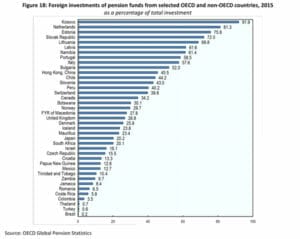
Some countries, including Brazil, Turkey, Thailand, Colombia, Costa Rica and Romania, have less than 7 per cent of their pension assets in foreign investments.

Brazil has less than 0.2 per cent investing offshore, according to the OECD global pension statistics. This compares to the Netherlands, which has 81 per cent of its pension assets invested outside the country.

Some emerging market countries have restrictions on the amount of foreign investments, notably some African countries and India which have a limit of zero.

Sponsored Content

“There is often much resistance to allowing pension fund assets to invest overseas as governments and authorities wish to see domestic savings used for domestic purposes,” the paper says. “Macroeconomic factors clearly play an important role – including foreign exchange regime, capital flows and policy and availability of foreign currency held by a country’s central bank … however, deciding on the amount and allocation of these international investments should be done in a systematic fashion.”

In particular it says that the amount of foreign investment allowed should be linked to the size of a pension fund’s assets compared to the size and turnover of domestic capital markets or flows, and currency movements.

The paper looks at Chile as an example of a country that has more systematically increased its overseas investment limits, raising them as the pension fund assets have grown and become too large for the domestic market.

The regulatory authorities in Peru have also gradually increased their limits on several asset classes.

The paper also points out that improving governance and management is an important precondition for diversifying these portfolios.



Asset Owner:World Bank

Leave a Comment

GIC, Temasek eye trillions of growth in climate adaptation market

GIC, Temasek eye trillions of growth in climate adaptation market

Singapore’s two largest asset owners, GIC and Temasek, see attractive opportunities in climate adaptation solutions – a relatively underfunded area compared to decarbonisation. The former has already made selective adaptation investments and said the opportunity set across public and private debt and equity could increase to $9 trillion by 2050.

Sort content by

Target Date Funds: Looking beyond the glide path

Target date funds vary in their broad asset allocation, in their sub-asset allocation of the broader asset classes, and their implementation. This paper outlines some methodologies across providers, highlighting the different risks associated with the various strategies and illustrating the impact on performance over both a longer period, as well as a shorter, more volatile,

Time to mend relationships in investment management

A new KPMG report, ‘Renewing the promise: Time to mend relationships in investment management”, shows the investment management industry should work to rebuild trust with investors through a ‘back-to-basics’ client relationship approach, increase knowledge sharing, and bolster corporate governance and risk management transparency. mrec4inarticleinline Sponsored Content scnative1 scnative2 scnative3

The risky proposition of US defined contribution plans

In the US, defined contribution plans have grown in importance but are relatively new to economic and regulatory uncertainty. In an environment such as this, Watson Wyatt suggests specific practices for managing fiduciary liability and optimising plan value for participants, with the possible result of revising the plan’s investment structure. mrec4inarticleinline Sponsored Content scnative1 scnative2

Quantifying labor and human rights portfolio risk

This paper, by senior research fellow at the Labor and Worklife Program at Harvard Law School, Aaron Bernstein, explores how pension funds can gather quantifiable, independently audited data on the risks posed by labor and human rights activities of global companies, that is analogous to financial information, and how investors can help facilitate the acceptance

Liability – informed risk budgeting and the use of higher tracking error active equity managers: the virtues of being different

In an environment where periodic illiquidity has become more frequent, Alan Dorsey and Juliana Davydov from Neuberger and Berman explore the risks associated with a new asset allocation approach and the use of managers with broader mandates. mrec4inarticleinline Sponsored Content scnative1 scnative2 scnative3

Do institutional investors have sensible investment beliefs?

This article by Kees Koedijk and Alfred Slager , published in the Rotman International Journal of Pension Management, presents the results of a global study of investment beliefs, and highlights the differences in how pension funds and commercial asset managers view capital markets. mrec4inarticleinline Sponsored Content scnative1 scnative2 scnative3

Previous




