
Emerging market funds need to diversify

Rush hour people movement during Lathmaar Holi Barsana

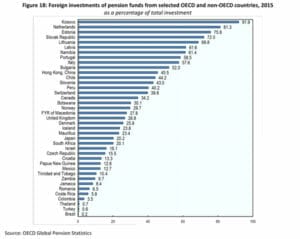
The extremely low levels of foreign investments in pension funds in emerging countries is cause for concern, according to the World Bank, which is calling for more diversification of portfolios.

A new paper by the World Bank, Pension funds capital markets and the power of diversification, outlines the need for pension funds, in emerging markets in particular, to invest more of their assets internationally in order to achieve higher returns with potentially lower volatility.

The paper calls for a deliberate creation of innovative domestic investment vehicles combined with more reasonable overseas investment limits, based on the size of the pension fund assets relative to macroeconomic and market factors.

Some countries, including Brazil, Turkey, Thailand, Colombia, Costa Rica and Romania, have less than 7 per cent of their pension assets in foreign investments.

Brazil has less than 0.2 per cent investing offshore, according to the OECD global pension statistics. This compares to the Netherlands, which has 81 per cent of its pension assets invested outside the country.

Some emerging market countries have restrictions on the amount of foreign investments, notably some African countries and India which have a limit of zero.

Sponsored Content

“There is often much resistance to allowing pension fund assets to invest overseas as governments and authorities wish to see domestic savings used for domestic purposes,” the paper says. “Macroeconomic factors clearly play an important role – including foreign exchange regime, capital flows and policy and availability of foreign currency held by a country’s central bank … however, deciding on the amount and allocation of these international investments should be done in a systematic fashion.”

In particular it says that the amount of foreign investment allowed should be linked to the size of a pension fund’s assets compared to the size and turnover of domestic capital markets or flows, and currency movements.

The paper looks at Chile as an example of a country that has more systematically increased its overseas investment limits, raising them as the pension fund assets have grown and become too large for the domestic market.

The regulatory authorities in Peru have also gradually increased their limits on several asset classes.

The paper also points out that improving governance and management is an important precondition for diversifying these portfolios.



Asset Owner:World Bank

Leave a Comment

GIC, Temasek eye trillions of growth in climate adaptation market

GIC, Temasek eye trillions of growth in climate adaptation market

Singapore’s two largest asset owners, GIC and Temasek, see attractive opportunities in climate adaptation solutions – a relatively underfunded area compared to decarbonisation. The former has already made selective adaptation investments and said the opportunity set across public and private debt and equity could increase to $9 trillion by 2050.

Sort content by

Taking the long view

Governments are among the few agencies that can help the private sector hedge against the increasing problem of aggregate longevity risk. David Blake, Tom Boardman, Andrew Cairns and Kevin Dowd from the Pensions Institute at Cass Business School urge governments to issue longevity bonds as soon as possible mrec4inarticleinline Sponsored Content scnative1 scnative2 scnative3

Does ‘2 and 20’ still exist?

New research of hedge funds managers by Preqin shows it is clear the idea of a ‘2 and 20’ fee structure is outdated and, although less succinct, a more accurate reflection would be a “1.63 and 17.21” formula. mrec4inarticleinline Sponsored Content scnative1 scnative2 scnative3

A framework for ESG considerations in portfolio design

The inherent breadth and ambiguity of environmental, social and governance issues has resulted in the integration of ESG considerations into portfolio design remaining largely a philosophical push, without clarity on the direct and indirect impacts on shareholder value. In this working paper, AQR Capital Management’s Jeff Dunn, outlines a simple framework for considering the impact

Macro factors – the update: Watson Wyatt

For the first time since 2006, Watson Wyatt has written a report that revisits the macro-economic factors that may affect global returns over the next decade. It highlights the increasing influence of public policy and emerging wealth on the investment agenda, and draws some tentative conclusions regarding the implications for investment portfolios. mrec4inarticleinline Sponsored Content

Costs, competition and crisis conspire against DC governance

The financial crisis has placed defined contribution (DC) pension provision firmly under the spotlight. The dramatic falls in fund values observed for most members during 2008 have been drawing attention to the risks inherent in DC pension provision and focusing attention on how employees, employers and plan fiduciaries can better manage their DC pension plans.

Focus on medium-term, too, can add 1-1.5% to returns

As institutional investors have been hit hard by events of the past 18 months, there has been a surge of interest in the adoption of an additional, mid-term, time frame in which to provide investment targets. Watson Wyatt believes pension funds should allocate between 5 and 15 per cent of their risk budget to dynamic

Previous




