
Emerging market funds need to diversify

Rush hour people movement during Lathmaar Holi Barsana

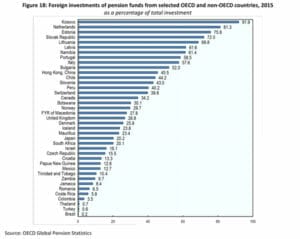
The extremely low levels of foreign investments in pension funds in emerging countries is cause for concern, according to the World Bank, which is calling for more diversification of portfolios.

A new paper by the World Bank, Pension funds capital markets and the power of diversification, outlines the need for pension funds, in emerging markets in particular, to invest more of their assets internationally in order to achieve higher returns with potentially lower volatility.

The paper calls for a deliberate creation of innovative domestic investment vehicles combined with more reasonable overseas investment limits, based on the size of the pension fund assets relative to macroeconomic and market factors.

Some countries, including Brazil, Turkey, Thailand, Colombia, Costa Rica and Romania, have less than 7 per cent of their pension assets in foreign investments.

Brazil has less than 0.2 per cent investing offshore, according to the OECD global pension statistics. This compares to the Netherlands, which has 81 per cent of its pension assets invested outside the country.

Some emerging market countries have restrictions on the amount of foreign investments, notably some African countries and India which have a limit of zero.

Sponsored Content

“There is often much resistance to allowing pension fund assets to invest overseas as governments and authorities wish to see domestic savings used for domestic purposes,” the paper says. “Macroeconomic factors clearly play an important role – including foreign exchange regime, capital flows and policy and availability of foreign currency held by a country’s central bank … however, deciding on the amount and allocation of these international investments should be done in a systematic fashion.”

In particular it says that the amount of foreign investment allowed should be linked to the size of a pension fund’s assets compared to the size and turnover of domestic capital markets or flows, and currency movements.

The paper looks at Chile as an example of a country that has more systematically increased its overseas investment limits, raising them as the pension fund assets have grown and become too large for the domestic market.

The regulatory authorities in Peru have also gradually increased their limits on several asset classes.

The paper also points out that improving governance and management is an important precondition for diversifying these portfolios.



Asset Owner:World Bank

Leave a Comment

GIC, Temasek eye trillions of growth in climate adaptation market

GIC, Temasek eye trillions of growth in climate adaptation market

Singapore’s two largest asset owners, GIC and Temasek, see attractive opportunities in climate adaptation solutions – a relatively underfunded area compared to decarbonisation. The former has already made selective adaptation investments and said the opportunity set across public and private debt and equity could increase to $9 trillion by 2050.

Sort content by

RogersCasey: in defence of active management

While recent manager performance has raised concerns about active management, US consulting firm Rogerscasey believes that active management is often called into question at precisely the wrong time. And while passive investing has proven to be a cost effective way for some investors to access some portions of the capital markets, there are situations where

Secular growth in emerging markets and how to access it

This paper by Scott Berg, global large cap equity portfolio manager at T Rowe Price examines the secular growth trends that have underpinned emerging markets and whether there is still an argument for exposure to these markets within a global equities portfolio. mrec4inarticleinline Sponsored Content scnative1 scnative2 scnative3

Why credit matters

The structural changes in the fixed income market mean corporate credit may be the single most important factor in generating risk-adjusted performance in fixed income, according to Janus. mrec4inarticleinline Sponsored Content scnative1 scnative2 scnative3

The real effects of banning placement agents in private equity

Preqin has canvassed public pension funds and other investors in the US to examine the specific effects of the SEC’s proposed rules relating to the introduction of the Advisers Act Rule 206(4)-5, on the private equity industry. The report includes key statistics on the use of  placement agents, the importance of private equity and other

Real assets and inflation hedge investing

Massachusetts-based consultant, NEPC, advises that clients allocate between 5 and 15 per cent to real assets – including commodities, TIPS and direct investments in real estate, energy and infrastructure. This article by consultant Edward O’Donnell examines the rationale, risks and potential returns of allocating to real assets. mrec4inarticleinline Sponsored Content scnative1 scnative2 scnative3

Does freezing a defined benefit pension plan increase company value?

In seeking to minimise pension risk, many companies have chosen to freeze or close defined benefit pension plan in the hope such an approach might give them time to adjust and increase corporate value. In a recent article published in the Financial Analysts Journal, Brendan McFarland, Gaobo Pang and Mark Warshawsky examine the impact of

Previous




