
Emerging market funds need to diversify

Rush hour people movement during Lathmaar Holi Barsana

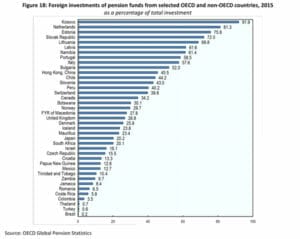
The extremely low levels of foreign investments in pension funds in emerging countries is cause for concern, according to the World Bank, which is calling for more diversification of portfolios.

A new paper by the World Bank, Pension funds capital markets and the power of diversification, outlines the need for pension funds, in emerging markets in particular, to invest more of their assets internationally in order to achieve higher returns with potentially lower volatility.

The paper calls for a deliberate creation of innovative domestic investment vehicles combined with more reasonable overseas investment limits, based on the size of the pension fund assets relative to macroeconomic and market factors.

Some countries, including Brazil, Turkey, Thailand, Colombia, Costa Rica and Romania, have less than 7 per cent of their pension assets in foreign investments.

Brazil has less than 0.2 per cent investing offshore, according to the OECD global pension statistics. This compares to the Netherlands, which has 81 per cent of its pension assets invested outside the country.

Some emerging market countries have restrictions on the amount of foreign investments, notably some African countries and India which have a limit of zero.

Sponsored Content

“There is often much resistance to allowing pension fund assets to invest overseas as governments and authorities wish to see domestic savings used for domestic purposes,” the paper says. “Macroeconomic factors clearly play an important role – including foreign exchange regime, capital flows and policy and availability of foreign currency held by a country’s central bank … however, deciding on the amount and allocation of these international investments should be done in a systematic fashion.”

In particular it says that the amount of foreign investment allowed should be linked to the size of a pension fund’s assets compared to the size and turnover of domestic capital markets or flows, and currency movements.

The paper looks at Chile as an example of a country that has more systematically increased its overseas investment limits, raising them as the pension fund assets have grown and become too large for the domestic market.

The regulatory authorities in Peru have also gradually increased their limits on several asset classes.

The paper also points out that improving governance and management is an important precondition for diversifying these portfolios.



Asset Owner:World Bank

Leave a Comment

GIC, Temasek eye trillions of growth in climate adaptation market

GIC, Temasek eye trillions of growth in climate adaptation market

Singapore’s two largest asset owners, GIC and Temasek, see attractive opportunities in climate adaptation solutions – a relatively underfunded area compared to decarbonisation. The former has already made selective adaptation investments and said the opportunity set across public and private debt and equity could increase to $9 trillion by 2050.

Sort content by

Inflation/deflation continuum can plot holes

This paper by RogersCasey’s Ryan Dembinsky and Srivatsa Kilambi demonstrate the “inflation/deflation continuum” is a way of assessing an investment program’s vulnerability to the dual threats, and competing forces, of inflation and deflation. The paper presents a framework whereby investors can plot their existing asset classes and assess where there may be holes. mrec4inarticleinline Sponsored

The beta-alpha ratio will yield more success

Using a “Beta-Alpha Ratio” will yield more success in choosing managers ex-ante, compared to other methodology prevalent in the consulting industry, according to a new paper by Wurts Associates’ director of research, Eric Petroff, and research associate, Curtis Yasutake. mrec4inarticleinline Sponsored Content scnative1 scnative2 scnative3

Spillover effects of counter-cyclical market regulation

Professor of finance at the EDHEC Business School and member of the EDHEC Risk Institute, Abraham Lioui, looks at the spillover effect that counter-cyclical regulation affecting one part of the market, banning short-selling, has on the broad market. By examining the effect of the ban on short-selling in 2008 on market indices in the US

Study links executives’ pay and behaviour

This research, commissioned by APG (the investment division of ABP, the €208 billion Dutch pension fund), examines the published literature on the link between remuneration and executive behaivour. It was conducted by the London Business School. mrec4inarticleinline Sponsored Content scnative1 scnative2 scnative3

A quality approach to investing in European equities

This research by T Rowe Price looks at the performance of European stocks over a seven-year period to December 2009 and finds, among other things, that companies with the highest return on equity outperform in times of risk aversion, giving investors some downside protection, but fall out of favour in momentum-driven markets.mrec4inarticleinline Sponsored Content scnative1

The ABCs of Hedge Funds: Alpha, Beta and Costs

This hot-off-the-press revised version (March 30) of The ABCs of Hedge Funds, which decomposes returns into three components – systematic market exposure (beta), value-added by hedge funds (alpha), and hedge fund fees (costs) –  includes data up to the end of December 2009. Among other things it finds the universe of hedge funds produced a

Previous




