
Emerging market funds need to diversify

Rush hour people movement during Lathmaar Holi Barsana

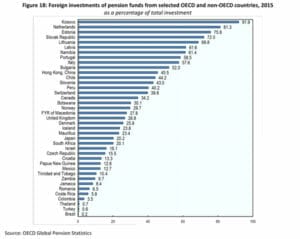
The extremely low levels of foreign investments in pension funds in emerging countries is cause for concern, according to the World Bank, which is calling for more diversification of portfolios.

A new paper by the World Bank, Pension funds capital markets and the power of diversification, outlines the need for pension funds, in emerging markets in particular, to invest more of their assets internationally in order to achieve higher returns with potentially lower volatility.

The paper calls for a deliberate creation of innovative domestic investment vehicles combined with more reasonable overseas investment limits, based on the size of the pension fund assets relative to macroeconomic and market factors.

Some countries, including Brazil, Turkey, Thailand, Colombia, Costa Rica and Romania, have less than 7 per cent of their pension assets in foreign investments.

Brazil has less than 0.2 per cent investing offshore, according to the OECD global pension statistics. This compares to the Netherlands, which has 81 per cent of its pension assets invested outside the country.

Some emerging market countries have restrictions on the amount of foreign investments, notably some African countries and India which have a limit of zero.

Sponsored Content

“There is often much resistance to allowing pension fund assets to invest overseas as governments and authorities wish to see domestic savings used for domestic purposes,” the paper says. “Macroeconomic factors clearly play an important role – including foreign exchange regime, capital flows and policy and availability of foreign currency held by a country’s central bank … however, deciding on the amount and allocation of these international investments should be done in a systematic fashion.”

In particular it says that the amount of foreign investment allowed should be linked to the size of a pension fund’s assets compared to the size and turnover of domestic capital markets or flows, and currency movements.

The paper looks at Chile as an example of a country that has more systematically increased its overseas investment limits, raising them as the pension fund assets have grown and become too large for the domestic market.

The regulatory authorities in Peru have also gradually increased their limits on several asset classes.

The paper also points out that improving governance and management is an important precondition for diversifying these portfolios.



Asset Owner:World Bank

Leave a Comment

GIC, Temasek eye trillions of growth in climate adaptation market

GIC, Temasek eye trillions of growth in climate adaptation market

Singapore’s two largest asset owners, GIC and Temasek, see attractive opportunities in climate adaptation solutions – a relatively underfunded area compared to decarbonisation. The former has already made selective adaptation investments and said the opportunity set across public and private debt and equity could increase to $9 trillion by 2050.

Sort content by

Active ownership

Academics from the London Business School, Boston College and Temple University, examine the outperformance of US public companies following corporate social responsibility engagement.

Capturing illiquidity premiums

This paper commissioned by the Norwegian Ministry of Finance investigates the possibilities for the Government Pension Fund Global (GPFG) to profit from liquidity premiums in  illiquid investments. It looks at the empirical evidence for the presence of liquidity effects in a broad range of asset classes: listed equities, corporate bonds, treasury and agency bonds, and

A trustee guide to factor investing

This research by academics at Tilburg University and the VU University Amsterdam, looks at the hurdles of implementing factor investing. It translates those into a checklist for implementing factor investing. The research, conducted for Robeco, finds that three approaches to factor investing are emerging and conducts case studies to examine how these approaches are implemented

Manager risk contribution in a multi-manager portfolio

This paper by MSCI creates a framework in order to answer the question: given a portfolio of managers, how does the active risk of each manager relate to the active risk of the portfolio? Asset owners often measure manager risk (the active risk of each manager) and have difficulty relating it to the contribution each

How active is your real estate fund manager?

Using detailed data from IPD, this paper looks at the holdings and performance of 256 UK commercial real estate funds from 2002-2011. It concludes the more active funds, those further from benchmark holdings, outperform but are not accompanied by higher risk.   To access the paper click here How active is your real estate fund

Persistently high equity risk premium unprecedented

This paper by the Federal Reserve Bank of New York looks at the equity risk premium information from 20 models and estimates the ERP for various time periods. Extraordinarily it finds that the (preferred) estimator places the one-year equity premium in July 2013 at 14.5 percent, the highest level in 50 years and well above the

Previous




