
Emerging market funds need to diversify

Rush hour people movement during Lathmaar Holi Barsana

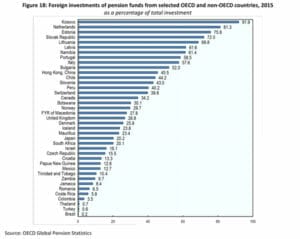
The extremely low levels of foreign investments in pension funds in emerging countries is cause for concern, according to the World Bank, which is calling for more diversification of portfolios.

A new paper by the World Bank, Pension funds capital markets and the power of diversification, outlines the need for pension funds, in emerging markets in particular, to invest more of their assets internationally in order to achieve higher returns with potentially lower volatility.

The paper calls for a deliberate creation of innovative domestic investment vehicles combined with more reasonable overseas investment limits, based on the size of the pension fund assets relative to macroeconomic and market factors.

Some countries, including Brazil, Turkey, Thailand, Colombia, Costa Rica and Romania, have less than 7 per cent of their pension assets in foreign investments.

Brazil has less than 0.2 per cent investing offshore, according to the OECD global pension statistics. This compares to the Netherlands, which has 81 per cent of its pension assets invested outside the country.

Some emerging market countries have restrictions on the amount of foreign investments, notably some African countries and India which have a limit of zero.

Sponsored Content

“There is often much resistance to allowing pension fund assets to invest overseas as governments and authorities wish to see domestic savings used for domestic purposes,” the paper says. “Macroeconomic factors clearly play an important role – including foreign exchange regime, capital flows and policy and availability of foreign currency held by a country’s central bank … however, deciding on the amount and allocation of these international investments should be done in a systematic fashion.”

In particular it says that the amount of foreign investment allowed should be linked to the size of a pension fund’s assets compared to the size and turnover of domestic capital markets or flows, and currency movements.

The paper looks at Chile as an example of a country that has more systematically increased its overseas investment limits, raising them as the pension fund assets have grown and become too large for the domestic market.

The regulatory authorities in Peru have also gradually increased their limits on several asset classes.

The paper also points out that improving governance and management is an important precondition for diversifying these portfolios.



Asset Owner:World Bank

Leave a Comment

GIC, Temasek eye trillions of growth in climate adaptation market

GIC, Temasek eye trillions of growth in climate adaptation market

Singapore’s two largest asset owners, GIC and Temasek, see attractive opportunities in climate adaptation solutions – a relatively underfunded area compared to decarbonisation. The former has already made selective adaptation investments and said the opportunity set across public and private debt and equity could increase to $9 trillion by 2050.

Sort content by

The arithmetic of “all-in” investment expenses

In the January/February issue of the Financial Analysts Journal, Jack Bogle, founder and former chief executive of the Vanguard Group, looks at the “all-in” investment expenses including not only expense ratios byt transaction costs, sales loads and cash drag. He highlights, in particular, how damaging these costs can be over the long run, and reaffirms

How to estimate the equity risk premium

Given the importance of equity risk premium, it is surprising how haphazard the estimation of equity risk premiums remains in practice. This paper by Aswath Damodaran at the New York University Stern School of Business examines a number of different approaches to determining the equity risk premium and why different approaches yield different values. It

Risk parity and beyond

This paper analyses whether the use of uncorrelated underlying risk factors, as opposed to correlated asset returns, can lead to a more efficient framework for measuring and managing portfolio diversification. The paper, by academics at EDHEC Business School and SYMMYS, acknowledges that the ability to construct well-diversified portfolios is a challenge of critical importance in

Emerging equity markets in a globalising world

Even though there has been dramatic globalisation over the past 20 years it still makes sense to segregate global equities into “developed” and “emerging” market buckets, according to a paper by Columbia and Duke academics. The research, which has important policy implications for institutional and pension fund management, shows that while correlations between developed and

Citigroup: a case study in managerial and regulatory failures

This article by Arthur Wilmarth from George Washington University Law School uses Citigroup as a case study to demonstrate the question of whether bank executives and regulators are able to supervise and control today’s complex megabanks. The study shows that post-mortem evaluations of Citigroup’s near-collapse revealed that neither Citigroup’s managers nor its regulators recognized the

Macroeconomic risk and hedge fund returns

This paper estimates hedge fund and mutual fund exposure to newly proposed measures of macroeconomic risk that are interpreted as measures of economic uncertainty. The academics, from Georgetown and Stern, find the resulting uncertainty betas explain a significant proportion of the cross-sectional dispersion in hedge fund returns. However, the same is not true for mutual

Previous




