
Emerging market funds need to diversify

Rush hour people movement during Lathmaar Holi Barsana

The extremely low levels of foreign investments in pension funds in emerging countries is cause for concern, according to the World Bank, which is calling for more diversification of portfolios.

A new paper by the World Bank, Pension funds capital markets and the power of diversification, outlines the need for pension funds, in emerging markets in particular, to invest more of their assets internationally in order to achieve higher returns with potentially lower volatility.

The paper calls for a deliberate creation of innovative domestic investment vehicles combined with more reasonable overseas investment limits, based on the size of the pension fund assets relative to macroeconomic and market factors.

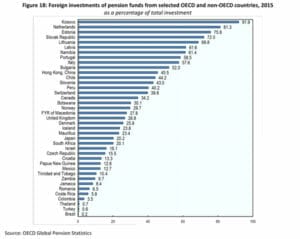
Some countries, including Brazil, Turkey, Thailand, Colombia, Costa Rica and Romania, have less than 7 per cent of their pension assets in foreign investments.

Brazil has less than 0.2 per cent investing offshore, according to the OECD global pension statistics. This compares to the Netherlands, which has 81 per cent of its pension assets invested outside the country.

Some emerging market countries have restrictions on the amount of foreign investments, notably some African countries and India which have a limit of zero.

Sponsored Content

“There is often much resistance to allowing pension fund assets to invest overseas as governments and authorities wish to see domestic savings used for domestic purposes,” the paper says. “Macroeconomic factors clearly play an important role – including foreign exchange regime, capital flows and policy and availability of foreign currency held by a country’s central bank … however, deciding on the amount and allocation of these international investments should be done in a systematic fashion.”

In particular it says that the amount of foreign investment allowed should be linked to the size of a pension fund’s assets compared to the size and turnover of domestic capital markets or flows, and currency movements.

The paper looks at Chile as an example of a country that has more systematically increased its overseas investment limits, raising them as the pension fund assets have grown and become too large for the domestic market.

The regulatory authorities in Peru have also gradually increased their limits on several asset classes.

The paper also points out that improving governance and management is an important precondition for diversifying these portfolios.



Asset Owner:World Bank

Leave a Comment

GIC, Temasek eye trillions of growth in climate adaptation market

GIC, Temasek eye trillions of growth in climate adaptation market

Singapore’s two largest asset owners, GIC and Temasek, see attractive opportunities in climate adaptation solutions – a relatively underfunded area compared to decarbonisation. The former has already made selective adaptation investments and said the opportunity set across public and private debt and equity could increase to $9 trillion by 2050.

Sort content by

Benchmarking infrastructure a step closer

The first valuation and risk measurement model created for unlisted infrastructure debt has been developed, with the release of a paper showing the valuation of illiquid infrastructure project debt, taking into account its illiquidity and the absence of market price feedback, can be done using advanced, state-of-the-art structural credit risk modelling. The paper by EDHEC-Risk

Scale and skill in active management

This paper by the Becker Friedman Institute for Research in Economics at the University of Chicago finds that the active management industry has become more skilled over time. But despite this rise in skill, average fund performance has failed to improve. To access the paper click below Scale and skill in active management  mrec4inarticleinline Sponsored

Smart beta versus smart alpha

With the advent of smart beta it was only a matter of time before the appropriate use of “smart” was analysed and questioned. A paper to be published in the forthcoming summer 2014 issue of The Journal of Portfolio Management looks at the active choices of smart beta strategies and how and when they can

Pension risk in DC funds

Defined contribution plans focus too much on the short-term accumulation of pension assets rather than the longer-term goal of securing an adequate retirement income. This paper by the World Bank, based on case studies from a number of countries, argues that pension supervisors have not properly defined the objectives of DC pension systems It suggests

Australian industry degraded by inflated fees

The Australian superannuation industry is often quoted as among the world’s best. However a new report by the Grattan Institute reveals Australian funds charge on average three times the OECD median rate. The report says that superannuation fee reform is the biggest opportunity for micro-economic reform in that country’s economy. The report, Super sting: how

Cost shifting and the freezing of corporate pension plans

This paper, which examines the impact of the trend in the US of corporate funds freezing their defined benefit funds and offering defined contribution plans, shows that net of the increase in total DC contributions, firms save 2.7-3.6 per cent of payroll per year, and over a 10-year horizon they save 3.1 per cent of

Previous




