
Emerging market funds need to diversify

Rush hour people movement during Lathmaar Holi Barsana

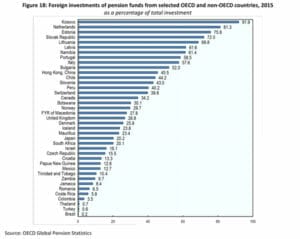
The extremely low levels of foreign investments in pension funds in emerging countries is cause for concern, according to the World Bank, which is calling for more diversification of portfolios.

A new paper by the World Bank, Pension funds capital markets and the power of diversification, outlines the need for pension funds, in emerging markets in particular, to invest more of their assets internationally in order to achieve higher returns with potentially lower volatility.

The paper calls for a deliberate creation of innovative domestic investment vehicles combined with more reasonable overseas investment limits, based on the size of the pension fund assets relative to macroeconomic and market factors.

Some countries, including Brazil, Turkey, Thailand, Colombia, Costa Rica and Romania, have less than 7 per cent of their pension assets in foreign investments.

Brazil has less than 0.2 per cent investing offshore, according to the OECD global pension statistics. This compares to the Netherlands, which has 81 per cent of its pension assets invested outside the country.

Some emerging market countries have restrictions on the amount of foreign investments, notably some African countries and India which have a limit of zero.

Sponsored Content

“There is often much resistance to allowing pension fund assets to invest overseas as governments and authorities wish to see domestic savings used for domestic purposes,” the paper says. “Macroeconomic factors clearly play an important role – including foreign exchange regime, capital flows and policy and availability of foreign currency held by a country’s central bank … however, deciding on the amount and allocation of these international investments should be done in a systematic fashion.”

In particular it says that the amount of foreign investment allowed should be linked to the size of a pension fund’s assets compared to the size and turnover of domestic capital markets or flows, and currency movements.

The paper looks at Chile as an example of a country that has more systematically increased its overseas investment limits, raising them as the pension fund assets have grown and become too large for the domestic market.

The regulatory authorities in Peru have also gradually increased their limits on several asset classes.

The paper also points out that improving governance and management is an important precondition for diversifying these portfolios.



Asset Owner:World Bank

Leave a Comment

GIC, Temasek eye trillions of growth in climate adaptation market

GIC, Temasek eye trillions of growth in climate adaptation market

Singapore’s two largest asset owners, GIC and Temasek, see attractive opportunities in climate adaptation solutions – a relatively underfunded area compared to decarbonisation. The former has already made selective adaptation investments and said the opportunity set across public and private debt and equity could increase to $9 trillion by 2050.

Sort content by

The predictive power of portfolio characteristics

Investors still rely, to a great extent, on past performance to assess managers’ future performance. Rather than rely on past performance outcomes to predict future results, a new paper, The predictive power of portfolio characteristics, argues that it is possible to improve the ability to predict future long-term success by identifying and measuring selected portfolio characteristics

Pension fund governance needs an overhaul, still

How much has pension fund governance changed in the past 16 years? Not much! A survey of pension fund governance by Keith Ambachtsheer and John McLaughlin, which asked respondents the same questions in 1997, 2005 and 2014 reveal that the same “sources of excellence shortfall” exist today as they did 16 years ago. Pension fund

Fees eat diversification’s lunch

The balance between the allocating to the right number of asset classes and over-diversification is a concern for pension fund investment executives and committees. A new paper by professors at the US Air Force Academy examines the relationship between fees of diversifying asset classes and their diversifying benefits. The paper finds that, in many cases,

Optimal long-term allocation with pension fund liabilities

The literature on how to optimally manage the investments of defined contribution funds is relatively scarce, despite the fact the growth in defined contribution continues to outpace defined benefit funds globally. Now new research from academics at the University of Lausanne demonstrates how to perform an ALM study from a financial prospective for defined contribution

The real factor exposures in “smart beta” indexes

Investors relying on nomenclature of smart beta indexes as an accurate reflection of their factor exposures should take a closer look. New research, using a “factor efficiency ratio”, finds that most smart beta indexes are unable to provide desired factor exposures without taking on substantial unintended exposures. Importantly the paper finds that some smart beta

Breaking down emerging markets active returns

New research by MSCI shows a rare insight into whether the factor phenomenon, driving development market equities beta, is at play in emerging markets. The research uses the Barra Emerging Markets Equity Model to look at the drivers of performance of emerging markets, and analyses the returns of active emerging market managers to identify the

Previous




